Skyroot’s landmark achievement of becoming the first Indian company to send satellites into orbit owes its origins to an unlikely source — fashion e-commerce.
Long before Skyroot became a household name in Indian space-tech, it was a two-person outfit working out of a small office in Kondapur, Hyderabad. Pawan Kumar Chandana and Naga Bharath Daka, both former ISRO scientists, had quit their government jobs after reading a draft of India’s Space Activities Bill in 2017, betting that private companies would soon be allowed to build and launch their own rockets. That bet needed money before it needed anything else, and the person who wrote the first cheque was Mukesh Bansal, the founder of Myntra and Cultfit.
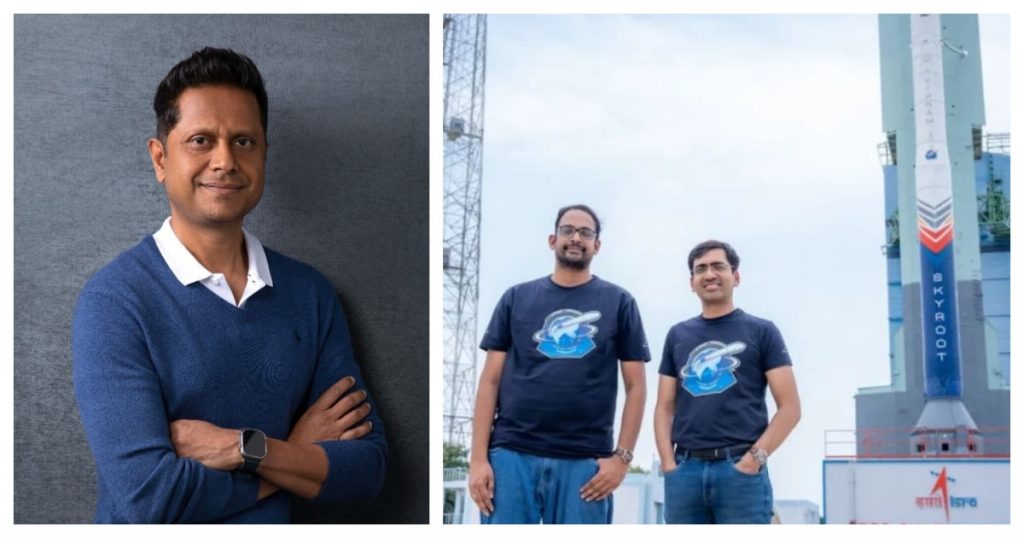
As per Tracxn data, Bansal put in $756K into Skyroot in July 2018, an angel round that valued the fledgling company at under Rs 5 crore. This was before the Indian government had formally opened up the space sector to private players, at a time when the very idea of an Indian startup building orbital rockets sounded closer to science fiction than a viable business. He came back with another $747k in April 2019, and then led Skyroot’s seed round in June 2020 with $369k, bringing in Vedanshu, Guraja Raja Sekhar and Venkat Aravind Dasyam as co-investors. Across these three rounds, Bansal put in over Rs 12 crore, and for nearly two years he was Skyroot’s only outside backer.
What makes this stand out is that Bansal wasn’t a deep-tech investor by background. He had built his reputation and fortune in consumer internet and fitness, first at Myntra and then at Cultfit (formerly Cure.fit), businesses with almost nothing in common with rocket propulsion or satellite payloads. Betting on two ex-ISRO engineers with a business plan to build reusable small-satellite launch vehicles, in a sector that private Indian companies weren’t even legally permitted to operate in yet, was a departure from anything in his own playbook.
Skyroot didn’t stay a secret for long once the money started showing results. In August 2020, it became the first Indian private firm to test an upper-stage liquid rocket engine, a 3D-printed engine called Raman that weighed half as much as conventional versions. That December, it followed up with Kalam-5, the first solid-fuelled engine fired by an Indian private company. By May 2021, Skyroot was raising a $15 million Series A led by Greenko Group founders Anil Chalamalasetty and Mahesh Kolli, and Bansal, rather than cashing out early, put in more money alongside institutional names like Neeraj Arora and WorldQuant Ventures.
He continued participating through Skyroot’s Series B rounds too, first in January 2022 alongside Sherpalo Ventures, and again in August 2022 in a $51 million round led by GIC that also drew in Skyroot’s own founders’ circle of investors, including Solar Group and Anil Chalamalasetty. Three months after that round closed, Skyroot launched Vikram-S, India’s first privately built rocket to reach space, a mission the company named Prarambh, meaning “the beginning.”
The years since have been a steady climb. Skyroot raised a Series B extension from Temasek and GIC in 2023 at a $519 million valuation, and by May 2026 it had pulled in $50 million from Sherpalo Ventures and GIC to become India’s first space-tech unicorn, valued at $1.1 billion. That was just the warm-up. On July 18, 2026, Skyroot’s Vikram-1 rocket reached a 450-kilometre orbit carrying four customer payloads, making India the third country in the world where a private company, rather than a government agency, has achieved orbital launch, after the United States and China.
Bansal’s stake has ridden that entire arc. According to data from Tracxn, he still holds close to 6% of Skyroot, an unusually large position for an investor who came in through angel and seed rounds rather than as a lead institutional backer. He has already taken more than Rs 100 crore off the table through partial exits, and his remaining stake is valued at over Rs 600 crore. Add the two together and Bansal is sitting on close to a 60x return on his original Rs 12 crore, made at a time when nobody could say for certain that an Indian startup would ever be allowed to launch a rocket, let alone build one that worked. Mukesh Bansal had created India’s fashion e-commerce category with Myntra, and then created India’s largest fitness brand in cult, but in the background, he also had a big part to play in India’s first-ever space launch of a private rocket.