India’s private sector has taken a giant leap into the skies.
Skyroot Aerospace’s Vikram-1 lifted off at 12:15 PM IST on Saturday from the First Launch Pad at the Satish Dhawan Space Centre in Sriharikota, marking the first time a privately built Indian rocket has attempted to reach orbit. The mission, called Aagaman, meaning “arrival” in Sanskrit, sent the four-stage, carbon-composite rocket on a roughly 16-minute flight designed to place small satellites into a 450 km, 60-degree inclination Low Earth Orbit.
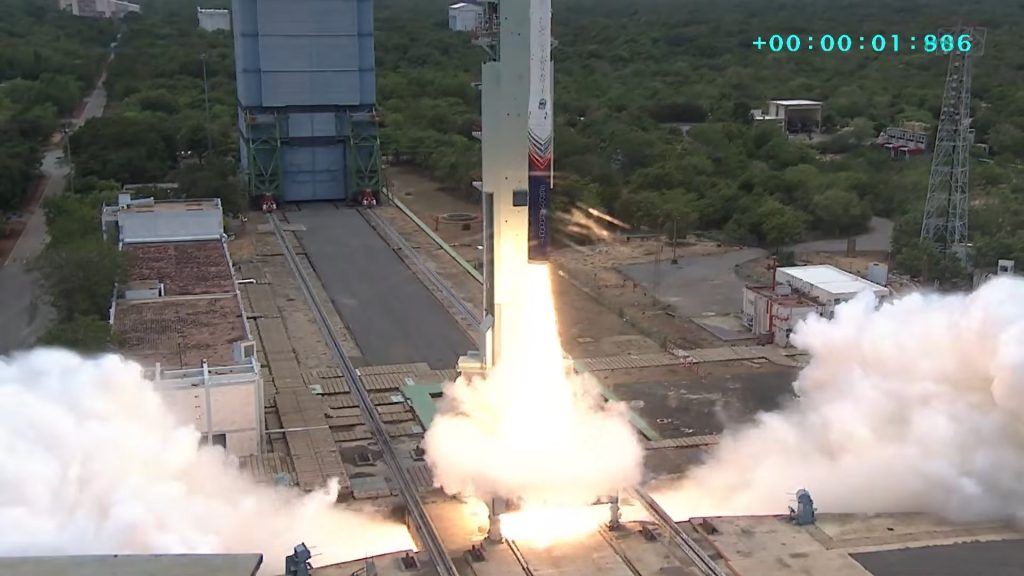
Hyderabad-based Skyroot confirmed the launch was successful, with CEO Pawan Kumar Chandana and COO Naga Bharath Daka calling it a proud moment for the company and for India’s commercial space ambitions. The rocket carried multiple foreign and domestic payloads, along with a more symbolic piece of cargo: a handwritten “Vande Mataram” postcard from Prime Minister Narendra Modi, tucked in among notes from Skyroot’s own team, its investors, and well-wishers from around the world.
Eight Years In The Making
Skyroot was founded in 2018 by Pawan Kumar Chandana and Naga Bharath Daka, both former ISRO scientists who left the space agency after India’s government put out a draft Space Activities Bill signalling that private companies would soon be allowed to build and launch their own rockets. The pair started the company out of a small office in Kondapur, Hyderabad, with a team of ten people.
What followed was a slow, methodical build-up rather than a straight shot to orbit. In 2020, Skyroot became the first Indian private firm to test an upper-stage liquid rocket engine, a 3D-printed engine called Raman that weighed half as much as conventional versions. Later that same year, the company fired its first solid-fuel rocket engine, named Kalam after the former president and rocket scientist A.P.J. Abdul Kalam.
That groundwork led to Vikram-S in November 2022, a suborbital sounding rocket that became India’s first privately built rocket to reach space. It flew for about six minutes, touched an altitude of 89.5 km, and splashed down in the Bay of Bengal, exactly as planned. The mission was named Prarambh, or “the beginning,” and it opened the door to what Skyroot was really building toward: an orbital-class launch vehicle.
Vikram-1 is that vehicle. It stands seven storeys tall, is built from an all-carbon-composite structure, and uses 3D-printed engines across three solid-fuel stages plus a liquid-fuelled Orbit Adjustment Module that can restart in space to place multiple satellites into different orbits during a single flight. Skyroot has pitched the rocket as something close to a cab service for satellites, one that governments, universities, and commercial operators can book for specific, custom orbits rather than waiting to hitch a ride on a larger, less flexible mission.
The company has also grown considerably in scale over the years. In May, Skyroot raised $60 million and crossed a $1.1 billion valuation, becoming India’s first space-tech unicorn, with backers including GIC, BlackRock, and Ram Shriram’s Sherpalo Ventures. Its total funding now sits north of $160 million.
India’s Private Space Sector Was Only Opened Up In 2020
For most of India’s spacefaring history, going back to the launch of the Rohini satellite in 1980, orbital access was the exclusive domain of ISRO. That changed in June 2020, when the government announced sweeping space sector reforms and set up the Indian National Space Promotion and Authorisation Centre, or IN-SPACe, to let private companies use ISRO’s infrastructure and get regulatory clearance to build and fly their own vehicles. NewSpace India Limited was also created around the same time as ISRO’s commercial arm, to work more directly with private players.
The reform triggered a wave of activity. Skyroot became the first company to sign an MOU with ISRO to launch its own rockets, and it has largely stayed a step ahead of the pack since. Chennai-based Agnikul Cosmos followed with its own suborbital test in 2024, using a single-piece 3D-printed engine of its own design. Both companies now sit at the center of India’s small but fast-growing private launch ecosystem, one the government hopes can eventually capture a meaningful slice of the global small-satellite launch market.
Where India Now Stands Globally
A successful Vikram-1 puts India in genuinely rare company. Historically, orbital launch capability has belonged to national space agencies, with only about thirteen countries, plus the European Space Agency, ever developing rockets capable of reaching orbit at all.
Private orbital launch is a smaller club still. The United States got there first, with companies like SpaceX and Rocket Lab turning commercial launch into a routine business over the past decade and a half. China followed in 2019, when Beijing-based i-Space became the country’s first private firm to put a satellite into orbit with its own rocket, and it has since built out a genuine commercial launch sector featuring companies like Galactic Energy and LandSpace. Japan has a technically diverse group of launch startups working on orbital vehicles as well, though most of its domestic satellite operators still end up booking rides on Rocket Lab or SpaceX rather than flying on Japanese-built rockets.
With Vikram-1, Skyroot would make India the third country in the world, after the US and China, to have a private company capable of reaching orbit on its own rocket. For a sector that only opened its doors to private players five years ago, that is a fast climb, and one that will likely be watched closely by the growing list of satellite operators looking for cheaper, faster ways to get to space.