You have to hand it to Indian startups for having their finger on the pulse of their users.
Swiggy Instamart has announced a partnership with Hindustan Petroleum Corporation Limited to launch on-demand LPG cylinder delivery on its platform, marking India’s first attempt at bringing gas cylinders into the quick commerce fold. The launch also introduces HP Navya, HPCL’s newly developed 10 kg composite cylinder, to Instamart’s catalogue.
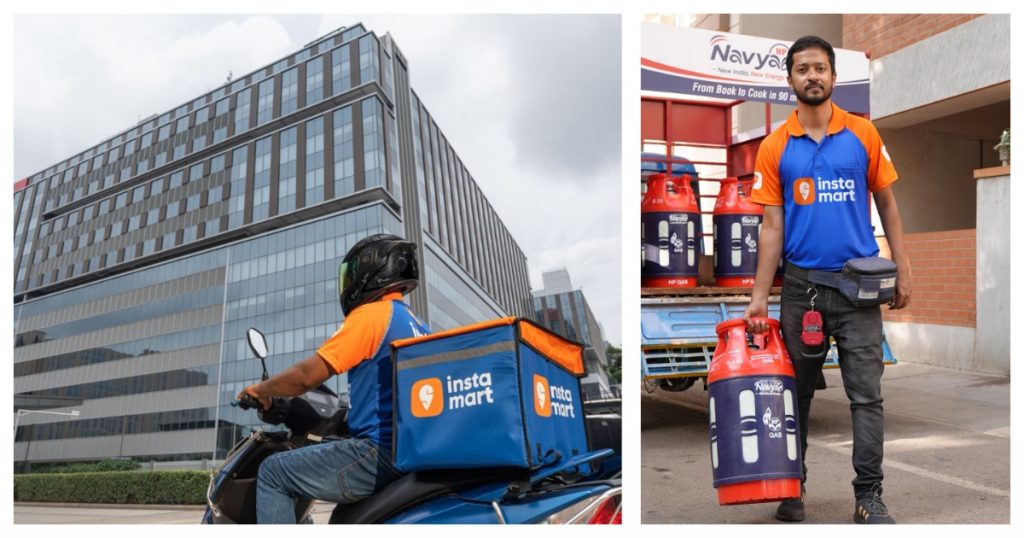
The service will begin in Bengaluru, where users can order the HP Navya composite cylinder or a 5 kg metal LPG cylinder directly through the app. The Navya cylinder is being pitched as a lighter, corrosion-resistant option with a translucent body that lets users keep an eye on how much gas is left inside, a feature aimed at apartments, students, and smaller households that don’t necessarily want a full-sized traditional connection. Notably, the 5 kg cylinder doesn’t require an existing domestic LPG connection, opening up the service to renters, PGs, and anyone who just wants a backup option without the paperwork that usually comes with getting a gas connection.
The mechanics of the process are fairly straightforward. Consumers select their cylinder of choice on Instamart, add it to the cart, and place the order like they would for any other product. First-time purchases go through as fresh cylinder purchases, and once that’s done, refills work through the usual system of swapping out the empty cylinder at the time of delivery. HPCL’s own distributor network handles the fulfillment, with trained personnel from these distributors making the deliveries under existing safety protocols. First orders will also involve identity verification and proof-of-delivery documentation, which HPCL says is meant to keep the process compliant given how tightly LPG distribution is usually regulated.
Instamart has been steadily pushing into categories that go beyond the groceries and quick snacks it built its early user base on. The company partnered with PharmEasy in 2024 to pilot medicine deliveries in the same city, recently delivered mangoes during mango season. Blinkit, meanwhile, delivers ambulances and prinouts. LPG is arguably an even bigger step, given how essential and safety-sensitive the category is. Amitesh Jha, CEO of Instamart, said the company has expanded its consumption use cases well beyond groceries to become part of everyday life, and that the HPCL tie-up extends that convenience to an essential household service while keeping the safety standards customers expect.
For HPCL, a Maharatna central public sector enterprise, the deal offers a shot at reaching a newer, more digitally native set of buyers without having to build out its own app-based delivery layer from scratch. Instamart already delivers over 50,000 SKUs to its customers, and folding in a state-run oil major’s product line is a fairly unusual crossover for what is still, at its core, a grocery and convenience app.
Quick commerce companies in India have been broadening their scope well beyond groceries for a while now. Blinkit and Zepto have pushed into everything from electronics to fashion, and the pressure this has put on traditional retail is visible in how brokerages have downgraded stocks like DMart over the growing share these apps are taking. LPG cylinders, though, sit in a different bracket altogether, tied up with government subsidies, distributor licensing, and safety regulation in a way that groceries or electronics simply aren’t. How smoothly Instamart and HPCL manage that layer of compliance as the service scales beyond Bengaluru will likely determine whether this becomes a genuine new vertical for quick commerce, or stays a Bengaluru-only experiment.