Rapido has entered the food delivery space, and it’s taking the incumbents head on.
A screenshot of the Ownly checkout screen, shared by a user on X, shows the app taking direct digs at the fee structures that have come to define ordering food online in India. Where Swiggy and Zomato bills typically list out a platform fee and a packaging fee alongside the usual GST and delivery charges, Ownly’s checkout page shows both crossed out, with cheeky one-liners replacing the numbers. Next to “Platform fees,” the app writes “We’re not those guys.” Next to “Packaging Fees,” it says “Seriously? Nope.”
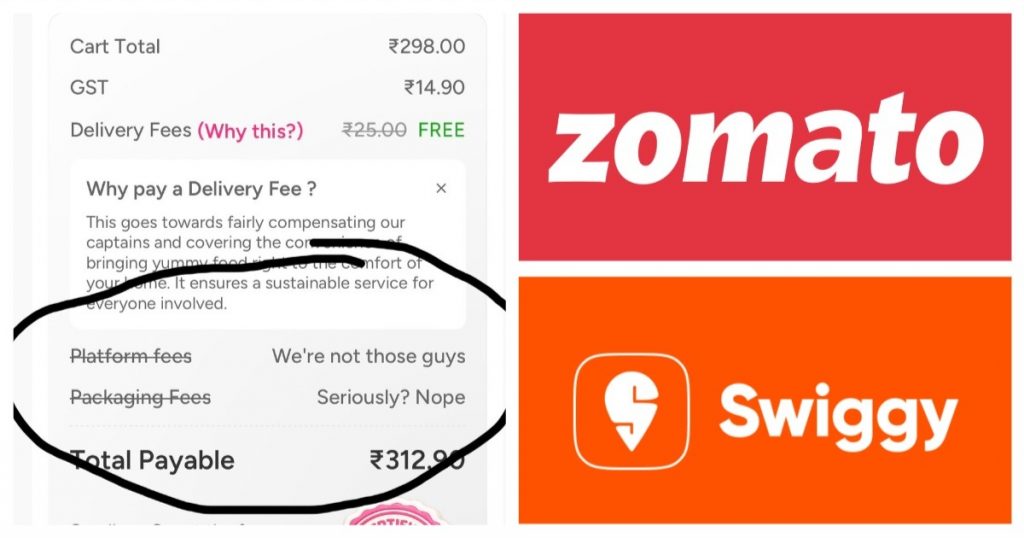
The bill in the screenshot is for two Krispy Kreme doughnuts. It totals ₹298 for the items, ₹14.90 in GST, and nothing else, bringing the total payable to ₹312.90. There’s also a banner at the top of the screen reading “No confusing fees. No hidden charges,” and a note at the bottom that says “Scroll up. Count the fees,” daring users to actually go verify that there’s nothing hidden in there.
It’s a pointed jab at the platform fee that Swiggy and Zomato have built into their business over the last three years. What started as a Rs. 2 charge in 2023 has been raised repeatedly and almost always in tandem by both companies, most recently touching Rs. 14.90 for Zomato and Rs. 17.58 for Swiggy. The fee has drawn scrutiny for how closely the two companies tend to move in lockstep on pricing, and it now accounts for a meaningful chunk of their bottom lines. Packaging fees, charged separately by many restaurants on these platforms, add another layer to the bill that customers often don’t notice until checkout.
Ownly’s whole pitch has been built around not doing any of this. The app runs on a zero-commission model, restaurants pay a fixed fee per order instead of the up to 30% commission that Swiggy and Zomato are known to charge. Because restaurants aren’t clawing back a large commission through inflated menu prices, Rapido has claimed its prices end up around 15% lower than what shows up on the incumbent apps. The company has said restaurants also cover delivery costs for orders within a 4 km radius, which is why “Delivery Fees” on the bill shows as free despite an original charge of ₹25.
The service started as a quiet beta in a handful of Bengaluru neighbourhoods and has since been folded directly into the main Rapido app, giving it access to the company’s existing base of riders and users. Rapido runs a fleet built for its ride-hailing business, and it’s betting that reusing that network for food deliveries, especially during the hours when bike and auto demand dips, gives Ownly a cost structure that Swiggy and Zomato can’t easily match without giving up margin.
Whether the sarcasm on the checkout screen holds up at scale is a separate question from whether it’s effective marketing. Zero-commission models have been tried before in Indian food delivery and have mostly struggled once companies had to actually pay for logistics at volume. But Rapido has managed to undercut larger, better-funded rivals on price before, its two-wheeler business did exactly that to Ola and Uber, and it’s leaning on the same playbook here. Restaurant owners, tired of commissions eating into margins, appear to be receptive to the pitch. The National Restaurants Association of India has been pushing for exactly this kind of alternative for years.
For now, Ownly is available only in Bengaluru, and the company has said expansion to other cities, including Tier 1 and Tier 2 markets, is on the roadmap. Swiggy and Zomato have seen off several well-funded challengers already. But between Rapido and Flipkart’s freshly announced entry into food delivery, the duopoly that has defined the space for the better part of a decade is suddenly looking a lot less settled.