Lenskart CEO Peyush Bansal had implied his the defense in Lenskart discrimination case — in which the company allowed store staff to wear hijabs but not bindis, tikas or kalawas — that the policy was outdated and wasn’t acted upon, but a Lenskart employee has now shared evidence that shows that the policy was not only in place until two months ago, but employees wearing bindis and kalawas were being actively penalized.
OfficeChai has obtained emails from a Lenskart employee which show how he had first written to the management about the discriminatory dressing policy as early as on 25th November 2025. Lenskart used to deduct marks from stores during audits where employees wore bindis and kalawas, which affected the ratings of the employees and the store managers. The employee also told OfficeChai that he was terminated for raising the issue, in spite of his performance at the company having been strong
Akash Falake, who worked as a Store Manager at Lenskart in Pune, had said that he believed that Lenskart’s dressing policy was unfair. “I would like to bring to your attention that there are certain company rules that I am not comfortable with and find difficult to understand. Specifically, I have noticed that wearing a hijab is allowed, but wearing a bindi or tika is not permitted. Since these are a part of Indian cultural and traditional practices, I feel the policy should treat all such expressions fairly and equally,” Falake had written to Lenskart’s HR in an email dated 25th February.
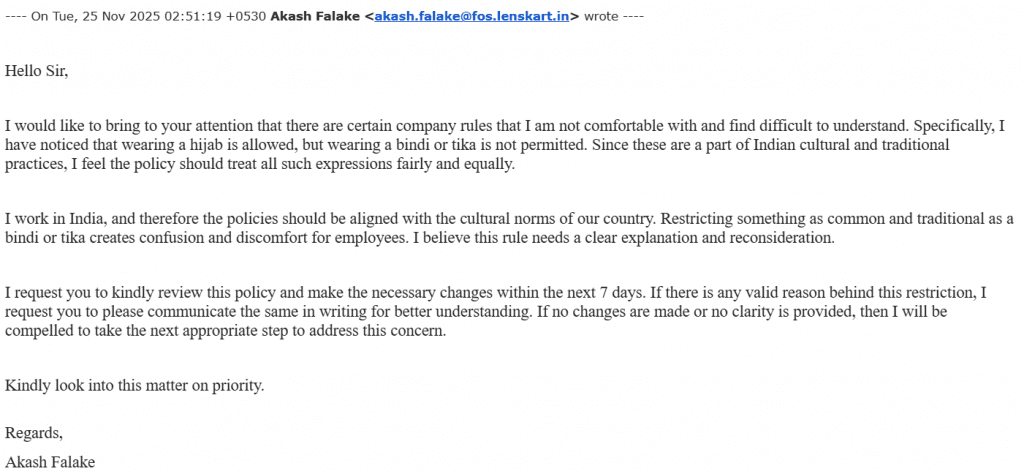
It appears that Lenskart initially took cognizance of the email. A Lenskart representative called him the next day, and after a discussion, said that Lenskart would need 30 days to review the matter. However, the representative did not put this confirmation on email.
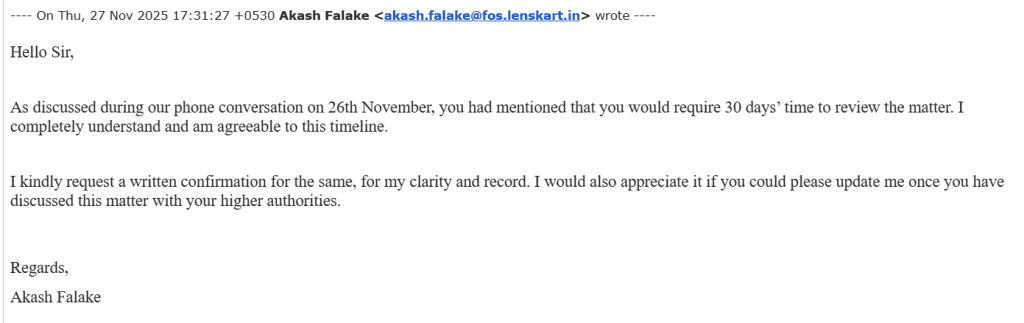
When Falake didn’t hear back from the company for more than two weeks, he sent a reminder. At this point, Akshay Bogar, who is an Assistant Manger Human Resources at Lenskart, added Vishal Giripunje, who is the Head of HRBP for the West Zone at Lenskart to the email thread. “Adding Vishal Giripunje to take this ahead,” he wrote.
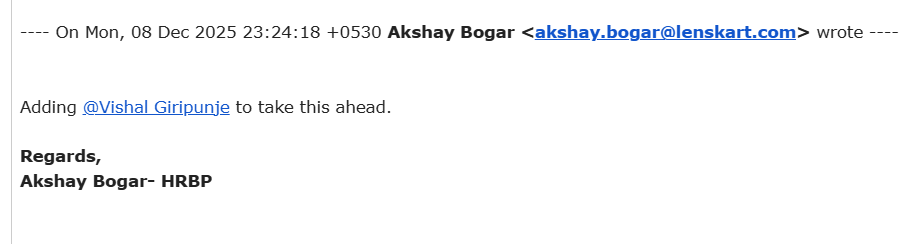
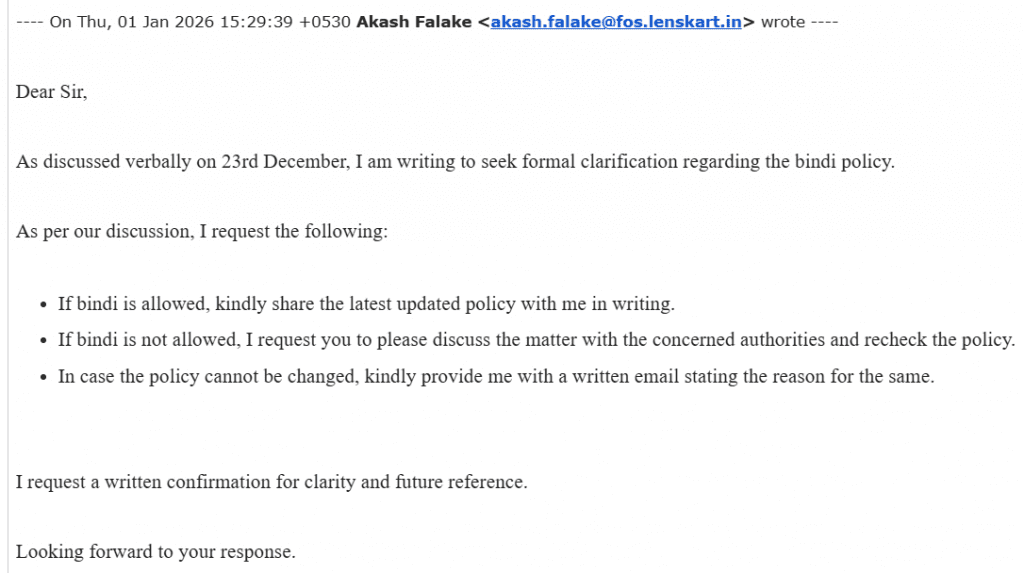
Lenskart spoke to Fakale verbally on 23rd December 2025, but the company didn’t change anything in writing — the official policy still said that hijabs were allowed, but bindis, tikas and kalawas were banned. Falake then wrote another email, seeking a formal confirmation of the policy. “If bindi is allowed, kindly share the latest updated policy with me in writing. If bindi is not allowed, I request you to please discuss the matter with the concerned authorities and recheck the policy. In case the policy cannot be changed, kindly provide me with a written email stating the reason for the same,” he said in his email.
But it appears that Falake never received a response. Till February, Lenskart was penalizing stores where employees wore bindis or tikas. “Despite clearly highlighting the issue earlier, it is still being observed that during store audits, marks are being deducted when a woman is wearing a bindi or a man is wearing a tika. These deductions are leading to store failure in audits, which in turn results in salary impact, incentive cuts, and performance rating reductions for store employees,” he wrote in an email dated 1st February 2026.
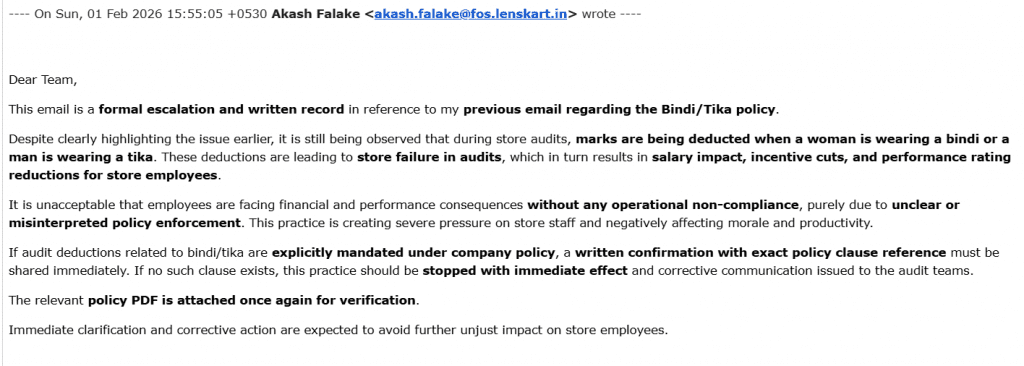
Falake still didn’t receive a response. He even contacted Lenskart’s legal team, but received no clarity. At this point, Falake took things further — on 20th February 2026, he lodged a complaint on the Maharashtra government’s Samadhan Portal Complaint via Complaint No. 300182711.
But the very same day as he registered the government complaint, Falake says he was terminated by the company. “On the very same day at approximately 4:00 PM—merely hours after filing the Government complaint—the company terminated my employment without following due process or granting any fair opportunity of hearing. The timing clearly establishes a case of victimization and retaliation for exercising my legal right to raise a grievance,” he says.
Lenskart Discrimination Case
The Lenskart discrimination case had first surfaced when Lenskart dressing guide for its store staff had been leaked on social media. As per the guide, Lenskart allowed employees to wear hijabs, but didn’t allow employees to wear bindis or kalawas (Hindu religious threads). After much outrage, Lenskart CEO Peyush Bansal had written a post on X, initially calling the document “inaccurate”, but said that it didn’t reflect their present guidelines.
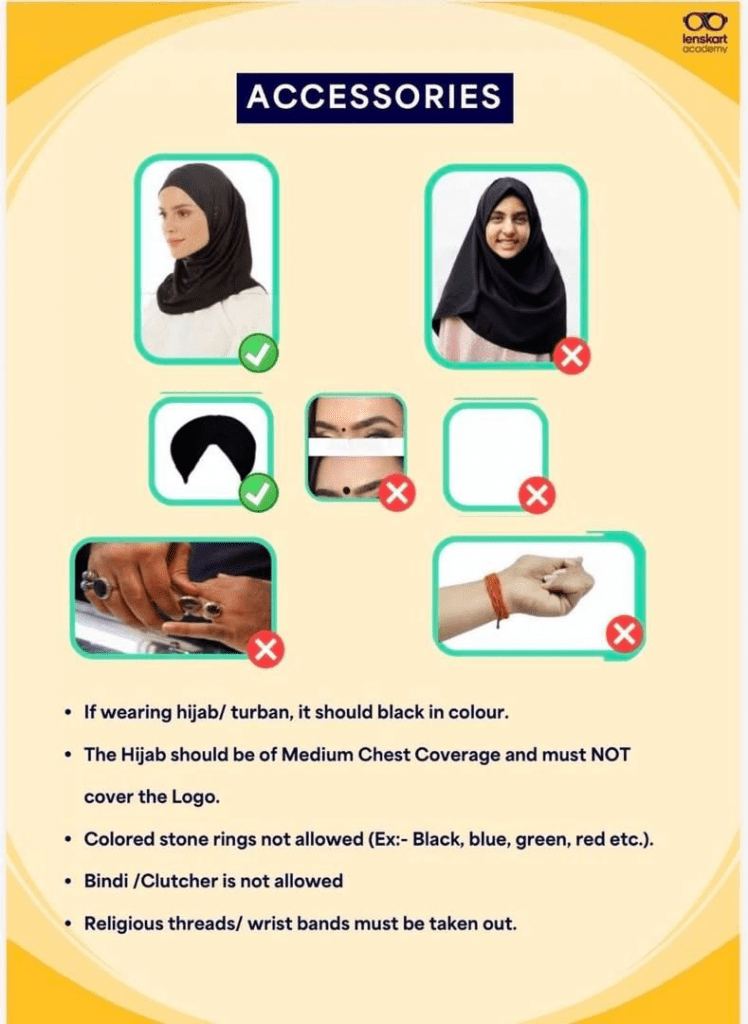
After Bansal had been even more vociferously attacked on social media for his response — he didn’t address why the policy existed in the first place, or shared the updated new policy — he had come up with another post. This time, he said that the policy had contained an “incorrect line”. “It contained an incorrect line about bindi/tilak that should never have been written and does not reflect our values or actual practice. When we discovered this on February 17, well before this became a public conversation, we immediately removed it,” he said.
But the emails released by Akash Falake show that this wasn’t the case. Lenskart was informed of the policy in writing on 25th November 2025. On 8th December, 2025 senior HR officials from the company were informed via the policy on email. Till February 2026, Lenskart had not changed the policy, or provided an update. And when the employee lodged a formal complaint with the government, he was promptly fired.
Falake says that this wasn’t the only instance when he felt discriminated against at Lenskart. “Lenskart never allowed us to wear kurtas on Diwali,” he says, unlike at Pantaloons and Reliance Trends where he’d previously worked where kurtas were allowed on festivals.
We have contacted Lenskart for a comment and will update the article if we receive a response.