Google’s quantum computing team has a new way of showing what its hardware can do, and this time it’s a game.
Google Quantum AI has published research on the cover of Science showing that its Willow quantum processor can consistently win a well-known two-player puzzle called the Mermin-Peres “magic square” game. The best classical strategy can win this game only 88.9% of the time. Google’s qubits won it 98.3% of the time. The company also ran larger versions of related tasks on up to 105 qubits, and beat classical strategies there too.
The paper is titled “Quantum-classical separation in bounded-resource tasks arising from measurement contextuality.” Its core claim is that a strange quantum property called contextuality survives at a scale far larger than it had been shown at before, and that it can be used as a practical tool to benchmark quantum hardware.
The Game You Can’t Win Classically
The magic square game is a cooperative game for two players who can plan ahead but can’t talk once the game starts. They’re given a 3×3 grid. One player is assigned a row, the other a column, and each must fill their line with +1s and –1s.
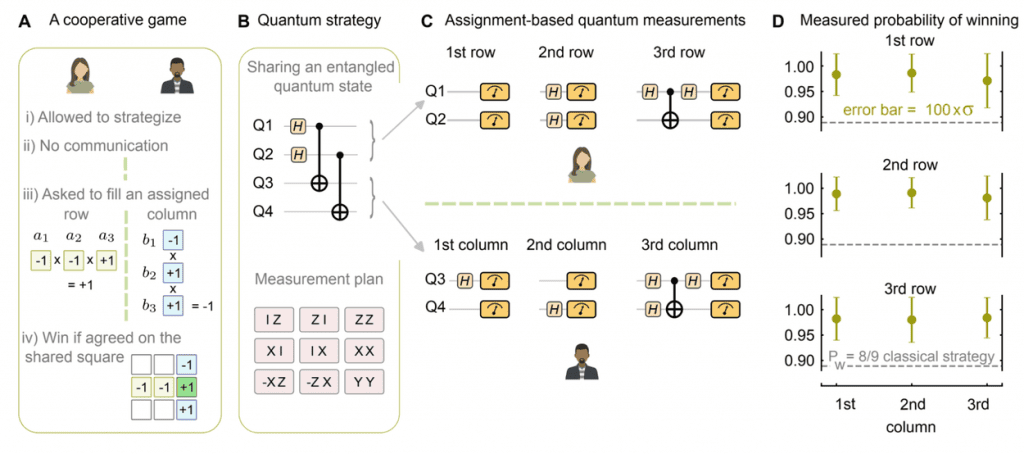
There are rules. Every row must contain an even number of –1s, and every column an odd number. The players win if they put the same value in the one square where the row and column cross.
The catch is that no fixed grid of numbers can satisfy all of those rules at once. The row rules and the column rules contradict each other, so any pre-agreed “cheat sheet” will fail on at least one of the nine possible row-and-column pairings. That’s why the classical ceiling is 8 out of 9, or 88.9%. No amount of cleverness gets you past it.
Quantum players don’t need a cheat sheet. If the two players share entangled qubits and measure them in specific ways, their answers line up every time in theory, giving a 100% win rate. In Google’s experiment, which used four qubits on Willow and ran each of the nine row-column combinations 100,000 times, the chip won 98.3% of the time. The gap from a perfect score comes from hardware noise.
What Contextuality Actually Means
The physics underneath the game is contextuality. Google describes it as the idea that a quantum system’s properties aren’t fixed in advance: what you get when you measure something depends on which other compatible measurements you make alongside it.
In everyday life, we assume objects have definite properties whether or not anyone is looking. A coin in a box is heads or tails. Contextuality says that, for quantum systems, you can’t assign fixed, pre-existing values to everything you might measure. The magic square game is a clean demonstration of this. Classical players lose because they’re forced to commit to fixed values. Quantum players win because they aren’t.
This matters beyond philosophy. Entanglement usually gets the attention, but some theorists believe contextuality is the deeper resource that gives quantum computers their edge on certain algorithms. Until now, it had mostly been shown in systems of only a few particles.
Scaling Up To 105 Qubits
Google ran three further experiments to push contextuality to larger systems.
- A contextuality score. On the same grid, the team measured an inequality where any model with fixed, pre-assigned values tops out at 4 and an ideal quantum system reaches 6. Willow scored roughly 5.6.
- A many-player game. The team ran a cooperative game based on a shared GHZ state, a type of many-qubit entanglement, and beat the classical limit with up to 71 qubits acting as players. Independently, the team verified that up to 45 qubits were genuinely entangled as a group.
- A hidden-function problem. On up to 105 qubits, the chip solved a two-dimensional “hidden linear function” problem, returning valid answers more than half the time and beating classical strategies that are limited to similar resources.
The research was led by Google Quantum AI scientists, with Pedram Roushan and Michel Devoret as senior authors. Devoret, Google Quantum AI’s chief scientist for hardware, shared the 2025 Nobel Prize in Physics.
A New Kind Of Hardware Test
One of the more practical takeaways is that these games work well as diagnostic tools. In the larger experiments, the tests picked up small, systematic errors in the chip’s operations that standard randomized benchmarks had missed. Google is proposing that contextuality-based games become a regular way of measuring hardware quality as processors improve.
For a field where companies frequently make big claims, a test with a hard, provable classical ceiling is useful. If a chip consistently beats 88.9% on the magic square game, something non-classical is happening, and there’s no dispute over how a supercomputer might have done.
What Google Isn’t Claiming
The paper is careful about its limits. The 105-qubit result does not amount to an unconditional proof that quantum computers beat classical ones in general. The classical benchmark at that scale is an estimate that depends on an unproven mathematical conjecture. The theory that guarantees a quantum advantage for the hidden-function problem applies to systems with tens of thousands of qubits, far beyond what was tested. And the quantum edge in the multi-player game shrank as more qubits were added, a reminder that noise still grows with scale.
Google says the work is a step toward applications in chemistry and materials science, but the experiments didn’t simulate anything in either field.
Part Of A Steady Run Of Results
The result is the latest in a string of announcements from Google’s quantum team built on Willow. The 105-qubit chip debuted in December 2024 with a random circuit sampling benchmark that it finished in five minutes, against an estimated 10 septillion years for a top supercomputer. Last October, Google ran its Quantum Echoes algorithm on the chip, claiming the first verifiable quantum advantage, at around 13,000 times faster than classical hardware. Just last month, the team showed it could produce high-fidelity “magic states” through a technique called magic state cultivation, tackling one of the most resource-hungry problems in fault-tolerant quantum computing.
Earlier this year, Google’s quantum researchers also published estimates suggesting that breaking the encryption behind major cryptocurrencies could take far fewer qubits than previously thought, a reminder of why the pace of progress matters well outside physics labs.
The competition is intensifying. Google has said it is targeting a useful, error-corrected quantum computer by 2029. Microsoft, which unveiled its topological Majorana chip last year and followed up with Majorana 2 this year, has set the same target, while IBM, Quantinuum and others are pursuing their own roadmaps. Google CEO Sundar Pichai has said practically useful quantum computers are five to ten years away, and has compared quantum computing today to where AI stood in the years before its breakout.
A puzzle game won’t discover new drugs or materials. But it gives the industry something it has often lacked: a clean, provable test of whether a machine is doing something a classical computer can’t. Google’s chip is now passing that test at a scale no one had managed before.