Apple is now one of the most valuable companies in the world, but it had started off by its founders selling off whatever they owned to get it off the ground.
Steve Wozniak — the engineer behind the Apple I and the technical genius of the founding duo — once described in striking detail just how bare-bones the beginning really was. The story is a masterclass in resourcefulness: no savings, no assets, no bank accounts. Just two young men, their most prized possessions, and a plan scrawled on paper.
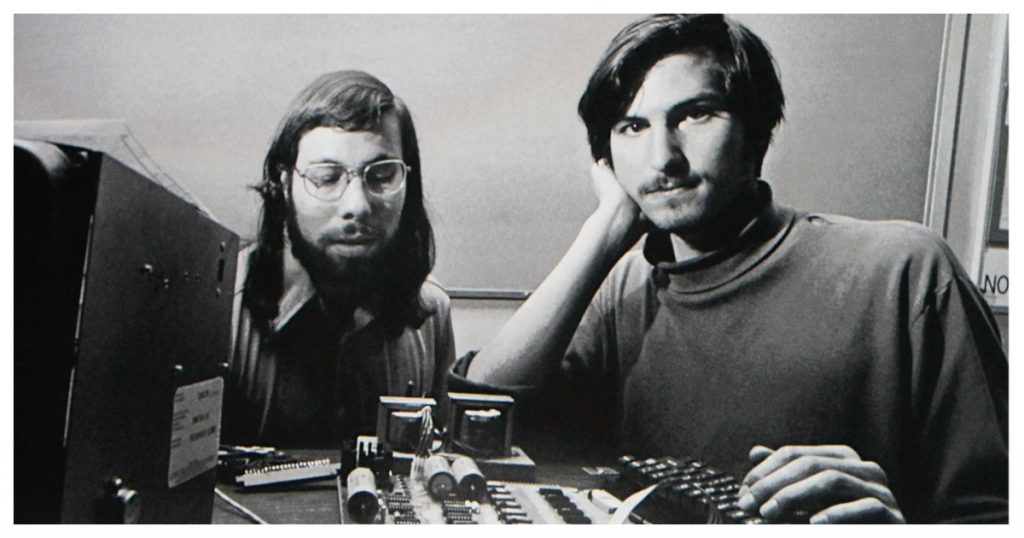
“We didn’t have any bank accounts. We didn’t have any savings accounts. We didn’t have any big assets we could turn into money,” Wozniak recalled. “I mean, I had to sell my most valuable asset, my Hewlett-Packard calculator. Steve sold some van he didn’t need, and we got a few hundred bucks each.”
That was the entire war chest. A few hundred dollars between two people who were about to take on the future of personal computing.
With that money, the two Steves did what any scrappy founder would do — they ran the numbers. “We calculated that we were gonna make PC boards for twenty bucks and sell them for forty. And we calculated that we had to sell fifty of them to get our money back.”
Then came the execution, and it was ruthlessly efficient. “Got the parts on thirty days credit, built the computers in ten days, and delivered them to the computer store for cash. So we got paid cash.”
Thirty days of credit. Ten days to build. Cash on delivery. The whole operation was a masterwork of cash flow management — the kind business schools now teach in case studies, pulled off by two guys in a garage with no financial cushion whatsoever.
Wozniak’s summary of the philosophy was simple and unsparing: “You do what you have to do.” But he singled out his co-founder for special credit. “Steve Jobs was so good at that, always finding a way — when you have very, very little in resources, finding a way to do what you could do. And of course, we wanna do ten times more, but here’s what you can do.”
That last line is worth sitting with. Here’s what you can do. Not what you wish you could do. Not what you’d do with a million dollars. What you can actually do, right now, with what you have.
It’s the founding logic of Apple — and, arguably, of every great bootstrapped company. Jobs and Wozniak didn’t wait for the right conditions. They created the minimum viable version of what they could build, sold it fast, and used the proceeds to do the next thing. The constraint wasn’t a disadvantage; it was the discipline.
Jobs’s instinct for doing more with less is well documented. His single-mindedness and intensity — described by early Apple employees as that of a “maniacal genius” — were visible from the very beginning, long before there was a product design team, a marketing budget, or a Cupertino campus.
The pattern of the two founders as complementary forces — Wozniak the builder, Jobs the operator — is one that continues to resonate. As Perplexity CEO Aravind Srinivas noted recently, the Jobs-Wozniak dynamic has become a reference point for how technical and creative talent can combine to produce something neither could alone.
Apple turned 50 this year. Its market cap now sits at around $3.77 trillion, making it one of the two most valuable companies on the planet. It got there, as Wozniak’s account makes clear, from a Hewlett-Packard calculator and a Volkswagen van.