Palantir CTO Shyam Sankar is one of the most powerful people in American defence tech, but his family’s story begins a long way from Silicon Valley — in a single-room mud hut in southern India.
Speaking on the Shawn Ryan Show, Sankar described how his father went from a mud hut in rural Tamil Nadu to a pharmacy school graduate, then to Nigeria, and finally to the United States as a near-refugee. Along the way, he said, his father was kept out of medical school by India’s quota system, slept under a relative’s kitchen table, and survived an armed robbery that forced the family to flee Africa with nothing.
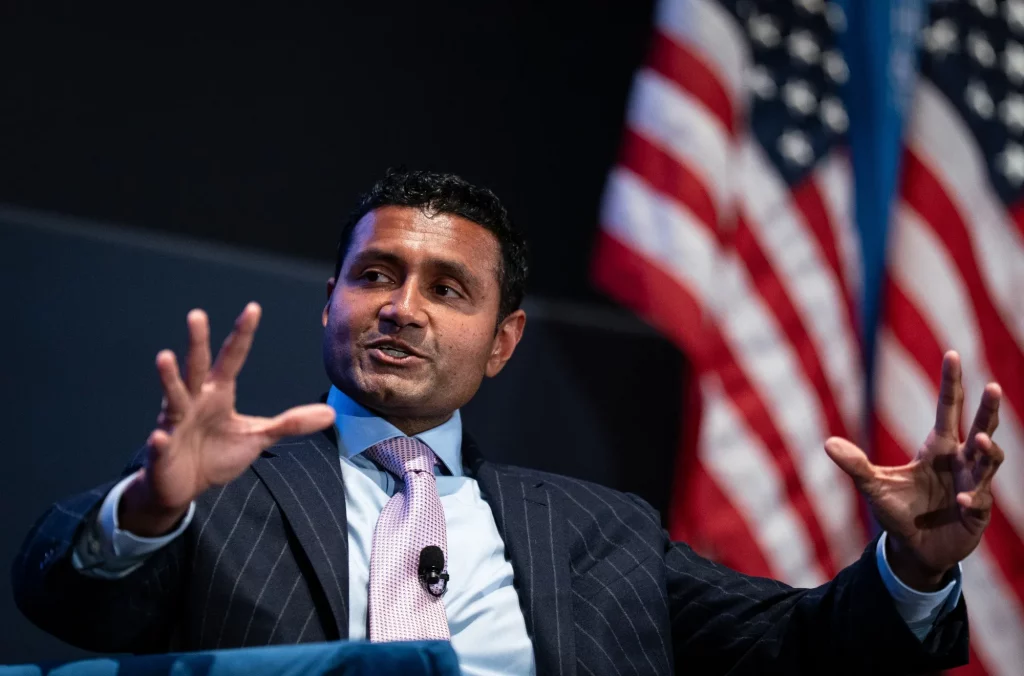
“My father was the last of nine children in a single home,” Sankar said. “He was born in a single-room mud hut in the south of India, and his siblings all helped him get to college.”
“He Wasn’t Allowed To Go To Med School”
Sankar said his father wanted to become a doctor but couldn’t get a seat, which he blamed on India’s reservation system. “India had its own version — still does have its own version of DEI. So he was not allowed… He was a very smart man, but he wasn’t allowed to go to med school,” Sankar said. “He couldn’t get a slot, but he became a pharmacist. That’s like the next best thing for him.”
Things didn’t get much easier after he graduated. “After he graduated from pharmacy school, he was sleeping literally under the kitchen table of one of his brothers,” Sankar said. “My sister-in-law — brother’s wife — got kind of tired of having him around the house, so found him a job in Nigeria.”
From Under A Kitchen Table To Lagos
His father was 23 when he left for Nigeria. Sankar described him as a young man excited about adventure who moved to Lagos to help build the first pharmaceutical manufacturing facility in Africa. Until then, Sankar said, nearly all of the region’s medicines were imported. Sankar was born in Mumbai, where his mother grew up, and the family moved back to Nigeria soon after.
That chapter ended violently. Sankar said armed robbers broke into the family’s home when he was a toddler. They beat his father, threatened the family and killed the family dog. The family left Nigeria with almost nothing and started over in the United States, settling in Orlando, Florida. There, his parents sold souvenirs to theme parks and later ran a dry-cleaning business.
Sankar called his father his hero. He said the family’s story left him with a deep sense of gratitude towards America — a country that isn’t perfect, he said, but where opportunity is real.
From Orlando To Palantir
Sankar started programming in high school. He studied at Cornell, then moved to Stanford, and in 2006 he joined Palantir as employee number 13. There he created the company’s forward-deployed engineering model, which puts Palantir engineers inside client organisations to build software alongside the people using it. The company is now pushing that model into the AI era, with teams at Palantir deploying AI forward-deployed engineers. Sankar became CTO in 2023 and, in June 2025, was commissioned as a Lieutenant Colonel in the US Army Reserve. He has become one of the most outspoken voices in tech on AI and national security, and has argued that EA-style AI safetyism increasingly looks like Marxism-Leninism.
Sankar’s story is a familiar one in Indian immigrant households, and particularly in Tamil ones: a large family pools its money to educate one child, that child takes a chance on a job far from home, and the next generation reaches heights the first could hardly have imagined. In Sankar’s case, the journey from a mud hut in Tamil Nadu to the top of a company now worth hundreds of billions of dollars took just one generation, by way of a kitchen floor and a robbery in Lagos.
His comments on reservations are also likely to strike a chord in India, where debates over quotas in medical admissions are still fierce. Sankar is far from the only executive at Palantir who doesn’t fit the stereotype of a Silicon Valley insider. CEO Alex Karp has spoken about how he’s never met someone really successful who had a great social life at 20. By Sankar’s telling, though, his own drive goes back much further, to a man who couldn’t get into medical school, slept under a kitchen table, and went on to build a factory on another continent.