There’s been plenty of hand-wringing about how much it costs AI companies to serve their models to customers, but Anthropic’s numbers suggest that the bulk of its compute isn’t going towards serving customers at all.
Altimeter Capital founder and CEO Brad Gerstner has shared a chart, built from Anthropic’s amended IPO filing, which shows how the company has split its compute spend between training and serving paying customers over the last few years. And the numbers for 2026 are interesting: in the first nine months of the year, only 26% of Anthropic’s $18.8 billion compute bill went towards serving paying customers. The remaining 74% went towards training, research, internal use and the free tier.
“Everybody thinks, oh my God, they gotta spend so much money to serve up Claude, to run these agents. Only 26% of their compute budget this year went to generating $100 billion in revenue. That’s 500 megawatts,” Gerstner said.
“They had two gigawatts of compute this year, and only 25% of it went to serving this all up. The vast majority of it goes to training, which, to me, says, wow, next year the consensus forecast is another 100 billion of revenue. They only need 500 megawatts,” he added.
“So when you hear all of this concern about data centers and this and that, they just don’t need that much compute to hit their numbers for next year,” Gerstner continued. “Of course, they want a lot more. Why do they want a lot more? Because they know we’re in the foothills of the singularity, of super intelligence. They want to be the first ones to get there. It takes a lot of training to get there, but this shows why it’s such a good business model.”
What The Chart Shows
The chart, titled “Anthropic Compute Allocation: Training vs. Inference,” uses data from Anthropic’s S-1/A, filed on November 2, 2026. It divides the company’s total compute and infrastructure spend into two buckets: compute used to serve paying customers (booked as cost of revenue), and everything else — model training, research, internal usage and free-tier compute (booked under R&D and S&M).
Here’s how the split has evolved:
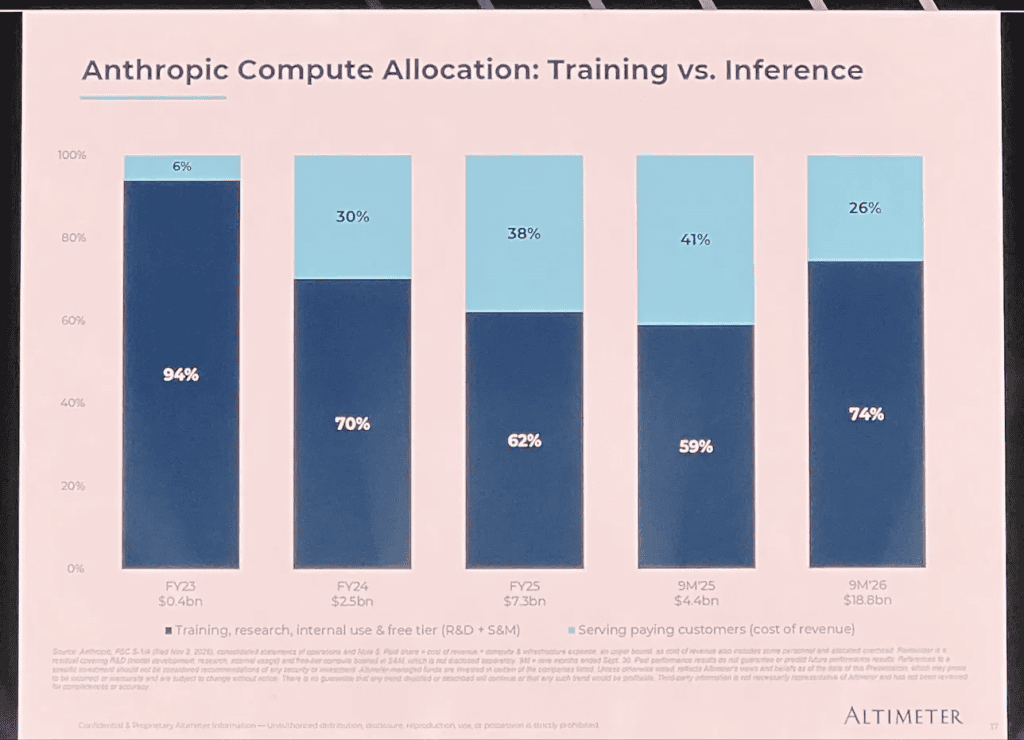
The trend is interesting. From 2023 through 2025, the share of compute going to paying customers rose steadily, from 6% to 41%, as Claude’s commercial business took off. Then in 2026, that trend sharply reversed. Even as Anthropic’s revenues exploded — its annualized revenue run-rate had crossed $47 billion by May, and its IPO filing put the figure at about $81 billion by the end of October — the share of compute used to serve those customers fell to just 26%.
In dollar terms, that works out to roughly $4.9 billion spent serving paying customers in the first nine months of 2026, against roughly $13.9 billion on everything else. A year earlier, those figures were roughly $1.8 billion and $2.6 billion respectively. So while compute spent on paying customers grew around 2.7x year-on-year, the training and research side grew more than 5x.
Why This Matters
The numbers cut against one of the more persistent worries about frontier AI labs: that inference costs would grow so fast alongside usage that margins would never materialize. If Anthropic can support a revenue base approaching $100 billion with about a quarter of its compute, the economics of serving AI look considerably healthier than many had feared. It also helps explain how Anthropic was able to pull ahead commercially, with reports suggesting it was generating 35% more revenue than OpenAI on a run-rate basis earlier this year.
It also reframes Anthropic’s massive compute buildout. The company has signed compute deals worth hundreds of billions of dollars with Amazon, Google, Broadcom, Microsoft and others, and has been reported to be targeting more than 3.5 gigawatts of capacity by the end of the year. Gerstner’s argument is that very little of that is needed to hit near-term revenue targets. Instead, the overwhelming majority is a bet on training ever-more-capable models, and on being the first to reach superintelligence.
A couple of caveats are worth noting. The chart’s footnote says the paying-customer share is an upper bound, since cost of revenue also includes some personnel and allocated overhead, meaning the true inference share could be even lower than 26%. And the “training” bucket isn’t purely training: it also includes free-tier inference and internal usage, which Anthropic doesn’t break out separately. With Anthropic’s own employees now relying heavily on Claude for their work, that internal usage is likely not trivial.
Still, the broad picture is clear. Anthropic is spending the vast majority of its compute on building the next generation of models rather than serving the current one. And if its paying customers really can be served with a fraction of the company’s capacity, it means each new model that Anthropic trains can be monetized at extremely attractive margins — which is exactly the kind of business model that investors like Gerstner are betting will justify the company’s soaring valuation.