A new global survey shows that people in emerging economies are far more upbeat about artificial intelligence than those in the United States and Western Europe, with India and China among the most optimistic countries surveyed and France and the US trailing well behind.
The survey, conducted by GlobeScan for The Economist in September 2026, asked respondents across eight countries a simple question: “Overall, do you think AI will have a positive or negative impact on humanity as a whole?” The results show a clear divide, with the gap between the Global South and the rich West turning out to be much wider than many would expect.
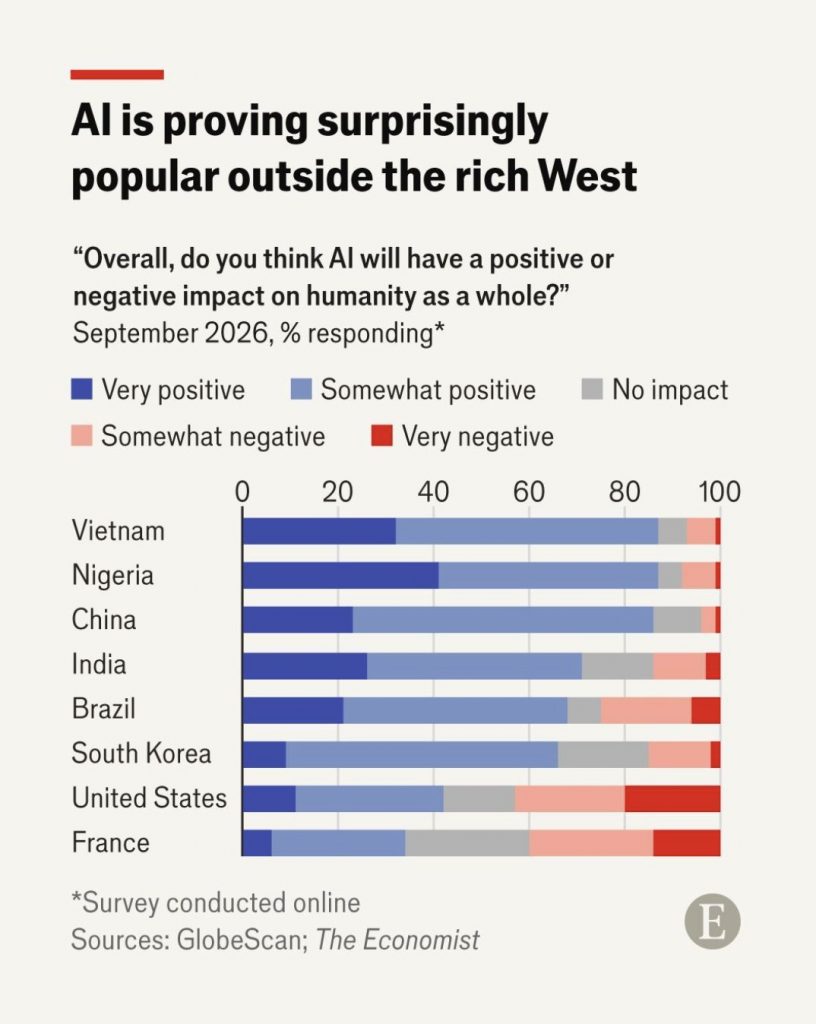
India And China Lead, The US And France Lag
Vietnam and Nigeria came out as the most AI-optimistic countries in the survey, with roughly 87% of respondents in each saying AI would have either a “very positive” or “somewhat positive” impact on humanity. China followed closely behind at around 85% combined positive sentiment, with a notably large share of Chinese respondents choosing “somewhat positive” over a more cautious middle ground.
India wasn’t far behind either, with close to 70% of respondents expressing a positive view of AI’s impact, split between roughly a quarter who were “very positive” and a larger group who were “somewhat positive.” That’s a sharp contrast to the United States, where only about 42% of respondents viewed AI positively, and France, where positive sentiment dropped to roughly a third of respondents, the lowest of all eight countries surveyed.
Negative sentiment followed the inverse pattern. The US had by far the largest share of people picking “very negative,” while France had the largest combined share of “somewhat negative” and “no impact” responses, suggesting that French respondents weren’t just wary of AI but widely saw it as irrelevant to their lives. Brazil and South Korea landed somewhere in the middle, both leaning positive overall but with noticeably larger pockets of skepticism than the Asian and African countries in the survey.
A Pattern That Keeps Showing Up
This isn’t an isolated finding. India has separately topped surveys measuring trust in AI and willingness to use it at work, with Stanford’s AI Index placing the country well ahead of the US on both counts even though America leads the world in AI investment. Indian respondents in that data showed close to 80% trust in AI and around 90% usage at work, a gap researchers have tied to the country’s large IT workforce and its status as one of the biggest markets for tools like ChatGPT.
China shows a similar pattern on a different question. A Gallup poll found that 93% of Chinese respondents believe AI will mostly help people in their country, compared to just 36% of Americans who say the same, a gap wide enough that Nvidia CEO Jensen Huang has pointed to it as a reason the US risks falling behind in the AI race. He has argued that pessimism in the West, not a lack of technical capability, is the bigger strategic weakness.
Why The Gap Exists
Researchers studying these divides point to a few recurring explanations. Countries with younger populations, manufacturing-heavy economies and less entrenched white-collar job markets tend to see AI as an opportunity rather than a threat to existing careers. Rapid recent modernization also plays a role — in China’s case, decades of fast-moving technological change have made the public comparatively comfortable with disruption.
By contrast, surveys in the US have repeatedly found rising anxiety around AI and jobs, with recent polls putting the share of Americans worried about AI-driven job losses at well over 50%, alongside growing unease about data centers, misinformation and the technology’s effect on the labor market more broadly. France has shown similarly cautious attitudes in past Ipsos surveys, consistently ranking among the most AI-skeptical countries in the world.
The latest GlobeScan-Economist numbers suggest that divide hasn’t narrowed going into late 2026 — if anything, it’s become one of the more consistent findings across global AI sentiment research this year.