A week after Jensen Huang’s exit from NVIDIA, the market is checking whether AMD has a China problem of its own.
AMD’s stock had a rough Thursday morning. Shares of the chipmaker fell more than 9% in early trading on November 19 after Hunterbrook, the investigative newsroom with a hedge fund attached, published a report alleging that AMD firmware has kept reaching a Chinese server maker on the US Entity List, along with three companies tied to it. AMD had closed at $530.14 the previous day. It dropped to around $476 within the first hour of trading, before clawing back some ground to trade near $499, down about 5.8%, by late morning.
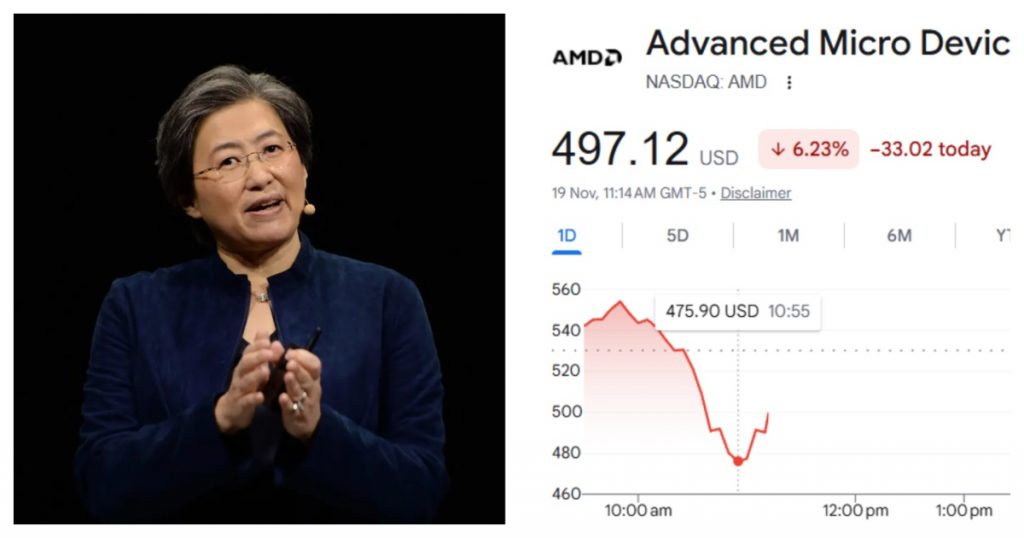
The report is titled “AMD Has Its Own China Problem,” and the timing is hard to miss. NVIDIA is still reeling from Jensen Huang’s resignation on November 12, which followed reports about his relationship with Alice Huang, a Megaspeed executive US officials suspect was working for Chinese intelligence. Some investors had been treating AMD as the cleaner alternative to NVIDIA. Hunterbrook is arguing that it isn’t.
Hunterbrook Capital, the fund affiliated with the newsroom, disclosed that it was short AMD and long a basket of comparable securities when the report was published.
What Hunterbrook Says It Found
The core of the report is about IEIT Systems, a Chinese server maker that is part of the Inspur Group. The US Commerce Department added IEIT to its Entity List in March 2025. Inspur Group itself was blacklisted in March 2023 over allegations that it tried to acquire US technology for China’s military. Companies on the Entity List need a licence to receive items covered by US export rules, and Commerce’s stated policy is generally to deny those licences.
According to Hunterbrook, IEIT has kept shipping BIOS updates that contain newer versions of AMD’s startup firmware since it was blacklisted. The newsroom says IEIT incorporated at least six newer AMD firmware versions after March 2025. The most recent update was posted on October 19, 2026, and contained firmware for AMD’s Turin EPYC server platform, with the package dated August 25.
Hunterbrook says IEIT’s builds typically followed AMD’s public firmware releases by about 25 to 61 days. In one case, an IEIT update posted in October 2025 included a fix for an AMD security flaw that AMD did not publicly disclose until February 24, 2026. If accurate, that suggests IEIT had the fix months before the vulnerability became public.
The report then widens the lens to three companies Hunterbrook ties to IEIT, none of which are on the Entity List:
- Kaytus Systems, based in Singapore, whose audited accounts name IEIT as its ultimate parent. Kaytus reported $1.57 billion in revenue across 2024 and 2025, and paid IEIT $164 million in “referral fees” in 2025, according to Hunterbrook.
- Aivres Systems, based in Fremont, California, which was called Inspur Systems Inc. until May 2023. In a patent lawsuit brought by HPE, Aivres said it was wholly owned by Kaytus Group. AMD’s own Instinct catalogue from February 2026 lists Aivres servers carrying MI300X and MI325X accelerators.
- Maginfra, a state-owned company in Jinan, China, registered in February 2025, a month before IEIT was blacklisted.
Hunterbrook says it compared firmware from the four companies and found Maginfra, Aivres and Kaytus firmware to be 99.94% identical to IEIT’s, apparently for the same AMD server design. Maginfra posted nearly identical firmware on October 15, days before IEIT’s latest update. The newsroom also cites US customs records showing 209 ocean shipments to Aivres since IEIT’s blacklisting, under three different shipper names.
The Bigger China Picture
Beyond the firmware, Hunterbrook points to how much of AMD’s business runs through China. AMD billed $7.75 billion, or 22.4% of its revenue, to customers in China and Hong Kong in fiscal 2025, compared with 9.1% for NVIDIA. Another $4.28 billion was billed to Singapore.
AMD also relies on Tongfu Microelectronics for most of its chip assembly, testing and packaging. Tongfu owns 85% of the two ventures that do this work, and AMD owns the remaining 15%. AMD bought about $2 billion in services from them in 2025, and has lent one of the ventures $100 million, which was still outstanding at the end of September 2026.
There is also Hygon, the Chinese chipmaker AMD partnered with through two Chengdu joint ventures that were themselves blacklisted in 2019. Hunterbrook notes that AMD’s licensing income rose 40% to $67 million in 2025, and says Hygon’s accounts imply about $270 million in payments over 2021 to 2025, close to the $263 million AMD reported. Hygon did not confirm whether “Company G” in its filings refers to AMD.
Why The Timing Matters
Two sets of export rules are central to Hunterbrook’s case. The first is the so-called affiliates rule, issued in September 2025, which would extend Entity List restrictions to foreign companies that are at least 50% owned by listed entities. That would likely capture Kaytus and Aivres, though the rule is currently suspended until January 10, 2027.
The second is an interim final rule that took effect on the same day the report was published. It requires licences for advanced AI chips and servers shipped to Singapore, Malaysia, Indonesia, Thailand and Brazil, with exceptions for US-headquartered buyers, and also covers data centres serving Chinese-headquartered companies. Hunterbrook argues that this could put pressure on AMD’s Singapore sales. Southeast Asia has become the focus of enforcement after Indonesian police raided a Megaspeed subsidiary and found empty server racks where NVIDIA GPUs were supposed to be.
The report also notes that AMD has $48.8 billion in purchase and service commitments and guarantees of up to $8.5 billion, against $15.8 billion in cash and short-term investments. Those commitments have ballooned as AMD has signed large AI chip deals, including with Anthropic, and gone on an acquisition spree that includes the $8.2 billion purchase of Fei-Fei Li’s World Labs.
What Hunterbrook Doesn’t Know
The report is careful about the limits of its findings. Hunterbrook says it does not know how IEIT obtained AMD’s code, or whether AMD holds a licence that permits the transfers. AMD did not answer questions on whether it provided firmware, technology or support to IEIT after the blacklisting. Hunterbrook says AMD asked for more time, was given an extra day, said it would respond, and then did not. IEIT, Maginfra, Kaytus, Aivres, Hygon, Tongfu and the Commerce Department’s Bureau of Industry and Security also did not respond.
William Reinsch, a former Commerce undersecretary now at CSIS, told Hunterbrook that software transfers are much harder to police than hardware shipments. He also pointed out that AMD may well have a licence, and that Commerce does not make that information public. Firmware also tends to travel in ways physical chips don’t, since server makers routinely redistribute it to customers. Hunterbrook, for its part, points to an October 2026 settlement with Lambda Research over software updates sent to a blacklisted Chinese company as evidence that regulators do pursue software cases.
A Familiar Playbook
Short sellers have turned their attention to chipmakers’ China exposure this year, and with some success. Culper Research flagged Jensen Huang’s ties to Alice Huang in a May report that the market largely ignored at the time, only for the issue to cost Huang his job six months later. With NVIDIA’s troubles, some analysts had pushed AMD as a beneficiary. William Blair raised its rating on the stock partly on that basis. Hunterbrook notes that AMD trades at a price-to-earnings multiple three to four times NVIDIA’s, which leaves less room for bad news.
It’s worth remembering that Hunterbrook profits if AMD’s stock falls, and none of its allegations have been tested by regulators. AMD hasn’t been accused of wrongdoing by any authority, and a licence could explain the firmware trail entirely. But after the past two weeks at NVIDIA, investors are clearly in no mood to give chipmakers the benefit of the doubt on China, and AMD will likely need to address these questions soon.