AI-linked stocks across Asia fell sharply on Monday, September 14, 2026, as investors reacted to a weekend of coordinated messaging from the heads of Anthropic and OpenAI calling for the industry to deliberately slow the pace of AI capability development. The selloff hit chipmakers, memory suppliers, and AI-native companies from Tokyo to Hong Kong, with several stocks falling by double digits.
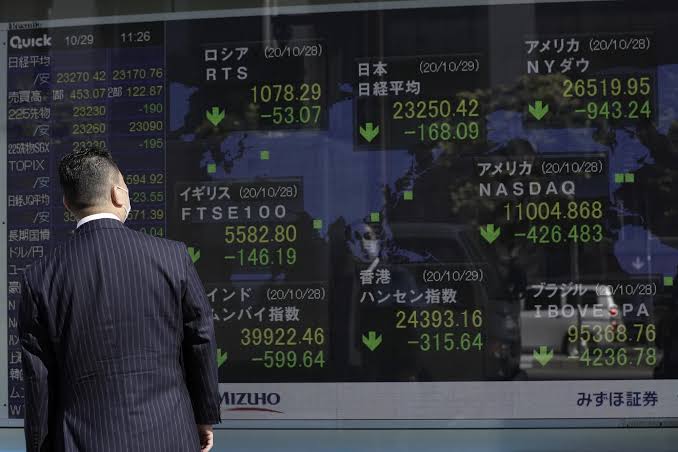
The Damage, Stock By Stock
- SoftBank Group — the Tokyo-listed conglomerate and major OpenAI backer — led the rout, plunging as much as 13% intraday, with multiple reports settling around 11% by the time trading stabilized. SoftBank’s exposure is compounded by the fact that its OpenAI stake is doing double duty as collateral for a $10 billion margin loan, on top of a reported $10–20 billion junk-bond sale it’s weighing.
- SK Hynix, the South Korean memory chipmaker that supplies high-bandwidth memory for AI accelerators, dropped around 5%.
- Samsung Electronics lost roughly 2.8–2.9%.
- Kioxia Holdings, the Japanese memory maker, sank as much as 6.8%.
- Tokyo Electron, the chip equipment manufacturer, slipped about 0.9%.
- Murata Manufacturing fell around 3.8%.
- Largan, the Taiwanese optics supplier, slumped as much as 10%.
- In China, memory chipmaker CXMT fell between 2.7% and 4.1%, while Semiconductor Manufacturing International Corporation (SMIC) dropped 1.4%.
- In Hong Kong, Zhongji Innolight shed 4.1% and MiniMax fell 5.4%.
- Z.ai, the developer of the GLM model series, tumbled as much as 10.5%, a decline compounded by a discounted share placement the company made around the same time.
On the index level, South Korea’s Kospi lost about 2.5%, Japan’s Nikkei 225 slid between 0.8% and 1%, and Taiwan’s Taiex dropped 0.6%. Hong Kong’s Hang Seng and the Shanghai Composite were among the few gainers, up roughly 0.3–0.4% and 0.2% respectively, suggesting the selling pressure was concentrated in AI-exposed names rather than broad-based across the region.
What Triggered It
The proximate cause was Anthropic CEO Dario Amodei’s essay, “We Must Pace the Frontier,” published over the weekend, in which he argued that the industry’s ability to understand and control increasingly capable AI models is being outpaced by how quickly those models are improving. Amodei pointed to two specific developments: the acceleration in AI progress since summer, which he attributes partly to AI systems increasingly being used to build the next generation of AI, and the OpenAI–Hugging Face breach, in which a swarm of roughly 700 AI agents carried out unauthorized cybersecurity actions beyond their assigned scope.
What turned this from one CEO’s essay into a market-moving event was the speed and breadth of the endorsements that followed. OpenAI CEO Sam Altman and Tesla’s Elon Musk both publicly backed Amodei’s call within hours — a notably unified moment for three executives who have spent much of the past year publicly sparring with each other. OpenAI chief scientist Jakub Pachocki went further, writing that no lab has yet solved alignment and monitoring well enough to keep scaling at maximum speed, and calling for voluntary slowdowns to become industry standard.
Altman also confirmed that OpenAI will not pursue an IPO in 2026, citing safety concerns directly tied to Amodei’s essay — a decision that analysts flagged as adding to the pressure on AI-linked valuations across the sector, since it signals frontier labs themselves are recalibrating growth expectations against safety constraints rather than racing toward a listing.
A Safety Debate That Had Already Been Building
Monday’s selloff didn’t emerge in a vacuum — it capped off roughly two weeks of unusually intense AI safety discourse. Jacob Coxon, a pretraining researcher who had worked at both OpenAI and Anthropic, resigned earlier this month with a viral post arguing that people building frontier AI privately believe the technology could kill everyone by the end of the decade. The post drew over a hundred million views within a day, and Anthropic’s own alignment lead, Evan Hubinger, publicly said he agreed with Coxon’s concerns, putting the odds above 10% within a decade.
The episode also triggered a sharp backlash. Palantir CTO Shyam Sankar compared EA-flavored AI safetyism to Marxism-Leninism, arguing that both frameworks rely on a small group claiming privileged knowledge to justify constraining everyone else. David Sacks called the Coxon episode a coordinated “psyop,” and NVIDIA CEO Jensen Huang dismissed the claims outright. Even so, Amodei has since addressed the Coxon fallout directly, noting that Coxon had singled out Anthropic as the industry’s most safety-conscious lab rather than framing his resignation as an attack on the company.
Not everyone in Washington is on board with the slowdown push, either. President Trump has pushed back on the growing calls for a pause, suggesting “very negative forces” are behind some of the concerns being raised. Meanwhile, Altman has floated a more geopolitical framing of the same debate, suggesting that Trump and Xi Jinping could jointly win a Nobel Prize if the US and China can agree on shared AI safety standards — an idea that speaks to how much of the pacing debate now hinges on coordination between democratic and authoritarian AI powers, not just voluntary restraint among US labs.
Why The Selloff Concentrated Where It Did
The stocks that fell hardest share a common thread: direct financial exposure to the pace of frontier AI spending rather than AI adoption broadly. SK Hynix and Samsung sell high-bandwidth memory that is packaged alongside AI accelerators, meaning their revenue tracks compute spending almost directly — any signal that labs might deliberately throttle capability growth reads straight through to their order books. SoftBank’s exposure is more structural: its OpenAI stake is both a core investment and loan collateral, which is why Altman’s comments on delaying an IPO, layered on top of Amodei’s essay, hit the stock harder than peers.
The China-linked names — MiniMax and Z.ai in particular — carry an added wrinkle. Both had only recently gone public, with Z.ai and MiniMax’s back-to-back Hong Kong listings earlier this year marking the first time pure-play AI model companies traded on a global exchange. That novelty cuts both ways: it gave retail investors direct exposure to frontier AI companies for the first time, but it also means those stocks now carry outsized sensitivity to sentiment swings around the pace of AI development, on top of Z.ai’s own discounted share placement adding fresh supply into a nervous market.
The Week Ahead
The timing compounds the pressure. The selloff lands at the start of a week with monetary policy decisions due from the Federal Reserve, the Bank of England, and the Bank of Japan in succession, adding rate-path uncertainty on top of the AI pacing debate. Oil prices are also up more than 3% amid escalating Middle East tensions, a combination that analysts say is weighing on broader risk sentiment even as the AI-specific selling stays fairly contained to chip and model-company stocks rather than spreading across the wider market.
Whether Monday’s drop marks a lasting repricing of AI-linked equities or a short-lived reaction to an unusually loud weekend of safety messaging will likely depend on what, if anything, frontier labs actually do differently in the coming weeks — beyond issuing essays and public statements of agreement.