China is looking to have a play in every part of the AI chain — and even one that’s so far been a global monopoly.
ASML shares fell more than 8% on Monday after The Information reported that a state-backed Chinese company in Shanghai has begun mass-producing its own immersion deep ultraviolet (DUV) lithography machines. The stock touched its lowest level since early June, and the damage wasn’t contained to ASML alone. Applied Materials, KLA, and Lam Research all slid on the news, as did BE Semiconductor Industries, which dropped 9%. Investors reading the report understood immediately what was at stake: the one link in the chip supply chain that China still couldn’t build for itself.
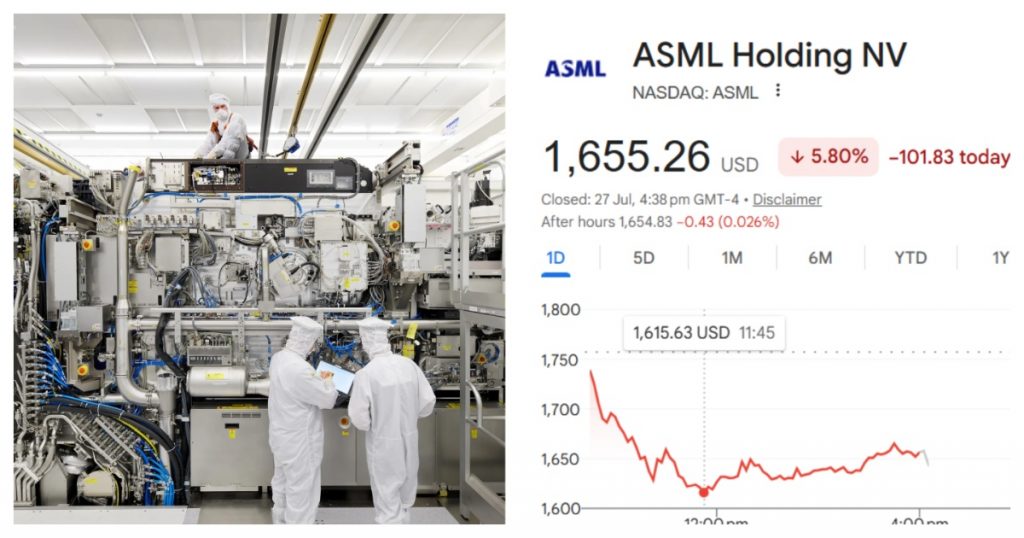
The monopoly in question
ASML doesn’t have competitors in advanced lithography so much as it has customers waiting in line. The Dutch company is the sole global supplier of the extreme ultraviolet (EUV) machines needed to print the smallest, most advanced chips, and one of only a handful of credible suppliers of the older immersion DUV systems that handle everything from mainstream logic to memory. TSMC, Samsung, and Intel all depend on ASML equipment to run their fabs. There is no plan B, because no one else has managed to replicate the physics and precision engineering packed into a machine that costs more than most startups raise in a Series A.
That monopoly has made China’s position particularly uncomfortable. Since Washington and The Hague restricted ASML from selling its EUV systems to Chinese customers, China’s chipmakers have been boxed into immersion DUV, the most advanced tool they’re still legally allowed to buy. That segment became one of ASML’s most important China revenue lines, with the country accounting for close to 30% of ASML’s net system sales even after the curbs, according to the company’s own disclosures. Executives had guided for that number to shrink. Now there’s a reason it might shrink a lot faster than anyone modeled.
The Information’s report, cited by Reuters, said the unnamed Shanghai company brought together development teams from several domestic firms, including one called Yuliangsheng Technology, and plans to manufacture around five DUV machines this year and roughly 20 in 2027. Deliveries are reportedly earmarked for SMIC, Hua Hong Semiconductor, and ChangXin Memory Technologies — three of the biggest names in Chinese chipmaking. For context, ASML shipped 131 immersion DUV systems last year, so this isn’t a company about to out-produce Veldhoven. What it does is give China a working domestic alternative to test, refine, and scale, which is a very different problem for ASML than losing a few units of market share.
Why lithography is the missing piece
The pattern has been consistent with China’s AI ambitions: every time a bottleneck looked permanent, a domestic workaround showed up within a year or two of the restriction being imposed. Huawei’s Ascend line has become the default compute layer for several major Chinese labs — Z.AI’s GLM-5.2 was trained entirely on Ascend chips, with no Nvidia hardware anywhere in the pipeline, and still ended up ahead of every Google model on a major benchmark. On the model layer, Moonshot AI’s Kimi K3 has done something similar to the software side of the stack, landing as a 2.8-trillion-parameter open-weight model that Moonshot itself says trails only Claude Fable 5 and GPT-5.6 Sol, and has already beaten both on individual benchmarks like Frontend Code Arena.
What China hasn’t had, until this week’s report, is a credible domestic path into the equipment layer — the machines that make the chips that run the models in the first place. Chips and models are the visible parts of the AI race, the ones that show up in benchmark charts and earnings calls. Lithography is the part almost nobody outside the semiconductor industry thinks about, and it’s also the part that determines whether everything above it is even possible. A country can design the best AI accelerator in the world, but if it can’t print the silicon, the design is a PDF. That’s been China’s real constraint, more than any individual chip ban — and it’s the constraint this report suggests is starting to loosen.
There’s an irony sitting underneath all of this that analysts have been circling for a while. Export controls were designed to slow China down by cutting off access to ASML’s most advanced tools. What they’ve arguably done instead is remove any incentive for Chinese fabs to keep buying foreign equipment when a domestic option becomes viable, and given state-backed firms a very clear, well-funded mandate to build one. Atreides Management’s Gavin Baker made a related point about the model layer when Kimi K3 launched, arguing that concentrated value in a few dominant players creates exactly the kind of pressure that invites disruption. The same logic applies one layer down the stack. A monopoly on the world’s most critical piece of industrial equipment was always going to be a target, and China has now put a name — even if an unofficial one — on its answer to it.
What this actually changes, and what it doesn’t
None of this means ASML’s business is suddenly in trouble. The machines described in the report are aimed at 28nm-class production with multi-patterning as a workaround for finer nodes, which is several generations behind ASML’s current DUV output, let alone its EUV systems. Five machines this year won’t replace the 131 ASML shipped last year, and China’s domestic EUV efforts remain, by most accounts, years away from anything resembling production. ASML’s CFO said as recently as this year that Chinese demand for its tools was running stronger than expected, not weaker.
What changed on Monday wasn’t the balance sheet. It was the narrative. For years, the market treated ASML’s lithography monopoly as close to unbreakable, a moat wide enough that even China’s enormous state resources couldn’t cross it on any reasonable timeline. That assumption just took a visible hit, and markets tend to reprice on the trajectory of a threat well before the threat is fully realized. If China can get a domestic DUV tool onto SMIC’s fab floor this year, however limited, the multi-decade head start ASML has enjoyed starts looking less like a permanent feature of the industry and more like a lead that’s actively being closed. Combined with what’s already happened in chips and models, the picture forming is of a country working backward through the entire AI stack, methodically removing one dependency at a time.