Twenty-three years before he became the AI industry’s most prominent doomsayer, Dario Amodei stood at a podium in Pasadena City Hall and warned local lawmakers that a war was about to wreck his university.
On March 10, 2003, a sophomore Amodei addressed the Pasadena City Council with a petition opposing the invasion of Iraq, signed by hundreds of members of the Caltech community. He read the petition’s language into the record — the signatories called themselves deeply troubled that the technology they were building might be turned toward indiscriminate war, and argued that any response to terrorism should run through the United Nations rather than a unilateral strike.
Then he turned to what the war would mean for his own school. Amodei told the council that Caltech’s finances had “fallen on hard times,” and predicted that pouring hundreds of billions of dollars into the war would make things dramatically worse: tuition would “skyrocket,” peaceful research programs would be scrapped in favor of military priorities, and graduates who didn’t want to work for the Pentagon would be stuck with lower salaries or no jobs at all. He called Caltech a national treasure and asked the council not to let the war “cripple” it.
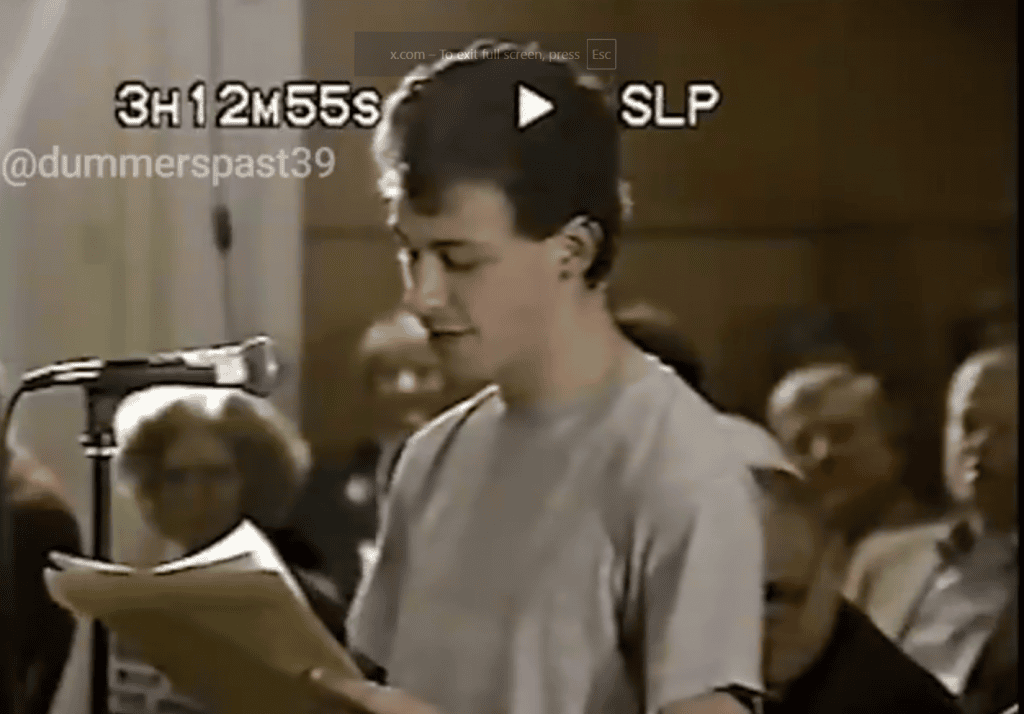
It’s a striking artifact to revisit now, because the shape of the argument — a confident, specific, worst-case forecast, delivered with real urgency about a system he understood technically but couldn’t fully control — is one Amodei has made again, more than two decades later, about an entirely different technology.
A Familiar Shape
As the co-founder and CEO of Anthropic, Amodei has spent much of the past two years warning that AI could gut the white-collar labor market. In 2025 he told Axios and later CNN that AI could eliminate roughly half of all entry-level white-collar jobs within one to five years, pushing unemployment as high as 20 percent in fields like law, finance, consulting and tech. He accused companies and governments of “sugar-coating” what was coming and argued most people had no idea how close the disruption was.
More than a year on, the aggregate numbers haven’t moved the way he described. The US unemployment rate sat at 4.2 percent in September 2026, within the narrow 4.1–4.3 percent band it has occupied since the spring — nowhere near the 10–20 percent range Amodei floated. AI has shown up in individual layoff announcements — Barclays, for one, recently said it would cut 5,000 jobs citing AI-driven efficiency gains — but these remain scattered data points, not the economy-wide collapse his original framing implied. By mid-2026, Amodei himself had noticeably softened the message, talking more about jobs changing shape than vanishing outright.
None of that proves the Iraq-era prediction and the AI-jobs prediction are the same kind of claim; one had a hard deadline and a fixable, well-understood cause, the other is an open-ended bet about a fast-moving technology that could still play out over a longer horizon than he first suggested. But put side by side, they share a pattern: a specific, high-confidence worst case, delivered with conviction that the rest of the world was dangerously underestimating the threat, that did not arrive on the timeline he gave it.
The 2003 prediction didn’t hold up especially well either. Congressional science advocates did warn throughout 2003 that the Iraq war’s cost would squeeze research budgets, and the National Science Foundation’s hoped-for budget-doubling plan was effectively abandoned as the war ramped up. But the dire version Amodei described to the council — skyrocketing tuition, canceled research, a generation of scientists pushed into unemployment or military work — never materialized. NSF funding kept growing in nominal terms through FY2004 and FY2005, federal R&D spending hit record levels, and Caltech’s research enterprise and tuition continued on roughly the trajectory any elite research university was already on. Congress trimmed ambitions; it did not gut the system the way the petition anticipated.
“The End Of The World Camp”
This isn’t the first time Amodei’s forecasting style has come under this kind of scrutiny. Richard Shapiro, who taught Amodei AP Physics at San Francisco’s Lowell High School in the late 1990s, recently told the San Francisco Chronicle that his star student was unusually rattled by the Y2K bug — the feared turn-of-the-millennium failure of systems using two-digit year codes. Shapiro said he figured Y2K would cause a few days of disruption at most; Amodei, by his account, fell squarely in what Shapiro called the “end of the world camp.” Y2K passed without incident on January 1, 2000, remembered today mostly as a case study in anxious energy poured into a problem that didn’t bite nearly as hard as the worst-case predictions suggested.
Lay the three moments next to each other — a teenager convinced Y2K would be catastrophic, a college sophomore convinced the Iraq war would cripple American science, a tech CEO convinced AI is about to erase a fifth of the workforce on a one-to-five-year clock — and a throughline starts to look less like three unrelated judgment calls and more like a disposition: a recurring pull toward the most alarming plausible reading of a technical situation, delivered with total sincerity and no real hedge.
That doesn’t make Amodei wrong about AI. Unlike Y2K or a wartime budget cycle, AI’s trajectory has no fixed deadline, and the risks he describes — mass displacement, systems acting deceptively, catastrophic misuse — are the kind that could still show up on a longer timeline than his original framing implied. But his track record gives a useful way to calibrate how much weight to put on the urgency itself, independent of whether the underlying concern turns out to be legitimate. Two previous confident, specific, worst-case forecasts came and went without the feared collapse. Whether that’s a man who keeps spotting real danger early, or simply someone who panics early and often and has, this time, found a platform large enough that the world panics with him, is still an open question — but it’s one his own history makes harder to answer in his favor by default.