Anthropic has released Claude Opus 5, and the pitch this time is unusually direct: a model that gets close to the company’s own frontier system, Fable 5, while costing half as much to run. That’s a meaningful shift in framing. Anthropic’s last few flagship launches leaned on beating rival labs. This one leans on beating its own top-tier model on price.
Opus 5 is priced at $5 per million input tokens and $25 per million output tokens, identical to Opus 4.8. It’s live today across Claude.ai, the Claude API, Claude Code, and Claude Cowork, and it’s now the default model on Claude Max and the strongest model available on Claude Pro.
Opus 5 benchmarks: where the gains actually show up
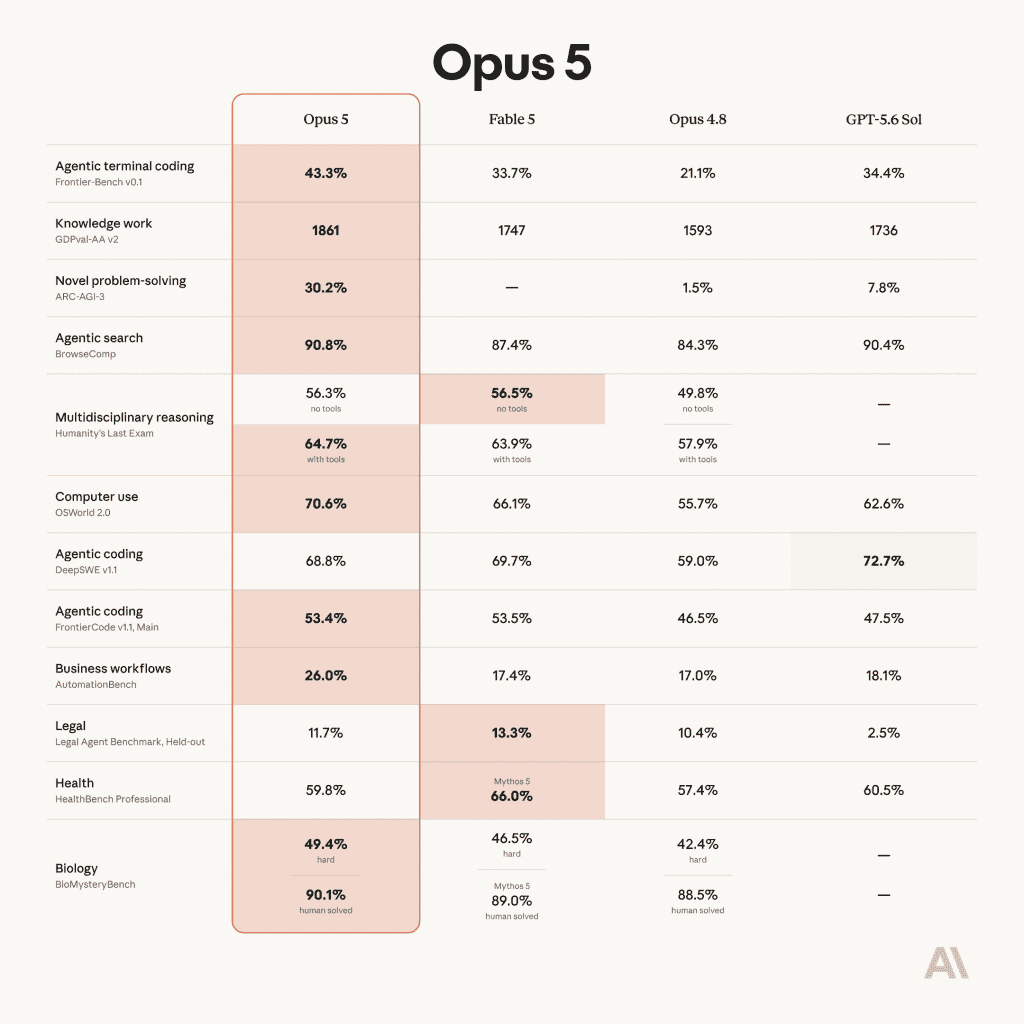
The Opus 5 benchmarks Anthropic is leading with aren’t the usual reasoning leaderboards, though it does well there too. The company is putting most of its weight behind coding and real-world knowledge work, the categories that show up in enterprise billing.
On Frontier-Bench v0.1, Opus 5 more than doubles Opus 4.8’s score while costing less per task. On CursorBench 3.2, at maximum effort, it lands within half a percentage point of Fable 5’s best result, at roughly half the cost per task. Anthropic also says Opus 5 beats every other model at a given cost on high, xhigh, and max effort settings on that benchmark.
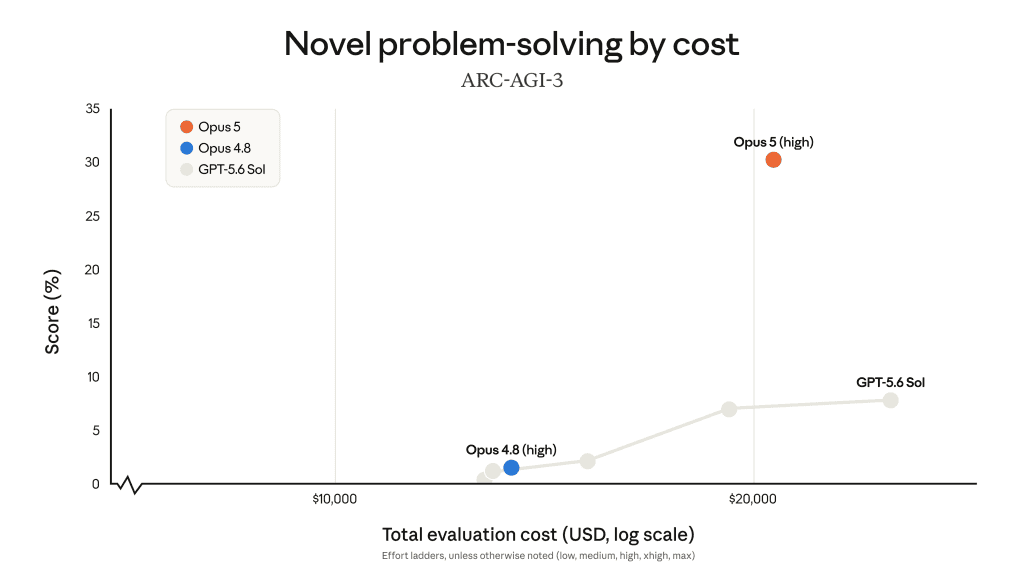
The most eye-catching number in the whole release is on ARC-AGI-3, a benchmark built around genuinely novel problems rather than pattern-matched ones. Opus 5 scores three times higher than the next-best model on that test. Opus 4.8 barely registers here, and even GPT-5.6 Sol, which OpenAI has been pushing hard on cost-efficiency claims against Anthropic’s models, sits well below Opus 5 on this particular chart.
Other Opus 5 benchmarks follow a similar pattern. On Zapier’s AutomationBench, which tests whether a model can carry a business task through to completion rather than just start it, Opus 5’s pass rate runs about 1.5 times the next closest model at matching cost. Even at its cheapest effort setting, it beats every competitor’s best result. On OSWorld 2.0, a computer-use benchmark, Opus 5 outperforms rivals at every price point and clears Fable 5’s peak score using roughly a third of the budget.
Anthropic is also claiming gains in scientific domains. Opus 5 improves on Opus 4.8 across every life sciences evaluation the company tracks, with the biggest jump — over 10 percentage points — on organic chemistry tasks like reading molecular structure from spectroscopy data.
Alignment and the cybersecurity gap with Mythos 5
Anthropic’s automated behavioral audit puts Opus 5 at 2.30 on its misaligned-behavior scale, the lowest score of any recent Claude model, ahead of Opus 4.8, Mythos 5, and Sonnet 5. The company frames this as Opus 5 showing the least deceptive behavior and the strongest adherence to Claude’s Constitution of anything it has shipped.
Cybersecurity is where Anthropic is more careful with its language. Opus 5 closes much of the gap with Mythos 5 on finding software vulnerabilities, but the two models pull apart sharply on exploit development — turning a found bug into something that actually works as an attack. On OSS-Fuzz, Anthropic’s own vulnerability-and-exploit benchmark, Opus 5 tracks close to Mythos 5 on discovery and falls well behind on exploitation.
The safeguards reflect that split. Opus 5’s cyber classifiers let it scan source code for vulnerabilities but block binary-based scanning, penetration testing, and exploit generation outright. Anthropic says these classifiers will trigger roughly 85% less often than they did on Fable 5, and in Claude.ai, Claude Code, and Cowork, anything flagged will fall back to Opus 4.8 automatically. Enterprises and researchers already enrolled in Anthropic’s Cyber Verification Program get a version of Opus 5 with those restrictions loosened.
On biology, Opus 5 carries a similar safeguard profile to Opus 4.8, and Anthropic now describes it as the most capable generally available model it has for scientific research use cases — while noting Mythos 5 still holds the edge on long-running, autonomous biological research specifically.
Opus 5 pricing and how it stacks up
The headline on Opus 5 pricing is that nothing has changed from Opus 4.8’s rate card, but the output per dollar has. Anthropic’s argument is that Opus 5 does more work per token and needs fewer turns to get there, which matters more to enterprise buyers than the sticker price alone. A Fast mode is also available, running at roughly 2.5 times default speed for twice the base price on the Claude Platform, or through usage credits in Claude Code.
This lands at a moment when the field has gotten unusually price-conscious. OpenAI’s GPT-5.6 Sol has been marketed heavily on cost per task, and Moonshot’s Kimi K3 has made a similar pitch at even steeper discounts. Anthropic’s answer with Opus 5 isn’t to undercut everyone on raw price — it’s still priced above Sol and well above K3 — but to argue that its performance-per-dollar curve beats the field once you account for how many tokens and turns each model actually needs to finish a task.
Two smaller updates are shipping alongside Opus 5 in beta. Developers on the Claude Platform can now swap which tools a model has access to mid-conversation without invalidating the prompt cache. And API users can turn on automatic fallbacks, so requests flagged by safety classifiers on Opus 5 or Fable 5 route to another available model instead of getting blocked outright.
Opus 5 doesn’t carry data retention requirements for general access, consistent with how Anthropic has treated its previous Opus releases. Developers can start building with it today under the model string claude-opus-5 on the Claude API.