While the frontier labs remain ahead of the competition, there are now many viable alternatives emerging that are close to the frontier — and at a lower price point.
Cognition, the company behind the autonomous coding agent Devin, has released SWE-1.7, which it’s calling the most capable model it has trained so far. The pitch is straightforward: performance within a few points of the best models on the market, at a cost that undercuts them substantially.
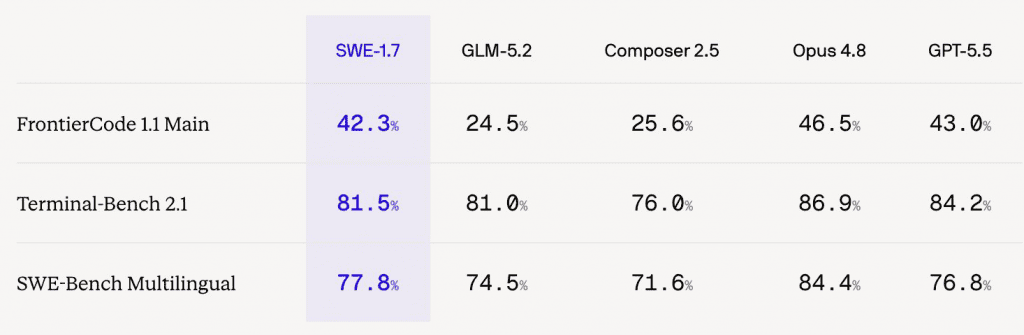
On Cognition’s own FrontierCode 1.1 benchmark, which the company built specifically to judge whether a model produces code that’s actually worth merging, SWE-1.7 scores 42.3%. That places it just behind GPT-5.5 at 43.0% and Claude Opus 4.8 at 46.5%, and comfortably ahead of Kimi K2.7 (30.1%), Composer 2.5 (25.6%), and GLM 5.2 (24.5%). On Terminal-Bench 2.1, SWE-1.7 hits 81.5%, again trailing GPT-5.5 (84.2%) and Opus 4.8 (86.9%) but landing ahead of GLM-5.2 and Composer 2.5. SWE-Bench Multilingual tells a similar story: 77.8% for SWE-1.7, versus 84.4% for Opus 4.8 and 76.8% for GPT-5.5.
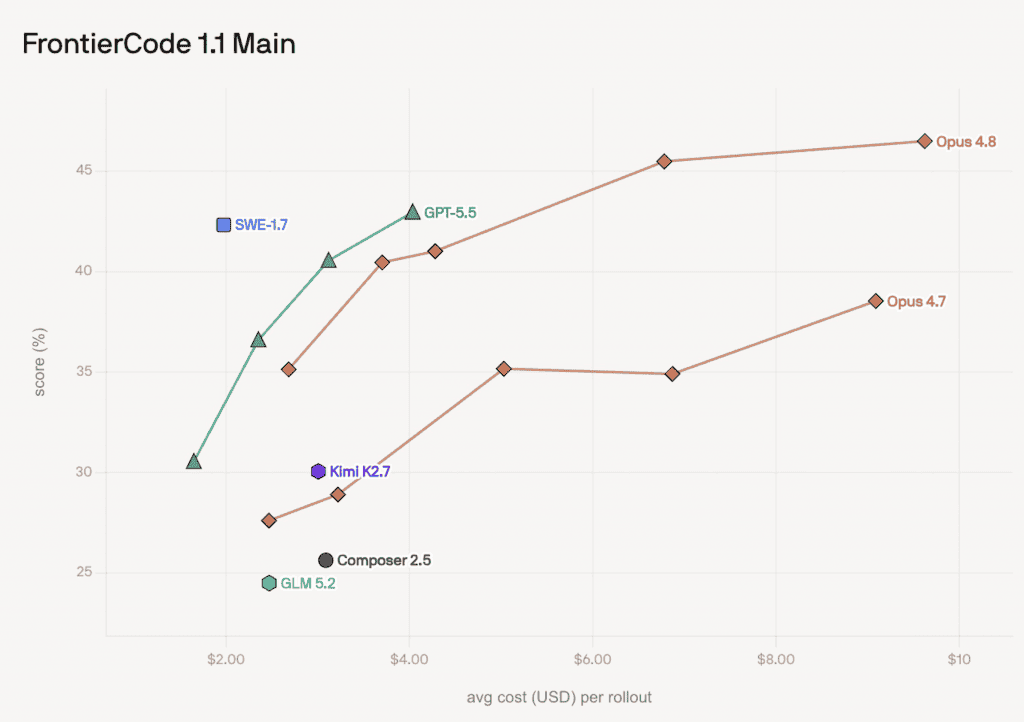
The number Cognition wants people to look at, though, is cost. The company says SWE-1.7 costs $1.97 per task on FrontierCode’s Main set, and its chart plotting score against dollars per rollout puts SWE-1.7 in a spot on the Pareto curve that none of the pricier models occupy. It’s a familiar move at this point in the AI market — Moonshot AI made close to the same case with Kimi K2.5, and Z.AI has run the same playbook with GLM. What’s notable here is that Cognition isn’t an open-source lab releasing weights — it’s an application company building a proprietary model to run its own product, and pricing it aggressively enough to matter to the wider market.
Built On Top Of Kimi K2.7
SWE-1.7 wasn’t trained from scratch. It’s built on a Kimi K2.7 base, which Moonshot AI had already put through extensive RL post-training of its own. Cognition says the fact that its own additional training run still produced large capability gains on top of an already heavily-trained base is itself a notable result — the company argues it pushes back against the idea that there’s a hard “post-training ceiling” past which further reinforcement learning stops paying off.
Getting there wasn’t trivial. Cognition’s writeup goes into detail on two problems that tend to derail long RL runs: entropy collapse, where a model stops exploring new strategies and its performance plateaus, and numerical drift between the policy doing the training and the policy generating rollouts. The company says it addressed entropy collapse mainly through top-p sampling, filtering out low-probability tokens that tend to come from trajectories that have already gone off the rails and would otherwise sharpen the model’s output distribution in unhelpful ways. To keep that approach from making the training-inference mismatch worse, Cognition built what it calls sampling distribution replay, recording which tokens were available to be sampled at rollout time and using those same constraints back in the trainer.
Training Across Three Continents
The infrastructure side of the release is arguably the more unusual part of the story. Cognition says its RL training run spanned four datacenters across three continents, mixing its own GPU clusters with rented capacity from inference providers including Fireworks. The company’s argument is that reinforcement learning suits this kind of distributed setup naturally — only the trainer needs to sit on a single tightly-networked cluster, while the inference engines generating rollouts are self-contained and can run wherever capacity happens to be available.
To keep those far-flung inference clusters in sync with the trainer, Cognition compresses each weight update into a delta and pushes it through cloud object storage rather than streaming the full model directly. The company says this shrinks each transfer by more than 99%, and that cross-continental weight updates for a trillion-parameter model complete in one to two minutes, with inference paused for only three to four seconds during the swap.
Fault tolerance gets a similar treatment. Inference-side failures are framed as cheap, since a dead engine only costs its in-flight sessions before the workload reroutes elsewhere. A trainer failure is more expensive, since it’s the one part of the system that’s tightly coupled, so Cognition checkpoints trainer state to local disk every step and replicates it across nodes so a failed node can be rebuilt in seconds rather than restarting the whole run.
Long-Horizon Tasks And Self-Compaction
Devin was built from the outset for asynchronous tasks that run for a long time without a human checking in, and SWE-1.7 was trained directly inside the Devin harness with that use case in mind. That creates a specific problem: rollouts can run longer than the model’s raw context window allows. Cognition’s answer is self-compaction, where the model periodically summarizes its own working state and picks up from that summary rather than the full history. The company says this technique, which it first tried on kernel-optimization tasks with an earlier model called Kevin, let training rollouts for SWE-1.7 run as long as six hours.
There’s a second, related problem — reasoning models tend to get wordier over the course of RL training, even on tasks that don’t need it. Cognition addressed this with what it calls an alternating length penalty, switching between phases where the model is optimized purely for getting the task right and phases where it’s penalized for going over a token and time budget. The result, per the company, is that response length compresses on easier tasks the model already knows how to solve, while it’s still allowed to think for a long time on genuinely hard ones.
Behavior Differs From Its Base Model
Cognition also spends a chunk of the release describing how SWE-1.7 behaves differently from Kimi K2.7 Code, the model it was built on top of. The company says SWE-1.7’s reasoning is noticeably more condensed — shorter sentences, fewer filler words — which it attributes to the effect of the alternating length penalty during training. At the same time, the model reportedly makes far more tool calls, file reads, and codebase searches than Kimi-K2.7-Code, Opus 4.8, or GPT-5.5 before it starts editing anything.
Cognition frames this as a deliberate tradeoff rather than an unambiguous win. The company says the extra investigation tends to pay off on bug fixes in particular, where SWE-1.7 is more likely to trace a reported symptom back to its actual root cause rather than patching the surface-level issue. But that thoroughness comes with a cost: the model tends to touch more files and write more test cases than a task strictly requires, expanding the scope of its changes beyond what a more surgical fix would look like. Cognition says it’s observed this same pattern — more reasoning correlating with wider change scope — across other frontier models in the industry, not just its own.
SWE-1.7 is live now in Devin’s Web, Desktop, and CLI clients, running on Cerebras hardware at what Cognition says is 1000 tokens per second.