DeepReinforce, the AI research startup behind the Ornith line of open-source models, has released Ornith-1.5, a new family of models spanning 9B, 35B, and 397B parameters that the company says performs on par with Claude Opus 4.8 across reasoning, coding, and agentic tasks. The models are released under the MIT license, meaning developers can use them commercially without restriction, and arrive just about two months after the company’s first release, Ornith-1.0.
The Company Behind Ornith
Ornith is built by DeepReinforce, an AI startup and research lab founded by Dr. Jiwei Li, a Stanford computer science PhD who completed his doctorate in an accelerated three-year timeline and was later named to MIT Technology Review’s Innovators Under 35 list for his work applying deep reinforcement learning to natural language processing. Before DeepReinforce, Li founded Shannon.AI, an NLP startup that grew to dozens of employees and raised around $20 million in venture funding, and he also served as Chief AI Officer at Altonomy. DeepReinforce itself has not disclosed funding details publicly.
Rather than starting out as a general-purpose model lab, DeepReinforce first built its reputation on narrower reinforcement-learning wins: CUDA-L1 and CUDA-L2, RL frameworks for automatically optimizing CUDA code, and IterX, an agentic code optimizer the company says surpasses hand-tuned libraries like NVIDIA’s cuBLAS. It also fields a coding agent that has placed first in competitive programming contests against human competitors. Ornith, launched in June 2026 as Ornith-1.0, marked the team’s move into full-scale open-weight language models, built on top of Qwen 3.5 with additional pretraining and post-training.
What’s New In Ornith-1.5
Ornith-1.5 keeps the three-tier structure of its predecessor — a 397B mixture-of-experts flagship, a 35B MoE mid-size model, and a 9B dense model — while dropping the intermediate 31B dense variant that shipped with Ornith-1.0. The bigger change is architectural: where Ornith-1.0 introduced “self-scaffolding,” in which the model learns to build its own task-specific orchestration harnesses instead of relying on human-designed ones, Ornith-1.5 closes that into a full self-improvement loop. The model now proposes its own training tasks, writes the scaffolds for them, and generates its own reinforcement-learning rollouts, continuously generating new training data without human curation in the chain.
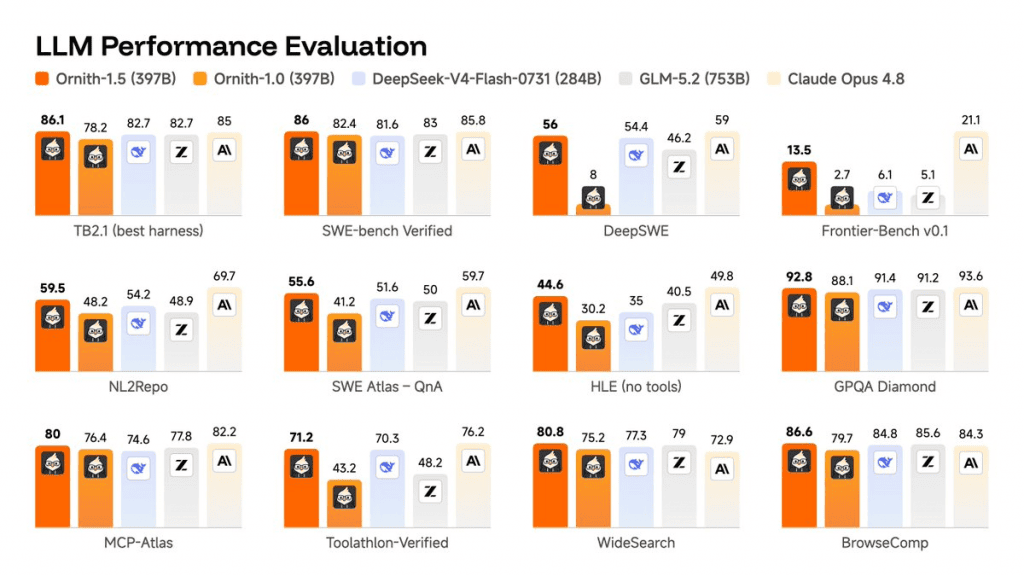
On benchmarks, DeepReinforce says the flagship Ornith-1.5-397B scores 86.1 on Terminal-Bench 2.1 and 86 on SWE-Bench Verified, edging out the 85 and 85.8 the company attributes to Claude Opus 4.8 on the same tests, and comfortably ahead of open-weight rivals DeepSeek-V4-Flash-0731 and GLM-5.2. It also reports a jump on DeepSWE, a harder agentic coding benchmark, from 8 on Ornith-1.0 to 56 on Ornith-1.5. Other reported scores include 44.6 on HLE (no tools), 92.8 on GPQA Diamond, 71.2 on Toolathlon-Verified, and 86.6 on BrowseComp — though the model trails Claude Opus 4.8’s reported 21.1 on the newer Frontier-Bench v0.1 with a score of 13.5.
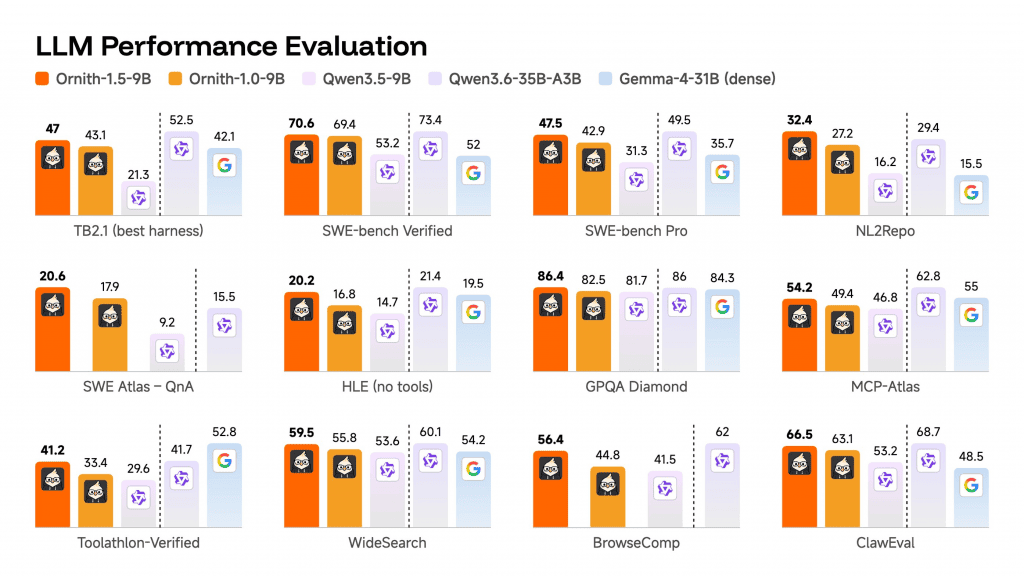
The 35B MoE model, which activates only 3B parameters per token, is positioned as the standout of the family: DeepReinforce claims it outperforms the similarly sized Qwen 3.6-35B as well as larger dense models like Gemma 4-31B and Meta’s Muse Glimmer-30B. At the small end, Ornith-1.5-9B ships alongside a quantized “Mobile” build compressed to about 1.5 GB, designed to run directly on iPhone and Android hardware while, DeepReinforce says, still beating larger models such as Gemma 4-31B and Qwen 3.6-35B.
Availability
All Ornith-1.5 models are open-weighted on Hugging Face under the MIT license, along with FP8, GGUF, MLX, and NVFP4 quantized variants. They can be run through Ollama, LM Studio, and AtomicChat, built into agent workflows via OpenCode and Hermes Agent, and fine-tuned using Unsloth.
The release lands amid a broader run of Chinese and Chinese-linked labs closing the gap with US frontier labs on open weights — Alibaba’s Qwen 3.8 Max and DeepSeek’s V4 Pro have made similar claims in recent months, and open-source models overall have been steadily eating into the market share once held by closed, proprietary offerings from Western labs. Ornith-1.5’s positioning against Claude Opus 4.8 specifically, rather than against other open models, fits into that pattern of open-weight releases increasingly measuring themselves against frontier closed models rather than just each other — a trend officechai has been tracking across the open-source AI landscape through 2026.