DeepSeek had first made the world aware of China’s AI capabilities, and it’s still on the Chinese frontier.
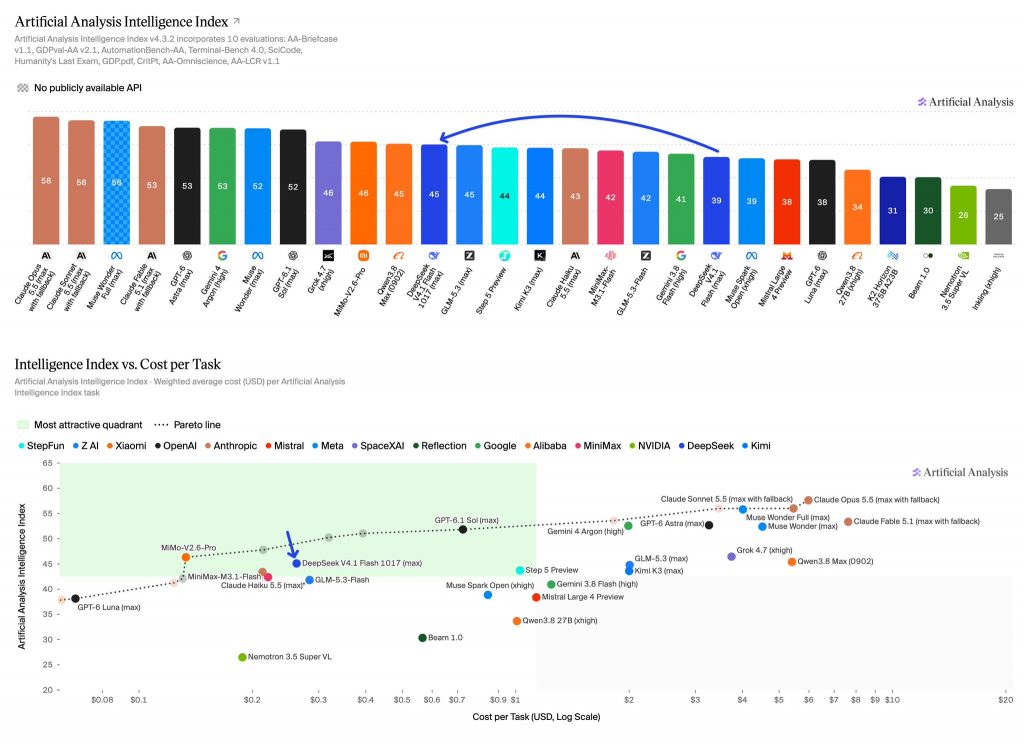
DeepSeek has pushed out an update to its flagship cost-efficient model, with DeepSeek V4.1 Flash 1017 scoring 45 on the Artificial Analysis Intelligence Index, a six-point jump over the DeepSeek V4.1 Flash it replaces. The update is enough to make it the joint #2 open-weights model on the index, tied with Z.ai’s GLM-5.3, and ahead of other open models including Step 5 Preview and Kimi K3, both of which score 44.
The gains come almost entirely from agentic capability, knowledge and scientific reasoning, rather than a wholesale rebuild of the model. On GDPval-AA v2.1, Artificial Analysis’ benchmark for real-world work tasks, DeepSeek V4.1 Flash 1017’s Elo rating climbs 146 points, from 1600 to 1746. On AA-Briefcase v1.1, the long-horizon agentic knowledge work evaluation, its Elo rises 150 points, from 1420 to 1570.
The more striking improvement shows up on AA-Omniscience, Artificial Analysis’ knowledge and hallucination benchmark. DeepSeek V4.1 Flash 1017’s non-hallucination rate jumps from just 4% to 33%, a 29-point swing, while accuracy also ticks up from 43% to 46%. Taken together, that pushes its overall AA-Omniscience Index score from -5 into positive territory at +5, meaning the model is now more likely to acknowledge what it doesn’t know than to hallucinate an answer. On CritPt, a scientific-reasoning evaluation, the model’s score nearly doubles, from 14% to 24%.
Pricing is unchanged from the original DeepSeek V4.1 Flash: $0.30 per million input tokens and $1.20 per million output tokens on the first-party API during peak hours, with off-peak rates at half that, plus a cache-hit price of $0.006 per million tokens, a 98% discount. That pricing, combined with the capability bump, is what puts DeepSeek V4.1 Flash 1017 in what Artificial Analysis calls the most attractive quadrant of its Capability vs. Cost chart, with a Cost per Task of $0.26 against an Intelligence Index score of 45.
That compares favorably with GLM-5.3-Flash, which costs $0.28 per task for a score of 42, though DeepSeek’s update isn’t the cheapest option at this tier. MiMo-V2.6-Pro costs just $0.13 per task for a score of 46, and GPT-6.1 Sol (medium) offers a score of 48 at $0.21 per task, both sitting further along the Pareto frontier than DeepSeek’s release.
The model keeps DeepSeek V4.1 Flash’s 1M-token context window and its 552B total parameter count (16B active), and remains released under the MIT license. It’s available through DeepSeek’s first-party API as well as third-party providers including Fireworks AI, Baseten, DeepInfra, Wafer AI and Cloudflare.
One tradeoff worth flagging is output length. DeepSeek V4.1 Flash 1017 uses 89,000 output tokens per Intelligence Index task, making it noticeably more verbose than cheaper open models like MiMo-V2.6-Pro (64K tokens), even as it stays well short of the 100K-plus token counts posted by models like Claude Opus 5.5 and Claude Sonnet 5.5.
It’s a reminder of how quickly open-weights rankings have moved: Kimi K3 had once placed third overall on the same index, right behind Claude Fable 5 and GPT-5.6 Sol, before a wave of newer releases pushed it down the open-weights pecking order. DeepSeek’s latest update is less a leapfrog than a reshuffle: it closes the gap on hallucination and agentic tasks without touching pricing, while MiMo-V2.6-Pro and GPT-6.1 Sol continue to offer more capability per dollar at the very top of the open and proprietary fields respectively.