Google model releases keep coming in thick and fast.
Google has released Gemini 4 Hydrogen, a fast, low-cost model in the Gemini 4 family, and its own benchmark table has it ahead of Anthropic’s Claude Sonnet 5.5 on seven of the ten evaluations it chose to publish. The company is pitching Hydrogen as the model that brings Gemini 4 to everyone, with availability across Google AI Studio, the Gemini API, Gemini for business, the Gemini app and Google Search.
Hydrogen is the third model in the Gemini 4 line, following Gemini 4 Argon and Gemini 4 Carbon. Its arrival had been anticipated by X users under the same codename since late October. While Carbon and Argon are aimed at deep, long-horizon reasoning, Google says Hydrogen is built for rapid execution in everyday coding and agentic workflows.
Gemini 4 Hydrogen benchmarks
Google compared Hydrogen against Claude Sonnet 5.5 and OpenAI’s GPT-6.1 Terra. Here is how the numbers break down (best score in bold).
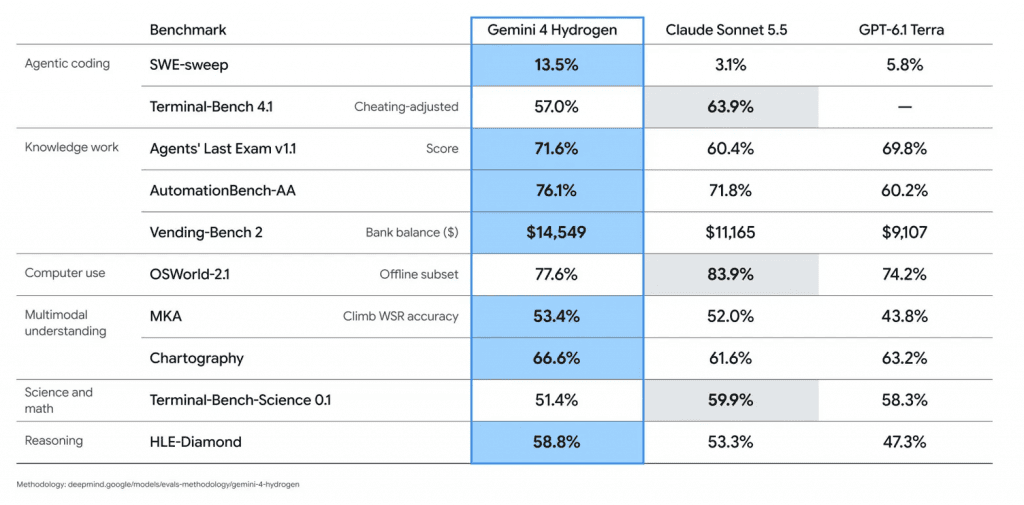
Knowledge work is where Hydrogen’s lead is clearest. It tops all three benchmarks in the category, and its $14,549 on Vending-Bench 2, which measures how much money a model can make running a simulated business, is nearly $3,400 ahead of Sonnet 5.5. On SWE-sweep, which tests whether a model can find and fix bugs without breaking existing code, Hydrogen’s 13.5% is more than four times Sonnet 5.5’s score and well ahead of Terra’s. Hydrogen also beats Terra on eight of the nine benchmarks where Terra has a reported score.
On HLE-Diamond, the closed-ended research benchmark on which Gemini 4 Argon recently topped the leaderboard, Hydrogen’s 58.8% is some distance short of Argon’s 69.1%, but it still clears Sonnet 5.5 by more than five points.
Where Sonnet 5.5 still leads
Anthropic’s model keeps its edge on three benchmarks, all of them terminal- or computer-driven. It scores 63.9% to Hydrogen’s 57.0% on Terminal-Bench 4.1, 83.9% to 77.6% on the OSWorld-2.1 offline subset, and 59.9% to 51.4% on Terminal-Bench-Science 0.1, where Hydrogen is also behind Terra. That is consistent with where Sonnet 5.5 has been strong since its launch, when Anthropic highlighted its big jump in agentic command-line work. Terminal-driven tasks have also been a recurring soft spot for Google’s models, including Argon.
Gemini 4 Hydrogen Pricing and speed
Hydrogen is priced at $1.50 per million input tokens and $7.50 per million output tokens, flat across its entire 1 million-token context window. That is 25% below Sonnet 5.5’s list price of $2 and $10. List price isn’t the whole story, though. Artificial Analysis found that Sonnet 5.5 uses a lot of tokens per task, which pushes its effective cost up, and Google also emphasises that Hydrogen often finishes tasks faster than models in its class.
Against its predecessor, Gemini 3.8 Flash, Google says Hydrogen finishes tasks 2.5 times faster at its default setting, more than triples the Terminal-Bench 4.1 score (57% versus 18.2%), and cuts fabricated claims by more than 5x. Partners reported similar gains: Pixelcut saw runs 1.8x faster, and Box saw about twice the speed with 12% fewer tokens. Cartwheel’s chief scientist called the model “thorough and skeptical,” noting it caught two problems in an approach the team had been working on for ten days.
Hydrogen offers four thinking levels: low, medium, high (the default) and a new xhigh tier. On the Artificial Analysis Intelligence Index, Google says Hydrogen scores 51 at high, edging past Argon’s 50 on the updated v5 index, and reaches 54 at xhigh. Sonnet 5.5 had scored 56 at max effort in Artificial Analysis’s earlier testing, though that was on a previous version of the index, so the figures aren’t directly comparable.
Orchestrator in Antigravity
Alongside the model, Google is introducing Orchestrator in Google Antigravity, which switches between models like Carbon and Hydrogen within a single session rather than using one model from start to finish. On Terminal-Bench 4.0, Google says Orchestrator reached near-Carbon task success while using 24% less quota and finishing 19% faster. For parallel-agent workflows, Carbon can act as coordinator while Hydrogen runs worker and verifier agents across isolated workspaces.
It is a notable push for a tool that Google has been steadily building into a serious coding option, with Argon in Antigravity placing third on Artificial Analysis’s Coding Agent Index behind only Anthropic’s models in Claude Code.
Availability
Hydrogen is rolling out globally from today. Developers can use it in AI Studio and the Gemini API, and in Android Studio on the paid tier. Paid Google AI Pro and Ultra subscribers get it in Antigravity, a broader opening than Argon, which was initially limited to Ultra subscribers there. Enterprises can use it through Gemini for business, and it is available to everyone in the Gemini app’s model dropdown and in Google Search, where it powers more visual responses and a wider fan-out of queries. Gemini in Google Sheets gets it first for Pro and Ultra subscribers and eligible business plans.
The bigger picture
As with most launches, these are Google’s own numbers, and the comparison is deliberately against Anthropic’s mid-tier model rather than its top. Anthropic’s higher tier has moved on since: Claude Fable 5.2 recently took the top spot on the Artificial Analysis Intelligence Index. But for the everyday-work tier where Hydrogen and Sonnet 5.5 compete, Google now has a cheaper, faster model that wins on most of the benchmarks it has put forward, with terminal and computer-use tasks the clear areas left to close.