Google had dug itself out of an AI-shaped hole after ChatGPT’s release, but it now finds itself in what could be an even bigger hole.
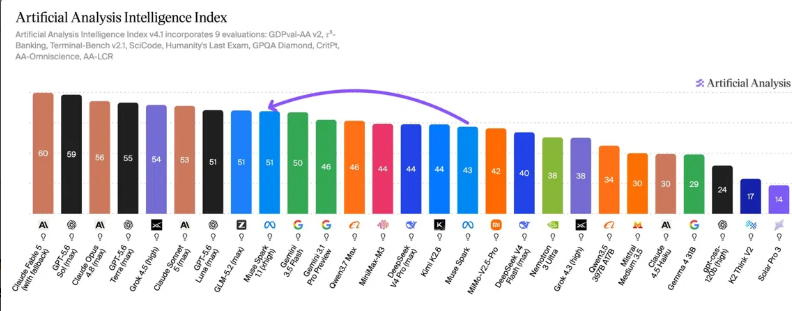
Google, which pioneered the AI era with inventions like the Transformer, currently is out of the top 5 AI model companies in the world. The latest version of the Artificial Analysis Intelligence Index, one of the more closely watched independent benchmarks in the industry, places Google’s best publicly available model, Gemini 3.5 Flash, at a score of 50 and well behind the top of the chart. Anthropic, OpenAI, SpaceXAI, Meta and even a Chinese open-source lab all have models ranked above anything Google currently has on the market. For a company that once looked unassailable in AI, and had spent the better part of the last year clawing its way back to the front of the pack, this is a stunning reversal.
The story of how Google got here begins with how badly it was caught off guard the first time around. When OpenAI released ChatGPT in November 2022, Google was left flat-footed despite having invented the Transformer architecture that underpins virtually every large language model on the market today, including ChatGPT itself. The company had been cautious about putting conversational AI in front of the public, worried about the reputational risk of a chatbot saying something embarrassing or wrong. That caution created the opening OpenAI needed, and some of Google’s own researchers, including Ilya Sutskever, ended up leaving to build what became OpenAI’s edge.
Google’s response, once it arrived, was serious. Co-founder Sergey Brin came out of a retirement he had described as some of the most fun he’d had in his life, and started showing up at the office to work alongside Gemini engineers. The turnaround that followed was real. Gemini 2.5 Pro topped LMArena on release, and later, Gemini 3.1 Pro Preview took the top spot on the Artificial Analysis Intelligence Index outright, a position it held for weeks before OpenAI and Anthropic caught up. On the image side, Nano Banana turned into a genuine cultural moment, pulling in tens of millions of new users and briefly making Gemini the most downloaded app in the world.
Then came Google I/O in May this year, and the cracks started to show. Google unveiled Gemini 3.5 Flash, a cheaper, faster model that impressed on agentic benchmarks but stopped short of frontier territory, landing at fifth on the Intelligence Index at the time. The company said Gemini 3.5 Pro, its actual flagship successor, would follow “next month.” June came and went with no sign of it. That kind of silence from a lab that has otherwise been shipping on a tight, aggressive cadence tends to mean one of two things: either the training run didn’t go the way Google hoped, or the resulting model isn’t close enough to the frontier being set by labs like Anthropic to justify a launch. Neither is a good look at this stage of the race.
Nano Banana’s dominance has faded in a similar way. OpenAI’s GPT Image 2 arrived in April and posted a lead over Nano Banana 2 that Arena itself called the largest gap between first and second place it had ever recorded, sweeping every sub-category on the leaderboard. The model that once symbolized Google’s comeback in consumer AI is now trailing the model built specifically to answer it.
The rest of the field, meanwhile, hasn’t stood still. Meta, working through Alexandr Wang’s Superintelligence Labs, put out Muse Spark 1.1 — an agentic, multimodal model that beats Gemini on several benchmarks and marked Zuckerberg’s first X post from his old account in three years. SpaceXAI, the entity that emerged after SpaceX absorbed xAI, released Grok 4.5 the same week, landing fourth on the Intelligence Index and ahead of Google’s entire Gemini lineup. And China’s Z.AI put out GLM-5.2, an open-weight model that scored higher than every model Google has released, becoming the first Chinese model to clear that particular bar. Anthropic’s models, Claude Opus 4.8 and the export-restricted Claude Fable 5, occupy the top two spots on the index by a comfortable margin.
Google’s position isn’t fatal. The company has the compute, the research bench, and the distribution through Search, Android and Chrome that none of its rivals can match, and Sundar Pichai has argued publicly that short-term rankings don’t define who wins the race. But a company that spent the better part of a year proving it belonged at the very top now has to explain a missing flagship model and a fading image lead at the same time. The longer Gemini 3.5 Pro stays unannounced, the harder that explanation gets.