Google Search is thriving in the AI era, contrary to some expectations, but the nature of search has changed all the same.
New data from Similarweb shows that the average Google search query in the US has grown noticeably longer since AI Mode launched in May 2025. Between June 2024 and that launch, the average query length stayed remarkably flat, hovering between 3.33 and 3.36 words for almost a full year. Since then, it has climbed steadily to over 3.51 words as of May 2026, with a peak of roughly 3.52 words in April.
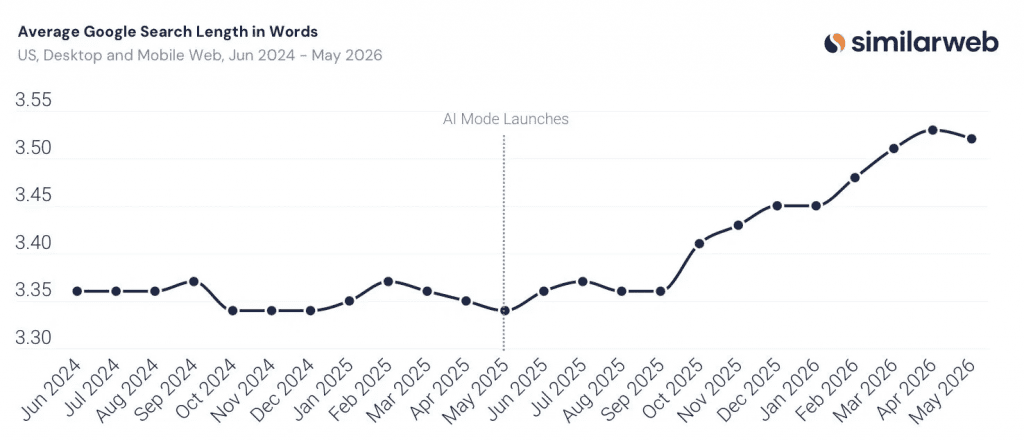
The timing lines up closely with the rollout of AI Mode, the version of Search that lets users type out full, conversational questions instead of short keyword strings and get an AI-generated response in return. For the first several months after launch, query length barely moved, sitting close to where it had been for the previous year. Then, starting around October 2025, it began rising month over month, and it hasn’t reversed since.
That gap between launch and effect is worth sitting with. Search behavior doesn’t change the moment a feature ships. It changes once enough people have used the feature elsewhere, gotten comfortable typing out full sentences to a chatbot, and started carrying that habit back into the search bar. Millions of people have spent the past two years asking ChatGPT, Gemini and other assistants detailed, multi-part questions rather than a handful of keywords. Similarweb’s framing is that this habit is bleeding into how people use Google itself, and the data lines up with that story better than any explanation tied purely to AI Mode’s own interface.
Google has been doubling down on AI Mode since launch, giving it prime placement on both the web interface and its mobile app, and expanding it to most countries. It has also added features like visual search within AI Mode, letting users show the app what they’re looking for rather than describe it in words. None of this happened by accident. Google has watched ChatGPT and other chatbots pull a chunk of the informational-query market away from traditional search, and AI Mode is its answer to that shift.
What makes this data notable is that it cuts against a narrative that has dominated coverage of search over the past year. Reports have repeatedly pointed to falling organic traffic to publisher websites, with one estimate putting the decline in search referral traffic at roughly 25 percent over twelve months, largely because AI Overviews and AI Mode answer questions directly on the results page. Zero-click searches, where a user gets their answer without visiting any website, have climbed past 68 percent of all Google queries. Even Wikipedia, long a fixture near the top of global traffic charts, dropped out of the top ten websites by traffic earlier this year, a shift widely attributed to AI answering questions that once sent people looking for an encyclopedia entry.
Longer queries fit into that picture rather than contradicting it. A short, three-word search like “best running shoes” is built for a results page of ten blue links. A longer, more specific query, the kind AI Mode is designed to handle, is built for a single synthesized answer. As people get used to typing out what they actually want rather than guessing at keywords that might match a webpage, the average query naturally stretches out. Google isn’t just answering more questions inside AI Mode. It’s training an entire generation of searchers to ask questions differently, even outside it.
Whether that’s good news for Google in the long run depends on which part of the business is being measured. Query volume and engagement inside Search appear healthy by this data, which matters enormously for ad revenue tied to the search results page itself. But every one of those longer, more conversational queries is also a query more likely to end without a click, which is exactly the trend that has publishers worried. Google gets to keep the user. The open web doesn’t necessarily get to keep the visit.