AI isn’t just changing the pecking order of individual companies, but it’s also changing the pecking order of entire stock markets.
A new ranking of the top 10 global stock markets by market capitalization — with data as of June 16, 2026 — shows just how dramatically fortunes have shifted in a single year. Japan has climbed from 4th to 3rd, overtaking Hong Kong. South Korea has rocketed from 13th all the way to 5th. Taiwan has jumped from 10th to 6th. The common thread running through all three is their deep entrenchment in the AI hardware supply chain — chips, memory, and advanced semiconductor manufacturing.
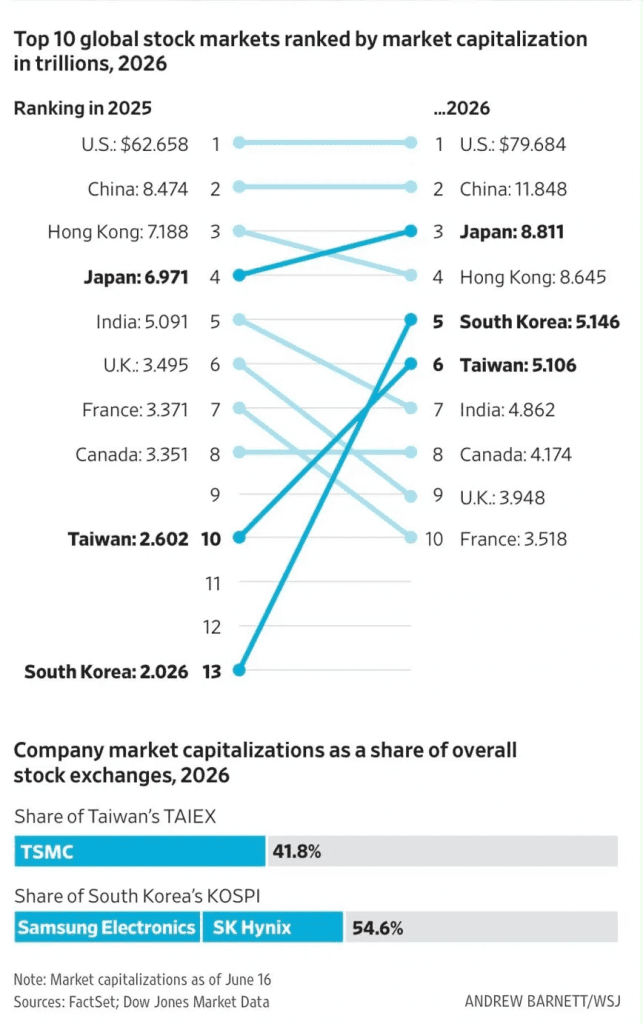
The countries that lost ground tell an equally clear story. The UK slipped from 6th to 9th. France fell from 7th to 10th. India dropped from 5th to 7th. These are all economies whose stock markets lack significant exposure to the infrastructure that AI runs on.
The Taiwan Story: One Company, 41.8% of an Entire Exchange
Taiwan’s rise is almost entirely attributable to TSMC. The company now accounts for 41.8% of the entire TAIEX — Taiwan’s main stock index — by market capitalization. That is an extraordinary concentration. When a single company represents nearly half of a nation’s stock exchange, the exchange’s fortunes and the company’s fortunes become the same thing.
TSMC’s position in the AI ecosystem is essentially irreplaceable in the near term. Every major AI chip — from Nvidia’s Blackwell to AMD’s MI-series — gets fabricated at TSMC’s facilities. TSMC announced its OpenAI partnership in late 2025, adding another hyperscaler relationship to an already formidable roster that includes every major AI infrastructure buyer on the planet. As AI chip orders have ballooned, TSMC’s revenues and valuations have followed — and Taiwan’s stock market has risen with them.
The South Korea Story: The Most Dramatic Climb
South Korea’s move from 13th to 5th is the most striking shift in the entire chart. Samsung Electronics and SK Hynix together now account for 54.6% of the KOSPI, South Korea’s benchmark index. That figure — over half of an entire national stock exchange — reflects just how thoroughly AI has repriced memory chips.
SK Hynix crossed a $1.08 trillion market valuation in May 2026, with its shares rising more than 200% year-to-date on top of a 274% rally the year before. The driver is high-bandwidth memory (HBM) — the specialized memory stacked directly onto AI chips to feed them data fast enough to be useful. SK Hynix is the dominant supplier of HBM to Nvidia, reportedly securing close to 70% of Nvidia’s HBM4 orders for the upcoming Vera Rubin platform. Samsung, despite its more diversified business, has benefited from the same structural demand shift.
This is what happens when a commodity business stops being a commodity. Memory chips spent decades in a boom-bust cycle, subject to brutal price swings with every shift in supply and demand. AI changed the supply-demand equation structurally. Goldman Sachs analysts have called the current dynamic “the great memory crunch” — hyperscalers spending over $700 billion on AI infrastructure in 2026 alone have consumed manufacturing capacity that would otherwise have served consumer electronics. Memory prices are up more than 50%, and the companies that make memory chips have been re-rated accordingly.
Japan: A Broader Beneficiary
Japan’s climb from 4th to 3rd is quieter but sustained. Unlike Taiwan and South Korea, Japan’s exposure to AI is more diffuse — spread across semiconductor equipment manufacturers, materials suppliers, and precision engineering companies that feed into the chip fabrication process. The AI hardware buildout has been good for all of them. The story of Toto — a Japanese toilet maker whose stock has doubled because it turns out to be a critical supplier of electrostatic chucks used in chip fabrication — captures just how deep the AI demand wave has penetrated into Japan’s industrial base. Companies that seemed entirely removed from AI have been repriced as semiconductor materials plays. Multiply that dynamic across enough companies and the aggregate moves a national stock market.
What This Means for Everyone Else
India’s slide from 5th to 7th is worth examining. India’s stock market is weighted heavily toward financial services, consumer goods, IT services, and pharmaceuticals. These sectors have not seen the same valuation rerating that semiconductor companies have experienced. India’s IT services industry does benefit from AI adoption — but as a services economy helping clients implement AI, rather than as a hardware economy making the components AI runs on. The market has treated those two positions very differently.
The UK and France tell a similar story. Both have sophisticated financial markets with large exposures to banking, energy, consumer staples, and industrials. Neither has a significant domestic semiconductor sector. France’s Mistral AI is building something meaningful in the model layer, but even at a $13.7 billion valuation, it is nowhere near the scale needed to meaningfully move a $3.5 trillion stock market. The model layer, for now, remains largely private — OpenAI, Anthropic, and DeepSeek are all unlisted.
The Concentration Risk No One Is Discussing
There is a scenario worth considering here. Taiwan’s market being 41.8% TSMC, and South Korea’s being 54.6% Samsung and SK Hynix combined, means these national markets have taken on enormous concentration risk. If AI infrastructure spending were to decelerate — whether due to a demand pullback among hyperscalers, a geopolitical shock, or a technological shift that reduces the need for current-generation chips — these indices would be disproportionately exposed. The same force that lifted them fastest could reverse the fastest.
For now, that scenario looks distant. Nvidia alone has secured over $500 billion in orders for its Blackwell processors. Hyperscalers are projected to spend $715 billion on AI infrastructure in 2026, up more than 70% from 2025. The demand that has repriced these markets shows no sign of abating. But the concentration is real, and it is unlike anything seen in major national stock markets before.
The broader implication of the chart is that AI has created a new category of economic geography — countries that sit in the hardware supply chain of AI infrastructure, and countries that don’t. For the former, the last two years have been extraordinary. The gap between them and the rest of the world’s stock markets continues to widen.