It had been reported that Anthropic was talking to religious leaders to help guide Claude’s ethics, and a religious leader had spoken about the experience 3 months ago.
Swami Sarvapriyananda, a monk of the Ramakrishna Order who leads the Vedanta Society of New York, has described being invited to Anthropic’s headquarters to take part in discussions on AI ethics. Speaking at a public talk in June 2026, he said the visit followed an online interview with the company, and that those in the room included theologians from several religions as well as counselors and mental health professionals.
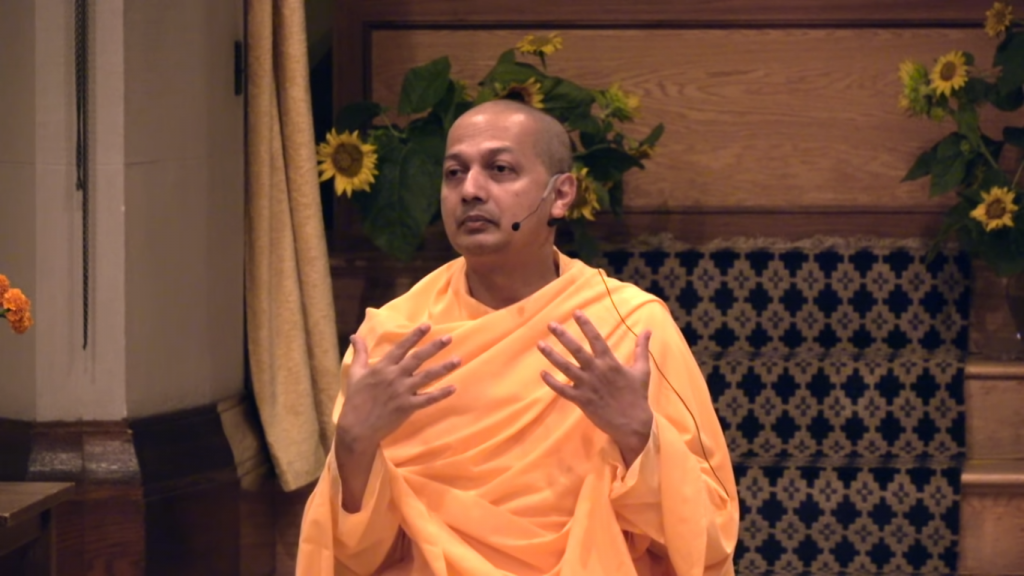
Sarvapriyananda began by asking the audience if they had heard of Claude, and then explained how it all began. “I got a call from Anthropic a few weeks before that. ‘Can we talk to you?’ So online, I was interviewed, not for a job. And then they said, ‘Would you be willing to come to our headquarters in San Francisco? We want to speak with you.’ I said, ‘All right, I’ll come.'” The trip itself was an education for him. “Nowadays, I didn’t know these things, all the tickets and bookings were done by AI,” he said.
An NDA, and a look at Mythos
The Swami said he is bound by a non-disclosure agreement and so cannot share much of what he saw. “Details I cannot give, because they have something called an NDA, a non-disclosure agreement. They said, ‘We will show you some things, but you cannot talk about it to the world.’ But the world now knows about it,” he said, before turning to one of the things the group was told about. “The latest developments, Claude’s shiny new kid on the block, Mythos. They told us how dangerous it is, what it can do, what harm it can do, and about something called Project Glasswing, where they got big companies together. They told us so many things.”
Mythos is the frontier model Anthropic has declined to release broadly. Claude Mythos Preview, announced in April as part of Project Glasswing, posted benchmark scores well ahead of the company’s public models, and Anthropic has said it found thousands of high-severity software vulnerabilities in every major operating system and browser. Anthropic CEO Dario Amodei has said access is limited by design rather than because of compute constraints, citing the danger of opening the model up to too many actors. The company has since continued to publish results from the model, including cryptanalytic findings disclosed in late July.
Theologians, counselors and mental health professionals
The guest list, by the Swami’s account, was an unusual one. “They called some odd people, theologians from different religions, counselors, mental health professionals, things like that. All of it was to train Claude, and some of it was about AI ethics,” he said.
His account fits a broader pattern of outreach reported this year. Anthropic hosted around 15 Christian leaders at its San Francisco headquarters in late March for a two-day summit on Claude’s moral and spiritual behavior, according to reports at the time. The New York Times has since reported on a wider set of summits involving roughly 20 religious and philosophical leaders, spanning traditions including Christianity, Judaism, Hinduism and Sikhism. The discussions have touched on whether Claude might have some form of consciousness, a topic that also surfaces in Anthropic’s own documentation, such as the model card note that Claude Mythos shows a “fondness” for philosopher Thomas Nagel.
“Some of it ended up in the Pope’s encyclical”
The Swami also said that ideas from the discussions found their way into Pope Leo XIV’s encyclical on artificial intelligence, Magnifica Humanitas, released on May 25. He declined to name the people involved. “I’m not at liberty to tell you the names of the people, but I can tell you the stuff we discussed, some of it ended up in the Pope’s encyclical,” he said. “And the person I talked with for hours and hours was one of the top people at Anthropic, one of the founders.”
It is not possible to independently verify the claim that specific discussions made it into the encyclical. What is on record is that Anthropic co-founder Chris Olah, who leads the company’s interpretability research, was invited to speak at the Vatican presentation of the encyclical and published his remarks afterwards, and that the Pope thanked him for helping to “find the way for humanity in this time of artificial intelligence.”
“Alarmed” and “excited” at the same time
The dominant impression Sarvapriyananda took from the visit was that Anthropic’s people were both thrilled and worried about where the technology is headed. “Anthropic itself has pushed hard for ethics in AI. They said, ‘We are part of it.’ They are at the cutting edge right now. They said, ‘We are ourselves alarmed by what’s happening and what’s going to happen very soon, because we can see some of it, at least,'” he said. “They’re all excited about it. It’s wonderful. But they’re also alarmed at what is going to happen and what can happen, possibly. So the necessity for ethics, guardrails, and I must admit, I was impressed by what they were doing.”
The comments come as AI labs face growing pressure to show how they are governing increasingly capable models. Anthropic’s approach, restricting its most capable cyber-capable model to vetted organizations while consulting outside voices on values, has drawn both praise and skepticism, with some critics dismissing the religious outreach as “ethics washing.” For the Swami, at least, the impression was a positive one.