A joint statement endorsed by the Lean FRO and the Mathlib Initiative says the 17-million-line proof states the right theorem, compiles and passes multiple independent proof checkers.
The Riemann Hypothesis appears to have been proved, and the proof was found with an AI model.
On Saturday, the Lean and Mathlib communities published a joint statement on the proof of the Riemann Hypothesis that Anthropic mathematician Levent Alpöge released on November 20. The statement is endorsed by the Lean FRO, the non-profit that develops the Lean proof assistant, and by the Mathlib Initiative, which maintains Lean’s shared library of mathematics. Its verdict is unambiguous: “We have full confidence that Alpöge’s proof of the Riemann Hypothesis is correct.” The statement congratulates Alpöge and formally certifies that both the statement and the proof are correct.
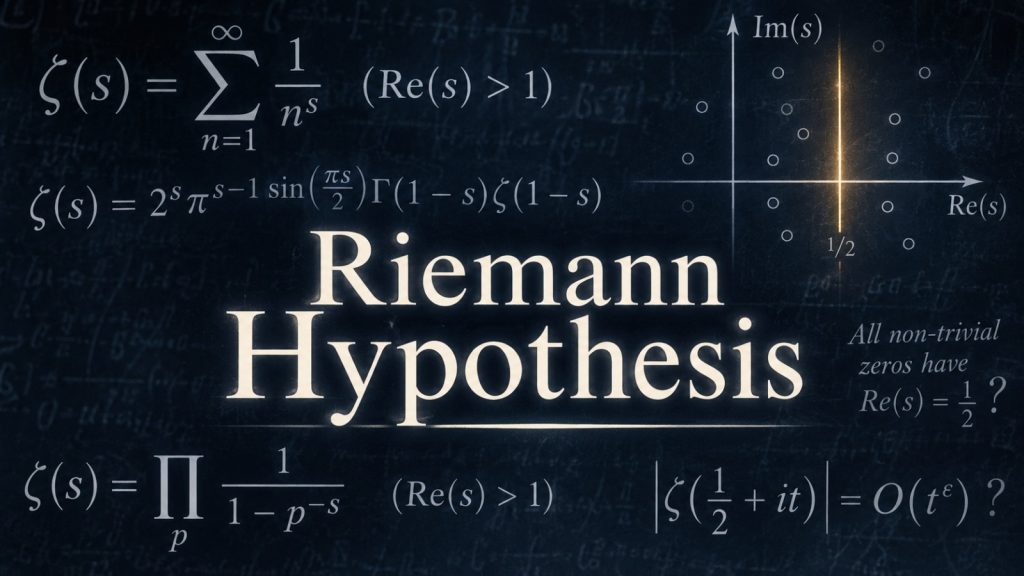
That turns a claim from an unsigned note on a personal website into what is, in practice, a verified result, about a day after it appeared. The note says Alpöge found the proof working with Claude over roughly 41 days.
A 17-million-line proof
The statement puts the scale of the proof in stark terms. Alpöge released it as a Lean library of about 17 million lines of code, which depends directly only on Mathlib. Nobody could check a proof that size line by line. The verification therefore had to rest on making sure that the computer checking was airtight, rather than on people reading the argument.
The statement says that over the past day, the Lean and Mathlib communities rallied to check the proof. It structures its certification around four criteria that a formal proof has to meet before it can be trusted, criteria that Imperial College’s Kevin Buzzard set out on his Xena Project blog earlier this month.
The four checks
The statement is right. The theorem Alpöge’s library proves is Mathlib’s own definition of the Riemann Hypothesis. That definition has been part of the library for some time, and the statement says it was carefully vetted by experts in both Lean and number theory. This rules out the most common failure in formalized proofs: proving something that only looks like the famous problem. It is a real risk. Buzzard found that dozens of the Lean files in OpenAI’s October release of 722 AI-generated manuscripts didn’t state the main theorem of the paper they came with.
The library compiles. The statement says dozens of people reported that the code compiled correctly and reproduced the same raw proof export file, with no errors or build failures. MIT mathematician Andrew Sutherland, who was among the first to compile it, maintains an overview of the verification effort.
The code proves exactly that statement. The community wrote a separate file that isolates the Riemann Hypothesis statement and imports nothing but Mathlib. Two independent tools then confirmed that the theorem in Alpöge’s library matches that statement exactly. This closes off a subtler trick, where a proof quietly redefines terms so that the theorem looks the same but means something different.
The proof is valid. The exported proof was checked by Lean’s official kernel, by two checkers called con-leche and con-ron that come with their own formal guarantees that they can’t accept a false proof, and by several independent checkers from third parties written in different programming languages. All the checkers were run on an inert export of the proof, so that no malicious code hidden in the Lean source files could interfere with them.
According to the statement, the proof passes all four tests.
What the certification does and doesn’t cover
The certification is about the Riemann Hypothesis itself. Alpöge’s note goes further and claims a proof of the Generalized Riemann Hypothesis, and mathematician Elliot Glazer said on day one that the formal statement in the release is GRH. Saturday’s statement, though, certifies Mathlib’s Riemann Hypothesis and doesn’t mention the generalized version.
It also doesn’t give mathematicians what they ultimately want: an understanding of why the hypothesis is true. Alpöge has said the human-readable version would run past 250,000 pages and that he doesn’t fully understand parts of it himself. The statement says the authors look forward to the mathematical community working to explain the new ideas in the proof. That work is only starting, and it could take years. It is exactly the black-box scenario Terence Tao has warned about: mathematics may now know that the Riemann Hypothesis is true long before anyone understands why.
The $1 million Millennium Prize is a separate question. The Clay Mathematics Institute still lists the Riemann Hypothesis as unsolved, and its rules require a solution to be published in a qualifying outlet and to have been generally accepted for two years before any award.
A landmark for AI, and for Anthropic
For Anthropic, the certification is a defining moment, and it comes in the week the company made its stock market debut. Only three months ago, Claude couldn’t prove the Riemann Hypothesis but improved a related bound from 41% to 67%, in work Alpöge helped review. A month ago, Terence Tao suggested AI might solve the Riemann Hypothesis only by around 2050. And OpenAI’s much weaker quasi-Riemann result, released in October, was hailed at the time as a major step.
The result also leaves a priority question open. Hours after Alpöge’s proof appeared, AMS president Ravi Vakil rushed out a separate “all human” proof of the Generalized Riemann Hypothesis by Alessandro Masullo, which Stanford’s Brian Conrad had been reviewing for months. That proof hasn’t been formally verified yet. Not everyone is celebrating, either. The Association for Human Mathematics has said it is gravely concerned about what the proof represents.
Still, in the narrow sense that matters most, the question first posed by Bernhard Riemann in 1859 now has a machine-verified answer. It came from a Harvard-trained number theorist working with an AI model, and was confirmed by an open-source community of mathematicians and programmers in about a day.