The Riemann Hypothesis went unsolved for 167 years. According to the timeline in the note claiming a proof, which appeared on Anthropic mathematician Levent Alpöge’s website on Friday, the final push took 41 days.
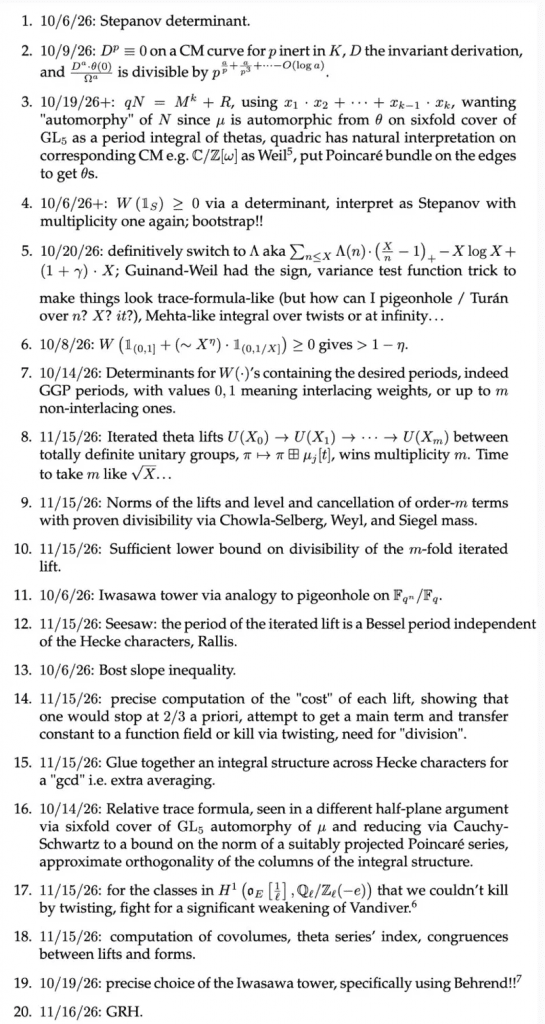
The note says Alpöge found the proof working with Claude, and that the method also proves the Generalized Riemann Hypothesis. It ends with a 20-step timeline of the key moments in the argument, each with a date. The earliest entries are dated October 6, 2026. The last, which simply reads “GRH,” is dated November 16. That is 41 days from start to finish.
The proof has not yet been independently verified. It has been released only as Lean code, and Lean experts are still checking it. But if it holds up, the timeline offers a rare look at how quickly a human working with a frontier AI model can now move on a problem that has defeated generations of mathematicians.
Week one: the foundations, all in a few days
The first week was packed. Four of the twenty steps are dated October 6 alone. They include a “Stepanov determinant,” the idea that anchors the whole approach, along with a nonnegativity bound obtained through a determinant, an analogy with a counting argument over finite fields, and an inequality from arithmetic geometry known as the Bost slope inequality.
Stepanov’s method is a technique that proves the analogue of the Riemann Hypothesis in the simpler world of “function fields.” It works by building an auxiliary function that vanishes to a very high order, which mathematicians call multiplicity. The October 6 entries show the strategy taking shape on day one: bring that method over to ordinary integers, where it had never worked before.
Two more steps followed within days. On October 8 came a bound that gives a result greater than one minus a small error. On October 9 came a vanishing statement on a special kind of curve, with a precise divisibility bound.
Mid-October: building the machinery
The next stretch was about adding structure. On October 14, the timeline records determinants involving a class of objects known as GGP periods, and a relative trace formula, a heavy tool from the theory of automorphic forms. On October 19 came a key identity tying the problem to theta functions, and a specific choice of Iwasawa tower using a trick from Behrend. On October 20, the timeline records a decisive switch to a weighted sum over primes, along with a note of open questions about how to finish the argument.
The quiet gap, then a one-day breakthrough
After October 20, the timeline goes silent for nearly four weeks. No steps are dated between October 21 and November 14.
Then comes November 15. Eight of the twenty steps, 40% of the timeline, are dated to that single day.
The most important is the idea the note treats as the turning point: a chain of iterated “theta lifts” between unitary groups. Each lift adds one unit of multiplicity, so a long chain does what derivatives do in the function-field setting, and the chain is made roughly as long as the square root of the size of the primes being counted. Alongside it on November 15 come estimates on the size of the lifts, a lower bound on their divisibility, an identity showing that the relevant quantity doesn’t depend on certain characters, a calculation of the “cost” of each lift, a way to glue the structure together, an attack on a weakened form of the Vandiver conjecture, and a set of covolume and congruence computations.
The next day, November 16, the timeline’s final entry reads simply “GRH.”
Was it really AI that solved it in 41 days?
It is tempting to say that AI solved the Riemann Hypothesis in 41 days, but the note itself supports a more careful version.
It describes the work as a collaboration. It credits Claude heavily, saying the model far outpaced Alpöge near the end, supplied key steps including the length of the theta-lift chain, and handled the automorphic forms on higher-rank groups that Alpöge says he has not mastered. It also says Alpöge steered the work toward the right analogy, and it presents the result as the culmination of his own long engagement with the problem. Mathematicians reacting online have made the same point, with some arguing that Alpöge deserves as much credit as Claude.
The 41 days also measure only what the timeline records. Alpöge didn’t start from zero on October 6. Earlier this year he was one of the Anthropic mathematicians who reviewed Claude’s improvement of a Riemann-related bound from 41% to 67%, and the note mentions other earlier work that shaped his thinking.
The note is open about the timeline’s limits, too. It says Claude compiled the timeline, describes it as rough, and warns that the descriptions of the parts where Claude is the expert are paraphrased from an AI summary and might not make sense. Some entries carry a “+” after the date, which suggests work that continued past the day listed.
Why the speed matters
The pace is in line with the rest of this year in AI mathematics. In September, OpenAI said its agents produced a Navier-Stokes blow-up proof in about 88 hours. Earlier this year, Alpöge used Claude to disprove the Jacobian conjecture. And in October, Claude independently disproved the Exponential Time Hypothesis on October 16, during the very weeks this timeline covers.
But the Riemann Hypothesis is in a different category. It is the most famous open problem in mathematics, a Millennium Prize Problem, and the foundation for thousands of results that are currently proved only conditionally. If 41 days of human-AI work really settled it, along with its generalized form, it would be the clearest sign yet that the bottleneck in mathematics is shifting from finding proofs to checking and understanding them.
That shift is already causing friction. The argument is so long that the note jokes the informal draft ran past 250,000 pages, and no human-readable version exists. That is the kind of black-box result Terence Tao has warned about. It took 41 days to produce the proof, if it is one. Understanding it could take mathematicians far longer.