After some time in the wilderness following the failure of Llama 4, Meta is firmly back in the AI race.
Meta’s newly released Muse Spark 1.3 has scored 61 on the Artificial Analysis Intelligence Index, the benchmarking firm’s composite score built from evaluations spanning knowledge work, agentic tasks, coding, and scientific reasoning. The score puts Muse Spark 1.3 (xhigh) in a tie with Grok 4.6 (high) and GPT-5.6 Sol (max), and just one point behind GPT-5.6 Sol (high fallback) and Claude Opus 5 (max), both at 63, and well within range of the current leader, Claude Fable 5.1 (max with fallback), at 66.
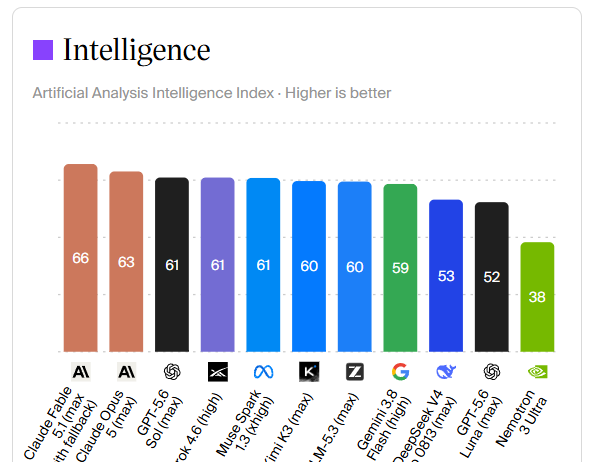
It’s a big jump for Meta. Muse Spark 1.2 had scored 57 on the same index a month ago, itself a climb from Muse Spark 1.1’s 51 and the original Muse Spark’s 43 back in April. The 4-point gain from 1.2 to 1.3 is the largest single jump the model family has posted between releases, and it’s enough to lift Meta from the “next tier down” cluster it had occupied since August into a genuine tie with the frontier field.
Where The Score Sits
Artificial Analysis’s chart places ten models in a tight band near the top. Claude Fable 5.1 (max with fallback) leads at 66, followed by Claude Opus 5 (max) at 63. Muse Spark 1.3 (xhigh) then ties for third at 61 with GPT-5.6 Sol (max) and Grok 4.6 (high). Just below that sit Kimi K3 (max) and Z.AI’s GLM-5.3 (max), both at 60, followed by Google’s Gemini 3.8 Flash (high) at 59, DeepSeek V4 Pro 0813 (max) at 53, GPT-5.6 Luna (max) at 52, and Nvidia’s Nemotron 3 Ultra trailing at 38.
The result puts Meta ahead of every Google model on the chart and effectively level with OpenAI and xAI’s current top offerings, a notable turnaround for a lab that was scoring in the low 50s as recently as August with Muse Spark 1.2. It still trails Anthropic’s two frontier models, Opus 5 and Fable 5.1, though the gap to Opus 5 is now down to just 2 points.
Speed: Muse Spark 1.3 Is The Second-Fastest Model On The Chart
On raw output speed, Muse Spark 1.3 (xhigh) generates 235 output tokens per second, second only to Google’s Gemini 3.8 Flash (high) at 305 tokens per second. That’s a large gap over the rest of the field — GPT-5.6 Luna (max) manages 120 tokens per second, Nemotron 3 Ultra runs at 115, and the pack of models clustered near Muse Spark 1.3 on intelligence is considerably slower: GPT-5.6 Sol (max) at 70 tokens per second, Claude Fable 5.1 (max with fallback) at 66, GLM-5.3 (max) at 63, DeepSeek V4 Pro 0813 (max) at 62, Claude Opus 5 (max) at 56, Grok 4.6 (high) at 54, and Kimi K3 (max) trailing at just 38.
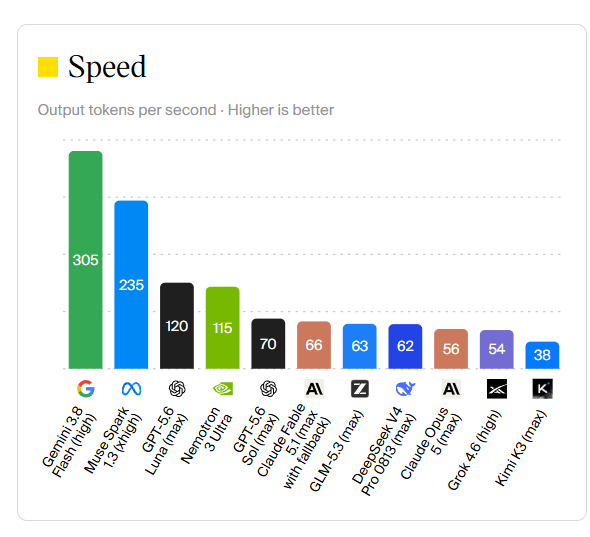
That combination is notable: Meta’s model matches or beats Opus 5, Fable 5.1, GPT-5.6 Sol, and Grok 4.6 on intelligence while running four to six times faster than most of them. For any workload where latency matters — interactive agents, real-time coding assistance, high-volume API use — that speed advantage compounds quickly.
Cost: Muse Spark 1.3 Remains Firmly Mid-Pack On Price
On weighted average cost per Intelligence Index task, Muse Spark 1.3 (xhigh) comes in at $0.55, up slightly from Muse Spark 1.2’s $0.40 but still well below the two Anthropic models it now matches or nearly matches on intelligence. Claude Opus 5 (max) costs $2.34 per task and Claude Fable 5.1 (max with fallback) costs $3.69, meaning Meta’s model is running at roughly a quarter of Fable 5.1’s price for a score just 5 points lower, and at less than a quarter of Opus 5’s price for a score 2 points lower.
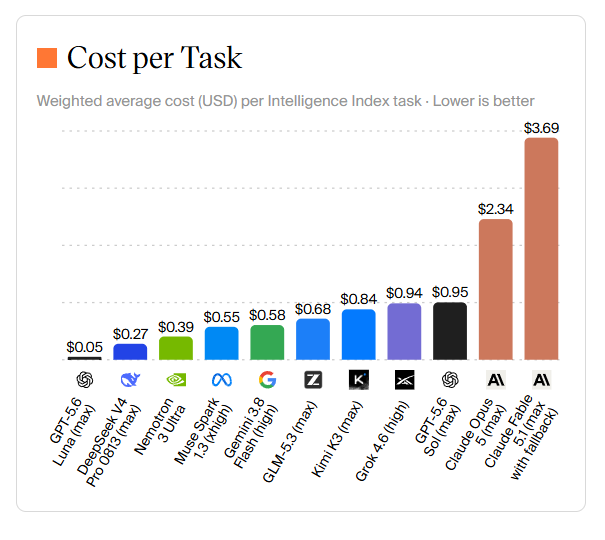
Against the rest of the field, Muse Spark 1.3 sits in the middle of the pack on cost. GPT-5.6 Luna (max) is the cheapest tracked model at $0.05 per task, followed by DeepSeek V4 Pro 0813 (max) at $0.27 and Nemotron 3 Ultra at $0.39 — all scoring meaningfully lower on intelligence. Gemini 3.8 Flash (high) costs $0.58, just above Muse Spark 1.3, while GLM-5.3 (max) costs $0.68, Kimi K3 (max) costs $0.84, Grok 4.6 (high) costs $0.94, and GPT-5.6 Sol (max) costs $0.95 — all more expensive than Muse Spark 1.3 despite scoring the same or lower.
Put together, the three charts describe a model that has closed the intelligence gap to the frontier almost entirely, kept its speed advantage from earlier Muse Spark releases, and holds a price roughly in line with mid-tier models — a combination that, if it holds up under independent use, makes Muse Spark 1.3 one of the more practically attractive options in the current field rather than just a benchmark-chart curiosity.
Meta’s rapid cadence continues to stand out here too. This is the fourth Muse Spark release in five months — following the original Muse Spark in April, Muse Spark 1.1 in July, and Muse Spark 1.2 in August — and each one has closed the gap to the frontier a little further, with 1.3 marking the first release where Meta is genuinely tied with, rather than trailing, OpenAI and xAI’s top models.