Meta is making a strong comeback in the AI race — a day after the company had released two very capable video and image models, it’s now rolled out an impressive new general-purpose model named Muse Spark 1.1.
Muse Spark 1.1 is a multimodal reasoning model from Meta Superintelligence Labs, and Meta is calling it a significant upgrade over the original Muse Spark that the company released a few months ago. The headline improvements are in tool use, computer use, coding and multimodal understanding, all areas where the first Muse Spark had fallen behind rivals from Anthropic, OpenAI and Google. The model is live now in “Thinking” mode inside the Meta AI app and on meta.ai, and Meta has also opened a public preview of a new Meta Model API so developers outside the company can build with it for the first time.
The model can apparently manage a context window of one million tokens on its own, deciding what to remember, what to retrieve from earlier in a session, and what to compress when things get long. Meta says this is central to how Muse Spark 1.1 handles agentic work, where it acts as a main agent that plans and delegates, and spins up parallel subagents that know when to execute on their own and when to escalate a problem back up.
Muse Spark 1.1 Benchmarks
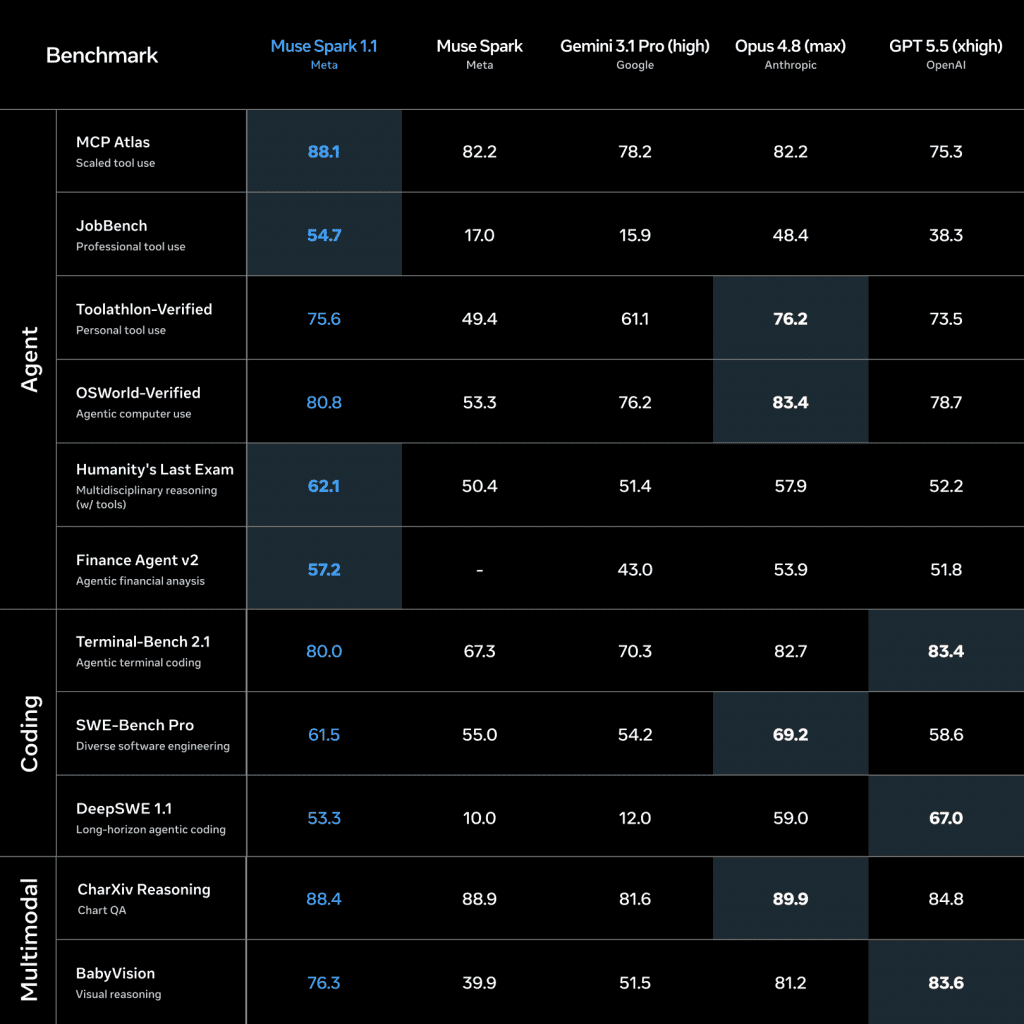
Meta released a fairly detailed benchmark table comparing Muse Spark 1.1 against the original Muse Spark, Gemini 3.1 Pro, Claude Opus 4.8 and GPT 5.5, split across agent, coding and multimodal categories.
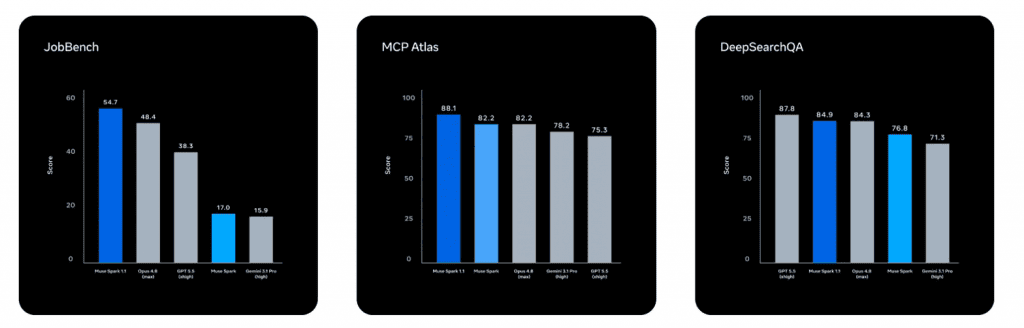
On the agentic side, Muse Spark 1.1 posts some of its strongest numbers. It scores 88.1 on MCP Atlas, a test of scaled tool use, ahead of Opus 4.8 and GPT 5.5, both of which sit in the high 70s and low 80s. On JobBench, which measures professional tool use, Muse Spark 1.1 scores 54.7 against Opus 4.8’s 48.4 and GPT 5.5’s 38.3 — a wide enough gap that it’s the standout result in the entire release. It also leads on Humanity’s Last Exam with tools (62.1, ahead of Opus 4.8’s 57.9) and on Finance Agent v2, an agentic financial analysis benchmark, where it scores 57.2 against Opus 4.8’s 53.9 and GPT 5.5’s 51.8.
The picture flips on a couple of other agentic tests. On Toolathlon-Verified, a personal tool use benchmark, Opus 4.8 edges ahead at 76.2 versus Muse Spark 1.1’s 75.6. And on OSWorld-Verified, which measures agentic computer use, Opus 4.8 leads more clearly at 83.4 against Muse Spark 1.1’s 80.8.
Coding is where the newer model shows the least separation from its rivals. On Terminal-Bench 2.1, Muse Spark 1.1 scores 80.0, behind both GPT 5.5 (83.4) and Opus 4.8 (82.7). SWE-Bench Pro follows a similar pattern, with Opus 4.8 out front at 69.2 against Muse Spark 1.1’s 61.5. On DeepSWE 1.1, a long-horizon agentic coding benchmark, GPT 5.5 leads at 67.0, with Opus 4.8 at 59.0 and Muse Spark 1.1 trailing at 53.3 — though still a large jump from the original Muse Spark’s score of 10.0 on the same test.
Multimodal scores tell a similar story of incremental gains rather than outright leadership. On CharXiv Reasoning, a chart understanding benchmark, Muse Spark 1.1 scores 88.4, just behind Opus 4.8’s 89.9 and roughly in line with the original Muse Spark. On BabyVision, a visual reasoning test, it scores 76.3, behind GPT 5.5 (83.6) and Opus 4.8 (81.2), but a sizeable jump over the first Muse Spark’s 39.9.
Meta also published a chart plotting OSWorld 2.0 scores against cost per task, and this is where Muse Spark 1.1 makes its strongest case. At roughly the same price point, it scores well above Gemini 3.1 Pro and GPT 5.5, and it reaches a score in the high 40s at a fraction of what Opus 4.8 costs to run at its own top score in the mid 50s. On Meta’s own internal benchmark, described as its primary coding evaluation, Muse Spark 1.1 scores 68.3, just behind Opus 4.8’s 69.0 and just ahead of GPT 5.5’s 67.1 — and nearly ten points clear of the original Muse Spark’s 58.8.
Agentic and computer use
Meta says Muse Spark 1.1 zero-shot generalizes to new native tools, MCP servers and custom skills, and that it’s been trained specifically to orchestrate multi-agent systems for lower end-to-end latency on complex projects rather than reasoning through every step sequentially. The company demoed this with an agentic dinner party organization task, where the model adapts an order in real time as new information about the event comes in, without needing the user to step back in.
On computer use, Meta says the model has learned when to write and run a script versus when to just click through an interface directly, and that it can generate batches of actions per step instead of reasoning one click at a time. A separate demo showed the model using a smartphone video to pull product photos and details, then operating a browser to list the item on Facebook Marketplace on the user’s behalf.
Coding and safety
Meta says the coding gains come largely from real-world tasks on large, complex codebases — diagnosing bugs, shipping features into enterprise systems, and running large migrations. The model is built to work across popular agentic coding harnesses, supporting planning mode, subagent delegation and context compaction. In one demo inside OpenCode, Muse Spark 1.1 builds a chat app, takes screenshots to catch user-facing bugs, traces them back through the code, and fixes and validates the changes on its own.
On safety, Meta says it ran Muse Spark 1.1 through its Advanced AI Scaling Framework, and that the model stayed within safe margins across chemical and biological, cybersecurity, and loss-of-control risk categories, alongside stronger resistance to jailbreaks and prompt injection attacks, and lower hallucination and sycophancy rates than its predecessor.
The release comes on a particularly crowded day for model launches — SpaceXAI and Cursor put out Grok 4.5 earlier today with its own set of claims against Opus 4.8 and GPT 5.5, underlining just how fast the frontier is moving right now, with several labs releasing models that beat each other on select benchmarks within hours of one another.