After some harsh reviews from early testers, an independent leaderboard has given OpenAI’s new flagship a less than flattering result.
On the Vals Index, GPT-6.2 Astra scores 67.66%, placing 7th. That puts it behind Claude Fable 5.2, Claude Sonnet 5.5, Gemini 4 Carbon and Claude Opus 5.5, and also behind Google’s older Gemini 4 Argon and its new low-cost Gemini 4 Hydrogen. GPT-6.2 Sol places 9th with 66.06%, only 1.6 points behind Astra.
The top six spots on the Vals Index all belong to Anthropic and Google. OpenAI’s best model sits below Gemini 4 Hydrogen, which Google released last week as a fast, low-cost member of the Gemini 4 family.
What Is The Vals Index?
The Vals Index is published by Vals AI, a San Francisco evaluation startup founded in 2023 by Stanford computer science graduates Rayan Krishnan (CEO) and Langston Nashold (CTO). The company builds independent benchmarks that test AI models on real professional work and sells evaluations to AI labs and enterprises. Its results have been cited in model cards from OpenAI, Anthropic, Google, Meta and xAI. Earlier this year, Vals raised a $40 million Series A led by Andreessen Horowitz at a reported $400 million valuation.
Rather than a single exam-style test, the Vals Index is a composite of agentic tasks in four economically important fields: finance, coding, legal and tax. Each field is weighted by its approximate share of US GDP. According to the published formula, finance carries the largest weight, followed by coding, with legal and tax weighted much lower.
Finance alone accounts for more than half of the index, and legal for under a tenth. Vals keeps private test sets to stop models from being trained on its evaluations, and it retires benchmarks once top models saturate them.
The index has become a regular reference in frontier model launches. Google cited it when it introduced Gemini 4 Argon, which briefly ranked first, and again when Gemini 4 Carbon posted 70.4% at launch.
Vals Index Top 10
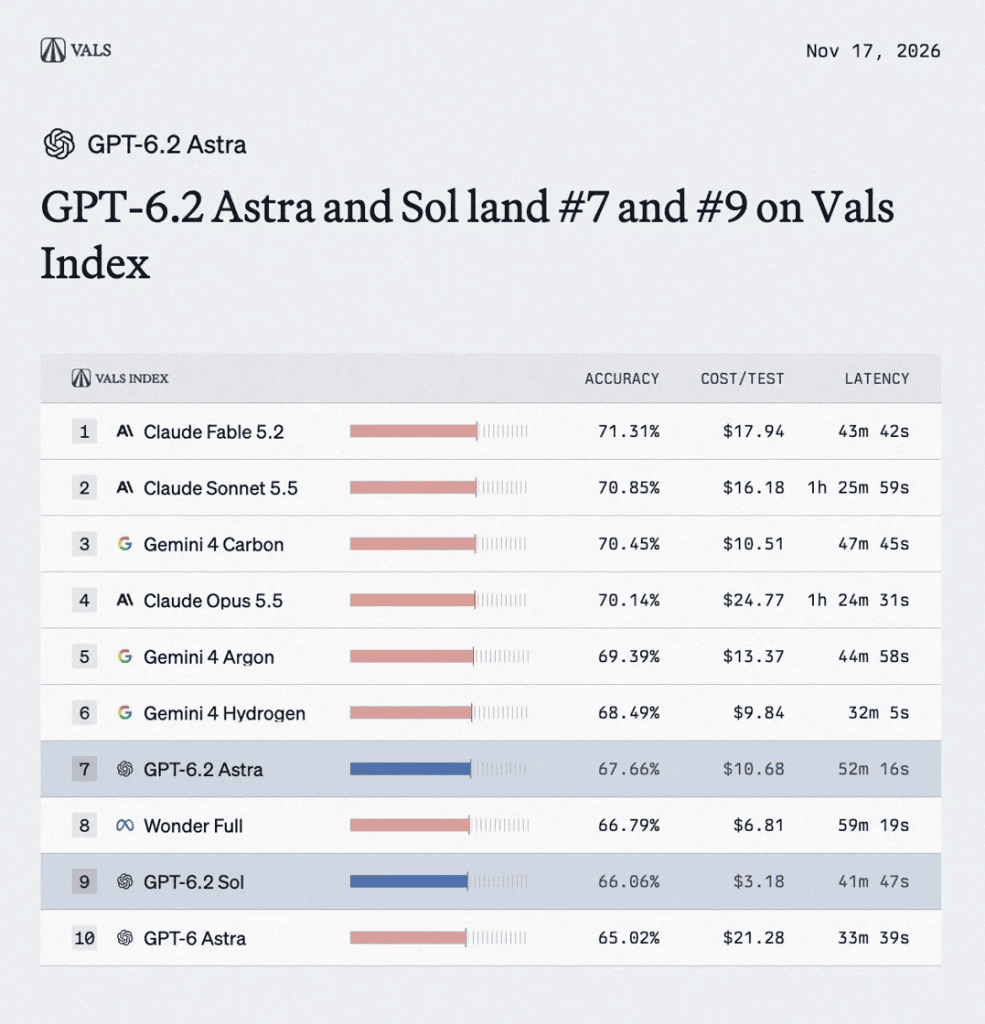
The field is tightly bunched: just 6.3 points separate first and tenth. GPT-6.2 Astra trails leader Claude Fable 5.2 by 3.65 points.
The comparison with Google is the awkward one for OpenAI. Gemini 4 Carbon scores 2.8 points higher than GPT-6.2 Astra at a slightly lower cost per test ($10.51 vs $10.68). Gemini 4 Hydrogen, Google’s budget model, also beats Astra by almost a point while costing less and finishing faster.
Where GPT-6.2 Does Better: Cost
The picture improves once cost is factored in.
At $3.18 per Vals Index task, GPT-6.2 Sol is the cheapest model in the top 10. It costs less than a third as much as GPT-6.2 Astra, less than half as much as Meta’s Muse Wonder Full ($6.81), and less than a fifth as much as Claude Fable 5.2. It is also within about 5 points of Fable 5.2’s score.
GPT-6.2 Astra is a clear improvement on its predecessor. It scores 2.6 points higher than GPT-6 Astra at about half the cost ($10.68 vs $21.28). Vals says it also uses the fewest output tokens of any top-10 model, averaging 91,000 per task. That fits OpenAI’s launch pitch that the 6.2 models deliver better results with fewer output tokens.
Speed is less impressive. GPT-6.2 Astra takes 52 minutes 16 seconds per test, about 19 minutes longer than GPT-6 Astra. Among the top 10, only the two Claude 5.5 models and Muse Wonder Full are slower.
Breakdown By Domain
Vals says the results vary much more by domain than the close overall scores suggest.
Science. GPT-6.2 Astra is the new No. 1 on the Vals Science Index. It also ranks first on Terminal-Bench Science and on VCB 1–100, costing about half as much per test as GPT-6 Astra and finishing in about half the time. GPT-6.2 Sol ranks third on Terminal-Bench Science at about a quarter of Astra’s cost. This matches Artificial Analysis’s finding that science is the 6.2 models’ strongest area. The Science Index is not part of the Vals Index calculation.
Coding. On Terminal-Bench 4, one of the coding components of the index, Astra ranks 5th and Sol 7th. That is solid but not leading, which is in line with Artificial Analysis’s Coding Agent Index, where GPT-6.2 Astra showed no improvement over GPT-6 Astra.
Legal. Legal is where the base models fall well short. On HLAB (Harvey’s legal agent benchmark), Astra and Sol roughly double their predecessors’ scores, but still rank only 11th and 21st. On Legal Research, they rank 30th and 52nd.
That contrasts with OpenAI’s own launch charts, where GPT-6.2 Astra more than doubled Claude Fable 5.2’s pass rate on the Harvey LAB-AA v1.1 variant. Vals’ independent HLAB run shows the gains, but not a leading position.
Astra For Law Ranks 6th On Legal Research
OpenAI has also launched Astra for Law, a specialised configuration of GPT-6.2 Astra for lawyers. Vals says it scores much higher than the base model on its Legal Research benchmark, ranking 6th overall compared with the base model’s 30th.
That gap suggests a lot of the base model’s weakness in legal work comes from setup rather than raw capability. But the Vals Index scores the general-purpose model, so the specialised version does not help Astra’s overall ranking. Legal also carries only a small weight in the index.
More Tool Calls, Shorter Answers
Vals also noticed a change in how the new models work. GPT-6.2 Astra and Sol make almost twice as many tool calls as their predecessors but write shorter final answers.
That is consistent with what other evaluators have found. Artificial Analysis traced GPT-6.2 Sol’s three-point drop on its Coding Agent Index to a 14-point fall on SWE-Atlas-QnA-AA, where the new Sol was more likely to leave key facts out of its answers. On benchmarks that reward complete written deliverables, such as legal research memos, more concise answers can cost points.
What It Means
Two independent leaderboards, released a day apart, rank the same model very differently. On the Artificial Analysis Intelligence Index, which leans heavily on science, knowledge and reasoning, GPT-6.2 Astra is second. On the Vals Index, which is weighted towards finance and coding work and scored by GDP share, it is seventh, behind all three Gemini 4 models.
The Vals Index has also been more favourable to Anthropic and Google all along. GPT-6 Astra sat at 65.0% when Gemini 4 Carbon launched at 70.4%, and the 6.2 upgrade has narrowed that gap without closing it.
For enterprise buyers, the takeaway is less about rankings than value. GPT-6.2 Sol delivers about 93% of Fable 5.2’s Vals Index score at less than a fifth of the cost. GPT-6.2 Astra now leads on science, and the Astra for Law configuration suggests OpenAI plans to compete in professional domains with specialised versions rather than relying on the general model alone.