Seven weeks ago, OpenAI claimed its internal model had found a dramatically faster theoretical way to multiply matrices. Now it says it has proved that nobody can ever do better.
In a new preprint titled simply “The matrix multiplication exponent is nine fourths,” posted to its public openai/math repository on November 24, OpenAI claims to have proved that the exponent of matrix multiplication, a number computer scientists call ω (omega), is exactly 9/4, or 2.25. That is true over every field, meaning every number system you might do the arithmetic in. If the proof holds, it settles a question that has been open since Volker Strassen kicked off the field in 1969. It also kills one of the most cherished conjectures in theoretical computer science: that ω might be 2.
What the number means
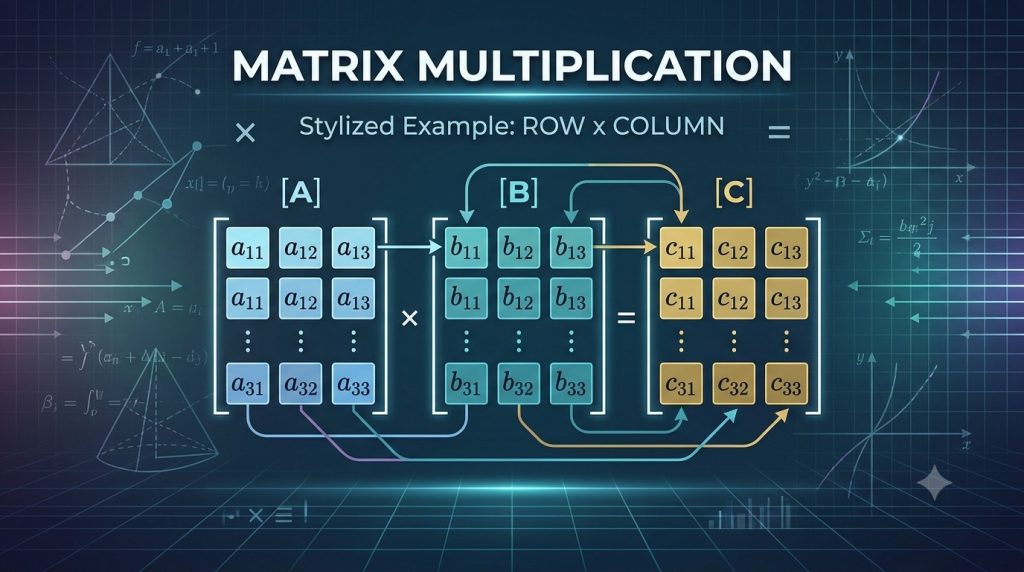
Multiplying two n×n matrices the schoolbook way takes about n³ multiplications. Double the size of the matrices and the work goes up eightfold. Matrix multiplication is also the math that underpins all of modern AI. Every layer of a neural network, in both training and inference, comes down to multiplying very large grids of numbers.
In 1969 Strassen showed that a clever trick with seven products instead of eight could beat n³. That set off a race to lower the exponent that has now run for more than five decades. Researchers chipped away for decades, often by a few thousandths at a time, and got it to roughly 2.371. Google DeepMind’s AlphaEvolve made headlines both for helping lower the theoretical bound and for finding a way to multiply 4×4 complex matrices with 48 multiplications.
The lower end of the range was even less settled. Since you have to at least read and write n² numbers, ω can’t be below 2. Beyond that trivial floor, nobody had proved anything. Many researchers suspected the true answer was 2, which would mean matrices could, in principle, be multiplied almost as fast as you can write them down.
Closing the gap from both sides
The new paper is the second half of a two-part story. In early October, as part of the huge batch of mathematical results OpenAI released from an unreleased internal model, the company posted a paper claiming ω ≤ 9/4 over the complex numbers. That was the biggest jump in the field in decades. Human mathematicians quickly picked it up. Houxi Lü extended a key step to arbitrary characteristic, and Alimzhan Amanov, Maxim van den Berg and Jeroen Zuiddam produced an exposition that proved the 9/4 upper bound over every field.
The November paper proves the matching lower bound. Its central claim is that the exponent is exactly 9/4 over every field. No algorithm, however clever, can multiply n×n matrices with O(n^s) operations for any s below 2.25.
The paper also gives a concrete floor at every matrix size, not just in the limit. For every n ≥ 2, any arithmetic circuit that multiplies two n×n matrices needs at least ⌈n^(9/4)/2⌉ multiplication or division gates, even if additions are free. A bilinear algorithm, the kind Strassen’s trick uses, needs at least ⌈n^(9/4)⌉ products. For 1,024×1,024 matrices, that works out to about 5.9 million products, compared with roughly 1 million for the trivial bound and about 1.07 billion for the schoolbook method.
In the language of tensors, which is how specialists study the problem, the paper shows that the geometric border rank of the matrix multiplication tensor is at least n^(9/4) and that its asymptotic rank is exactly n^(9/4). Before this, the best known concrete lower bounds on the rank were only a constant multiple of n², such as Markus Bläser’s 5/2·n² − 3n and J.M. Landsberg’s 3n² − o(n²).
The result extends to rectangular matrices too. The paper shows that the “dual exponent” α, which measures how lopsided a matrix product can be while still running in roughly n² time, lies between 1/2 and 2/3. The accompanying Lean scope document goes further and states that α is exactly 1/2, along with a closed-form formula for the exponent of every rectangular shape.
The paper also says the result refutes a prediction Strassen made in 1994 about “tight” tensors. That conjecture would have implied an asymptotic rank of n² for the matrix multiplication tensor. The paper also notes that its bound conflicts with an upper estimate proposed in the first version of a recent arXiv preprint.
How the proof works
Lower bounds in complexity theory are notoriously hard, because you have to rule out every possible algorithm and not just the ones people have thought of. The 111-page paper takes an unusual route.
It argues by contradiction. Suppose some algorithm beat 9/4 by any fixed amount. The paper shows that such an algorithm could be used to compress a certain kind of tensor network far more than should be possible. A tensor network is a web of small components wired together. Repeated compression would make it absurdly cheap to test whether every entry in a list of binary words is distinct. A separate result proves that this test can’t be that cheap, even when many lists are handled at once. So the faster algorithm can’t exist.
The geometric heart of the argument treats the price of a tensor like a distance, so a matrix product looks like a triangle of three wires. The paper ties the number 9/4 to a specific shape: a tripod with three unit-length arms. The distance between any two tips is 2, giving a perimeter of 6, and dividing 6 by a “shared-label rate” of 8/3 gives exactly 9/4. A companion paper, “Euclidean geometry in the asymptotic spectrum of tensors,” posted the same day, supplies that geometric framework.
The paper is one of nine manuscripts OpenAI added on November 24. The rest include claimed circuit lower bounds for Hamiltonian cycle and the permanent, which OpenAI says subsume the VP ≠ VNP proof it posted hours after Anthropic’s Claude posted its own. There are also papers on strongly polynomial-time linear programming and an exponential bound for the sunflower problem.
The caveats
This is a preprint, and nobody has peer reviewed it. OpenAI’s own repository describes its manuscripts as “raw research data” rather than polished papers, and warns that unformalized results could have issues. Experts including Terence Tao have cautioned that AI-generated proofs can look flawless while hiding subtle mistakes.
There is a Lean formalization, which is a big point in the result’s favour. But its scope is slightly narrower than the paper’s. The Lean development proves the 9/4 exponent for division-free circuits computing formal polynomial identities, while the paper’s main theorem also covers circuits that are allowed to divide. Strassen showed in 1973 that divisions can usually be eliminated for problems like this one, but the formal check and the written claim still aren’t identical.
The result also changes nothing in a data center tomorrow. GPUs multiply matrices the schoolbook way, or with a level or two of Strassen-style tricks, because the asymptotically faster algorithms only pay off at astronomical sizes. Nothing is going to train faster because of this.
Why it matters anyway
The paper settles where the floor is. For decades, the hope that ω = 2 has sat in the background of theoretical computer science and quietly shaped expectations about how cheap linear algebra might eventually get. If OpenAI’s proof is right, that hope is gone. Arithmetic matrix multiplication carries an unavoidable extra quarter power of n on top of the cost of writing down the answer. A huge number of algorithms, from graph problems to the lattice-sieving methods used to attack post-quantum cryptography, inherit their running times from ω. All of them now have a definite answer about how far fast matrix multiplication can take them.
The speed is just as striking. A question that had resisted the field’s best minds since 1969 went from “somewhere between 2 and about 2.371” to a claimed exact answer in roughly seven weeks, with a machine finding both the algorithm and the proof that it can’t be beaten. Over the same stretch, AI labs have posted claimed proofs that the Exponential Time Hypothesis is false, that VP ≠ VNP, and a claimed solution to the Navier-Stokes problem. The open problems of theoretical computer science are now being claimed faster than the human community can check them. Mathematicians’ ability to verify that work may soon be the real bottleneck.