Anthropic isn’t exactly peaking ahead of its much-anticipated IPO.
For the first time since the week of February 26, 2024, OpenRouter users spent more money on OpenAI’s models than on Anthropic’s in a single week, according to the platform’s own weekly wallet-share data. The flip happened in the week of September 7, 2026, when OpenAI models pulled in just over half of the combined dollar spend between the two labs, edging past Anthropic’s Claude family for the first time in more than two and a half years.
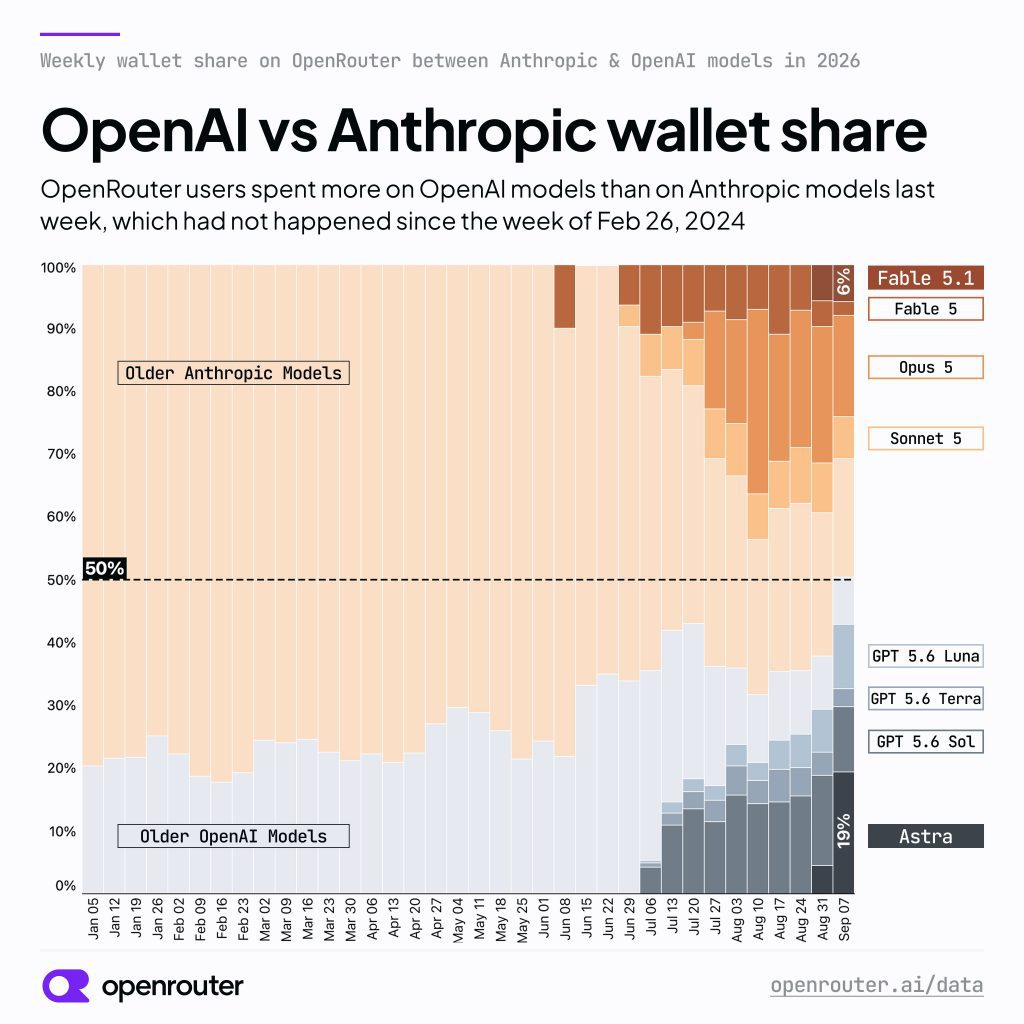
The shift is notable because it’s measured in dollars, not tokens. OpenRouter’s wallet-share chart tracks how much developers and enterprises actually pay for each provider’s models — a different signal from raw token volume, where cheaper models can rack up huge counts without matching revenue. Anthropic’s models carry premium pricing, so losing wallet share, rather than just usage share, is the more direct read on where paying customers are putting their money.
How the gap closed
Anthropic held a comfortable and fairly stable majority of combined spend through most of 2024 and 2025, generally sitting in the 75-80% range against OpenAI’s older models. That lead started eroding visibly in the summer of 2026. OpenAI’s newer “GPT 5.6” line — split across Luna, Terra, and Sol variants — began climbing through July, and the launch of a model called Astra in August accelerated the move further. By the week of August 10, Anthropic’s share had already dipped as low as the high 50s before partially recovering.
Anthropic wasn’t standing still on its side either. Claude Fable 5 launched into the mix over the summer, followed by Fable 5.1, which Anthropic positions as a broad upgrade over its predecessor, particularly for agentic coding and long-running agentic workflows. But the combined pull of OpenAI’s four-model lineup proved too strong to hold back in the most recent week, with Astra alone accounting for roughly 19% of total spend and OpenAI’s newer models collectively pushing past the 50% mark.
A reversal of a longer-running story
The OpenRouter flip cuts against the narrative that’s dominated coverage of the Anthropic-OpenAI rivalry for most of 2026. Ramp’s business-spending data showed Anthropic’s share of combined OpenAI-and-Anthropic business subscription spend climbing from roughly 10% in early 2025 to over 65% by February 2026, with Anthropic particularly dominant among the most AI-sophisticated sectors and VC-backed companies. That data source measures corporate subscription spend rather than pay-as-you-go API usage, which is the more direct comparison to what OpenRouter tracks — so the two datasets aren’t necessarily in conflict, but they do point to different parts of the market moving in different directions at the same time.
It’s also worth noting that OpenRouter itself has become a bigger prize than just a leaderboard. Stripe has acquired OpenRouter for more than $7 billion, turning what was once a niche developer routing layer into a strategically valuable window on enterprise AI spending across every major provider.
The broader OpenRouter ecosystem, meanwhile, has been reshaped this year less by the OpenAI-Anthropic rivalry than by Chinese open-weight models. US models’ combined share of token volume on OpenRouter fell from around 70% to roughly 30% between June 2025 and June 2026, with DeepSeek and other Chinese labs absorbing most of the difference. That collapse is measured in token volume rather than dollars, though, and it’s a useful reminder that “OpenAI vs Anthropic” wallet share is really a fight over a shrinking slice of a platform where cheap, high-volume open-weight models increasingly set the pace on raw usage — even as premium closed models like Claude and GPT continue to capture an outsized share of the revenue.
Whether OpenAI’s latest models can hold onto their newly won majority of OpenRouter wallet share, or whether this turns out to be a one-week blip before Anthropic’s Fable line claws back share, should become clearer over the next few weekly updates.