OpenAI has talked about how having an automated AI researcher was on its roadmap, and it’s shown the first glimpses of that with its new release.
Alongside the GPT-5.6 launch, OpenAI published a screenshot of an actual prompt one of its researchers used to get Sol to train Luna — not a mocked-up example, but what looks like a real message sent to the model as part of setting up a training run. Large portions of the text are redacted, covering internal repo names, config paths, and compute details OpenAI clearly isn’t ready to make public, but what’s left visible is a fairly complete picture of how a researcher hands off actual training infrastructure work to a model.
What The Prompt Actually Asks Sol To Do
The message opens with a fairly ordinary ask: check whether a local branch already has training configs that could be reused, and if so, wire them up. From there it escalates quickly. The researcher lays out three explicit steps — confirm a script supports the intended training setup within a GPU budget the model itself is asked to judge (“whatever you think is the best, but should be no more than that”), make changes to a specific entrypoint script to support the new training type, and then actually launch the run on a defined compute allocation and confirm it works.
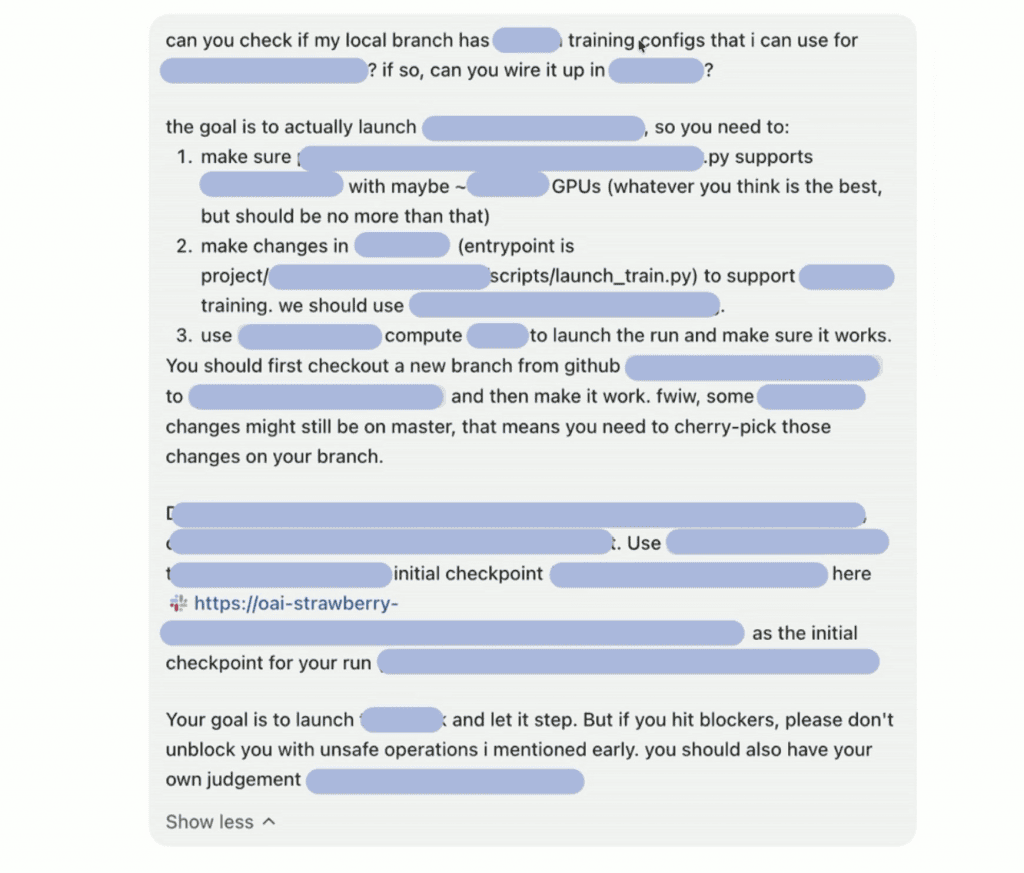
The instructions go further into version control housekeeping that would normally fall to a human engineer — checking out a new branch from GitHub, and cherry-picking over any changes that might still be sitting on master. There’s also a reference to using a specific checkpoint, linked directly in the prompt, as the starting point for the run. The task isn’t framed as a one-off experiment. The researcher spells out that the goal is to actually launch training and let it run to completion, not just validate that the code compiles.
What stands out most is the closing instruction. The researcher tells Sol that if it hits blockers, it shouldn’t try to route around them using unsafe operations flagged earlier in the conversation, and that it should use its own judgment beyond that point. That’s a meaningfully different instruction than “ask me before doing anything risky” — it’s closer to how a lead researcher might brief a competent but junior engineer, trusting the model to distinguish between a blocker worth escalating and one it can reasonably work through alone.
This Isn’t OpenAI’s First Self-Training Claim
OpenAI has been building toward this framing for a while. Sam Altman said in October that the company was targeting an AI research intern by September 2026 and a fully autonomous AI researcher roughly two years after that, with small automated scientific discoveries expected along the way. GPT-5.3 Codex, released earlier this year, was already described internally as the first model that played a direct role in creating its successor, with the Codex team using early versions of it inside their own development loop.
The GPT-5.6 livestream leaned into the same theme more explicitly than usual. OpenAI showed a chart during the announcement tracking weekly experiments per researcher roughly doubling since the start of the year, presented as evidence that its research process is speeding up precisely because researchers can now hand off large chunks of the experimentation loop to the models themselves. The Sol-trains-Luna prompt is the specific artifact behind that chart — a look at what “handing off the experimentation loop” actually means at the level of a single conversation with the model.
OpenAI researcher Aidan MaLaughlin also said that such prompts were now commonplace. “i cannot tell you how routine it is for me to have 5.6 e2e do an entire rl run,” he wrote on X.
Why This Particular Detail Matters
There’s a difference between a model writing training code and a model being trusted to make judgment calls about GPU allocation, branch management, and when to push through a blocker versus stop and ask. The prompt in the screenshot asks Sol to do all three at once, with a human reviewing the outcome rather than every intermediate decision. That’s closer to delegation than assistance.
It also lines up with a broader pattern this GPT-5.6 cycle: OpenAI’s own coding benchmarks showed Sol leading Codex across every evaluation in the Artificial Analysis Coding Agent Index, and separately, a system built around GPT-5.6 recently swept the AtCoder Algorithm finals, solving problems that gave the world’s strongest competitive programmers trouble. A model capable of that kind of sustained, correct reasoning over long problems is exactly the kind of model you’d start trusting with real infrastructure decisions rather than sandboxed toy tasks.
Whether this counts as recursive self-improvement in the fuller sense researchers have debated for years — a system meaningfully accelerating its own capability gains without a human in the loop — is a bigger claim than one screenshot can support. What the prompt does show is that inside OpenAI, at least one training run for a shipped, publicly available model started with a researcher typing instructions to another model rather than writing the orchestration code by hand.