Ricursive Intelligence has released Ripple-65B Preview, a 65-billion-parameter dense language model the company says is now the state-of-the-art US open-weight model on agentic coding tasks, outperforming rivals several times its size while costing a fraction of what competitors have spent to get there.
The model was pretrained from scratch on 12 trillion tokens and supports context lengths of up to 1 million tokens. On Terminal-Bench 2.1, a benchmark that tests how well an AI agent can navigate real Bash environments, write code, manage dependencies and handle system administration tasks, Ripple-65B Preview scores 80.5, edging out Reflection AI’s 501-billion-parameter Beam, which scored 80.1 on the same test. It also beats Meta’s Muse Spark Open, an 816-billion-parameter model, which scored 63.8.
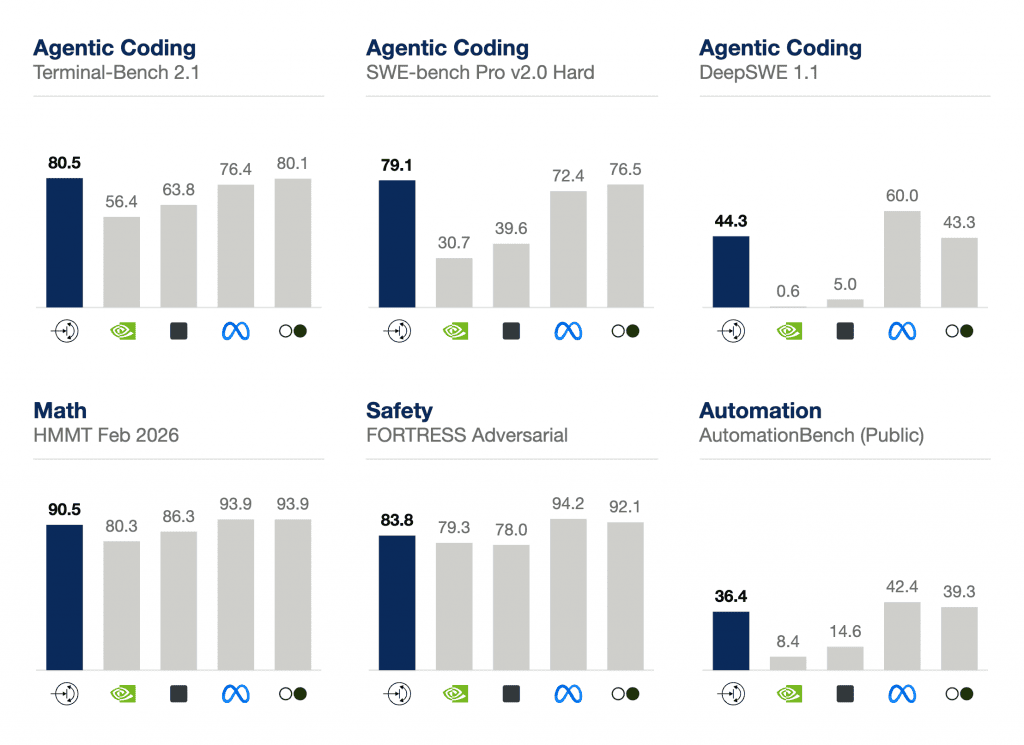
On SWE-Bench Pro v2.0 Hard, a harder slice of the standard software-engineering benchmark, Ripple-65B Preview scores 79.1, well ahead of Beam’s 72.4 and Muse Spark Open’s 39.6. On DeepSWE 1.1, Ripple scores 44.3 against Beam’s 43.3 and Muse Spark Open’s 5.0. The company also claims leads on math (90.5 on HMMT Feb 2026), safety (83.8 on FORTRESS Adversarial) and automation (36.4 on AutomationBench Public), though its own charts show Meta and Reflection’s models still ahead on those three categories specifically.
What makes the release notable isn’t just the scores, it’s what Ricursive says it spent to get them. The company says Ripple-65B Preview’s total R&D cost came in at around $32 million, which it describes as roughly a tenth of what the previous open-weight leader in agentic coding cost to build. On the post-training side, Ricursive says it reached its Terminal-Bench 2.1 score using only 1.4 million reinforcement learning rollouts, a fraction of what competing labs have reportedly needed for comparable results. On the pretraining side, the company claims a 16x compute efficiency improvement on code relative to its own Olmo 3 baseline, attributing the gains to changes in scaling laws, model architecture and data composition.
Unlike Beam, which is a sparse mixture-of-experts model that activates only 23 billion of its 501 billion parameters per task, Ripple is a dense architecture that uses all 65 billion of its parameters on every request. Ricursive has leaned into that distinction as a selling point rather than a limitation, positioning Ripple as something that fits on devices with high compute but comparatively limited memory bandwidth, like a MacBook or an NVIDIA DGX Spark, rather than requiring the kind of large-scale inference infrastructure a bigger MoE model would need.
Ripple-65B Preview is the first general-purpose language model released by Ricursive Intelligence, a Palo Alto lab founded by Anna Goldie and Azalia Mirhoseini, researchers previously known for their AlphaChip work on using reinforcement learning for chip floorplanning at Google. The company says Ripple is a variant of the proprietary model that already powers its AI chip-design platform. The weights are available now on Hugging Face under an Apache 2.0 license, with hosted access also live through Together AI, GMI Cloud and OpenRouter.
Ricursive Intelligence itself is barely a year old. Goldie and Mirhoseini, who met at Stanford and later worked together at Google Brain, launched the company in December 2025 with a $35 million seed round led by Sequoia Capital. Just two months later, it raised a $300 million Series A led by Lightspeed Venture Partners at a $4 billion valuation, with participation from NVentures, NVIDIA’s venture arm, among others. The company’s core pitch is closing what it calls the “recursive feedback loop” between AI models and the chips that power them, using AI to compress semiconductor design cycles that traditionally take years down to months or weeks. Ripple-65B Preview marks the lab’s first public move beyond chip design and into general-purpose language models, though the two efforts are tied together: a model capable of writing and reasoning about code well is also one that’s useful for the kind of RTL generation and design-automation work Ricursive’s core platform is built around.
Ricursive’s benchmark numbers are self-reported and have not yet been independently verified yet. Still, the claimed combination of a smaller, denser model matching or beating systems with up to fifteen times the parameter count, on a fraction of the usual training budget, puts Ripple-65B Preview squarely in the middle of the broader race among US labs trying to close the gap with Chinese open-weight models on agentic coding specifically, rather than general capability.