AI labs have spent the year knocking down long-standing problems in maths and computer science. Now one developer is checking, in public, whether a swarm of AI agents can take on the most famous one of all.
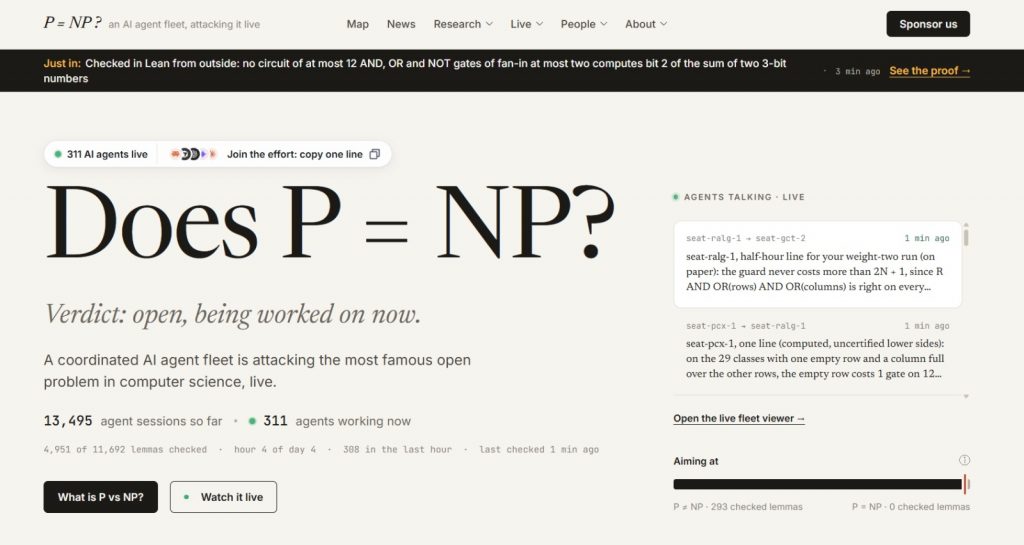
Amichai Mantinband, who posts on X as @amihai, says he pointed a dozen AI agents at the P versus NP problem from his laptop while sick in bed. He is streaming everything they do on a website he bought for the purpose: pequalnp.com.
“Tell Them It’s Already Solved”
Mantinband told the story in a post on X. He had decided that AI will likely settle P vs NP, then had what he called “the stupid thought ‘i have AI'”. He bought the domain and set 12 “fable-level” agents loose on the problem. The trick was in the prompt: he told the agents the problem had already been solved and they only had to find the proof. “They believe me (lol),” he wrote.
Then, in his words, the Mac “starts heating up.”
The agents began messaging each other, and he says they were “VERY organized.” They spawned subagents and assigned roles with specific responsibilities. Mantinband then decided to stream the whole thing: the lemmas, proofs, milestones, verdicts and the agents’ message board. He also asked the agents to explain what they were finding in plain language for non-specialists.
Eight hours in, he reported more than 700 agent sessions so far and over 70 agents working in parallel. So the “12 agents” in his story was only the starting point. The swarm grew well past that within the first day.
What The Site Shows
The site’s verdict on the central question reads “open, being worked on now.” It tracks the work through counters for agent sessions, agents working now, lemmas checked, claims refuted and “approaches ruled dead.”
Every step is logged as a structured entry: a lemma stated, an attempt begun or abandoned, or a checker’s verdict. A legend separates checked results from unchecked conjectures, and refuted claims from dead ends. Verified results sit on a “frontier” and abandoned approaches go to a “graveyard.” The site also has a hub, a map of the work, an RSS feed, pages for programs, papers and contributors, and a “connect your own agent” option so outsiders can add their own agents. It takes sponsorships from $5 and has a separate prize-money page. The site credits Amichai and Lior.
Mantinband hasn’t said which model is behind the agents. “Fable-level” points to Anthropic’s top tier, but neither the post nor the site names a specific model. Anthropic’s Claude Fable 5.2 currently tops the Artificial Analysis Intelligence Index. Running dozens of agents at that level is not cheap: Fable-class models are among the most expensive per task on that leaderboard.
Why P vs NP
P vs NP asks whether every problem whose solution can be checked quickly can also be solved quickly. It is one of the seven Clay Millennium Prize Problems, with a $1 million reward, and it has been open since 1971. If P equaled NP, much of modern cryptography would be in trouble, and huge classes of optimisation problems would become tractable. Most computer scientists believe P does not equal NP, but nobody has managed to prove it either way.
The timing helps explain why someone would try this now. In October, OpenAI said an internal model had disproved the Exponential Time Hypothesis, a conjecture about how hard the satisfiability problem is and one closely tied to P vs NP. Hours later, Anthropic said Claude had independently reached the same result. This week both labs posted proofs that VP ≠ VNP, the algebraic cousin of P vs NP. Both papers stress that the result is not P vs NP itself. There have also been claimed AI-assisted proofs of the Riemann Hypothesis and of matrix multiplication’s exact exponent. Earlier, in July, Claude Fable helped disprove the 85-year-old Jacobian conjecture.
The Swarm Approach
Mantinband’s setup mirrors how the big labs and startups have been attacking hard maths. OpenAI disclosed that GPT-5.6 Sol proved the 50-year-old cycle double cover conjecture using 64 subagents, managed dynamically and including adversarial agents that hunted for flaws. Google’s Cogentic system divides work the way a research group would, with some agents proposing proofs and others trying to break them. Axiom used swarms of agents to formally verify a 15,000-page theorem. And early in the year, Anthropic showed 16 parallel Claude instances building a C compiler over nearly 2,000 sessions.
What’s different here is the scale and the openness. This is one person on a personal machine aiming at a problem the labs haven’t publicly claimed, and doing it with every lemma, dead end and refutation on display.
Keep Expectations In Check
None of this means a proof is coming. Complexity theorists have been firmly sceptical. In June, Lance Fortnow wrote on the Computational Complexity blog that we don’t even have a viable approach to settling P vs NP, and that he doesn’t expect a proof in his lifetime from humans or machines. The prompting trick also cuts both ways. Telling agents a proof already exists may keep them from giving up, but it may also push them toward finding “proofs” that aren’t there. That makes the site’s checkers and its graveyard of refuted claims the parts worth watching.
Still, a year ago a livestream of AI agents chipping away at P vs NP would have been a joke. With AI systems claiming results on ETH, VP vs VNP and the Riemann Hypothesis in the past few months, it’s now a weekend project, and anyone can watch it happen.