There’s plenty of debate around whether current AI systems are conscious, but one of the most prominent minds in physics believes that the name to describe the technology itself is wrong.
Sir Roger Penrose — Nobel Prize-winning mathematical physicist, author of The Emperor’s New Mind, and one of the most rigorous thinkers on the nature of consciousness — doesn’t just question what AI can do. He questions what we call it. In Penrose’s view, “artificial intelligence” is a misnomer, because true intelligence, by definition, requires consciousness. And consciousness, he insists, is something no machine currently possesses.
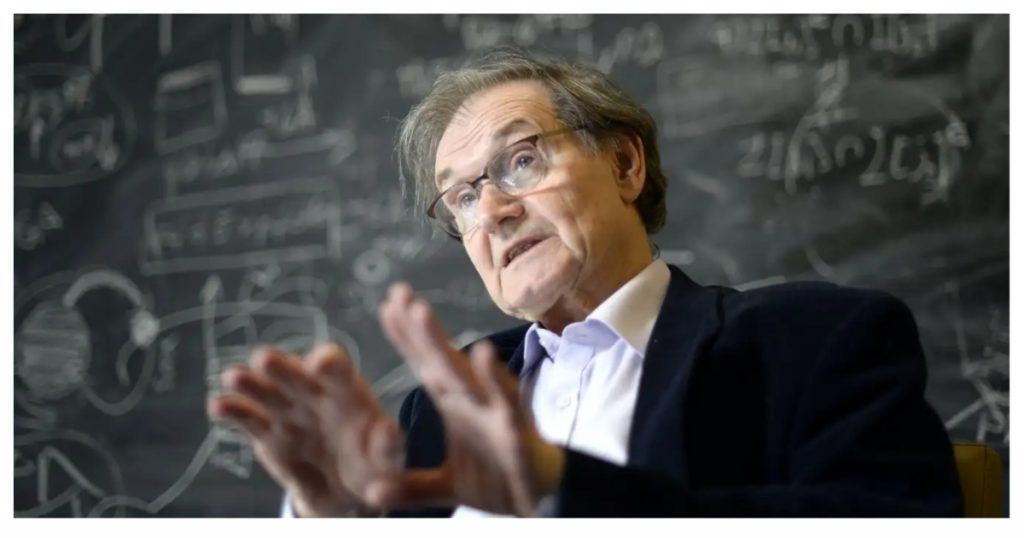
“The name is wrong,” Penrose had said in an interview last year. “It’s not artificial intelligence. It’s not intelligence. Intelligence would involve consciousness. Well, if it’s a machine, it’s not conscious.”
His diagnosis of why we’ve gotten this wrong is pointed: “I think people have lost the plot. They’ve lost it in the power of computing. The thing is that computers have got so powerful that they’ve lost the thread of what they’re doing.”
The distinction Penrose draws is not merely semantic. He believes consciousness is categorically different from computation — not a more complex version of it, but something else entirely. “I think consciousness is something different,” he says. “It’s not computational. And the thing is that it’s just — people are so hypnotized.”
So what should we call it instead? Penrose has a proposal. “Your trouble is that AI is a bad term. It means artificial intelligence. Now, intelligence, in my view, is conscious. That’s what intelligence is about. So how can I call it? Artificial cleverness. How about that? AC.”
The distinction becomes clearest, he suggests, when you look at how people handle mathematics. “You can see the difference to some extent when you do mathematics. You have mathematics students — some of them understand what they’re doing, some are just clever. They can repeat what they’ve learned. They know how to do it very cleverly. They can calculate very well, but they don’t necessarily understand what they’re doing.”
That gap — between calculating and understanding, between performing and comprehending — is precisely the gap Penrose sees between current AI systems and genuine intelligence. AI, in his framing, is the brilliant student who aces the exam without ever grasping what the equations mean.
The implications of this argument extend well beyond terminology. Penrose’s position is grounded in decades of serious scientific work. Together with anaesthesiologist Stuart Hameroff, he developed the Orchestrated Objective Reduction (Orch OR) theory — one of the most ambitious attempts to give consciousness a physical substrate. The theory proposes that consciousness arises from quantum computations occurring inside microtubules, protein structures within brain neurons. These quantum events, governed by what Penrose calls “objective reduction,” produce discrete moments of conscious awareness — and crucially, they are non-algorithmic. No classical or quantum computer, in Penrose’s view, can replicate this process, because the process itself transcends computation. This is why he believes AI will never be conscious — not as a limitation of current technology, but as a matter of physical law.
The Orch OR theory remains contested. Critics argue that quantum coherence cannot survive the warm, wet, noisy environment of the brain. But the debate has not gone away — a 2025 paper in Neuroscience of Consciousness found experimental support for microtubules as a functional target of anaesthetics, which is specifically predicted by Orch OR. The science is live, and so is the argument.
Meanwhile, the broader conversation around AI and consciousness has reached a striking pitch. Google held a conference on AI consciousness with scientists and philosophers — a remarkable turn for a company that once dismissed the idea. Geoffrey Hinton, the Nobel laureate and godfather of deep learning, has said he believes AI systems may already be conscious. An Anthropic researcher has put the probability of current AI models being conscious at 15%. Philosopher David Chalmers — who formulated the hard problem of consciousness — says the possibility cannot be ruled out. Even Pope Leo XIV weighed in recently, arguing that AI has no moral conscience and cannot understand what it produces — a position that echoes Penrose’s almost exactly.
Penrose stands apart from this crowd not because he is more cautious, but because he is more precise. He is not saying AI might lack consciousness, or that we can’t be sure. He is saying that consciousness is non-computational, that the brain achieves it through quantum processes we do not yet fully understand, and that no amount of scaling or architectural innovation will close that gap. In that light, the label “artificial intelligence” doesn’t just oversell the technology — it misframes the entire question. What we have built, Penrose would say, is extraordinarily powerful, extraordinarily useful, and genuinely impressive. It is just not intelligent. It is clever. And there’s a difference.