Anthropic and OpenAI aren’t yet listed, but the effects of Kimi K3’s launch are being felt in the listed stocks of Chinese AI companies.
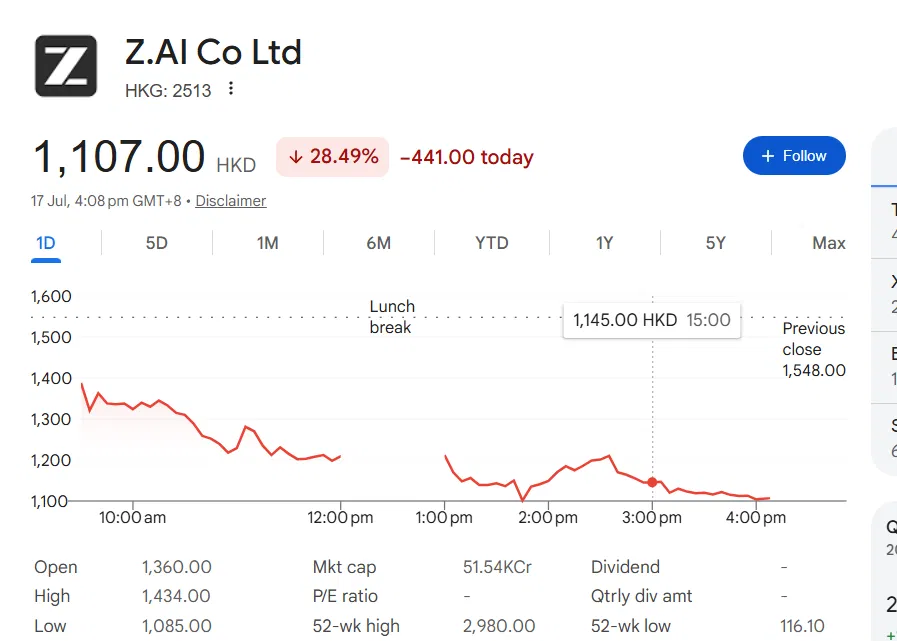
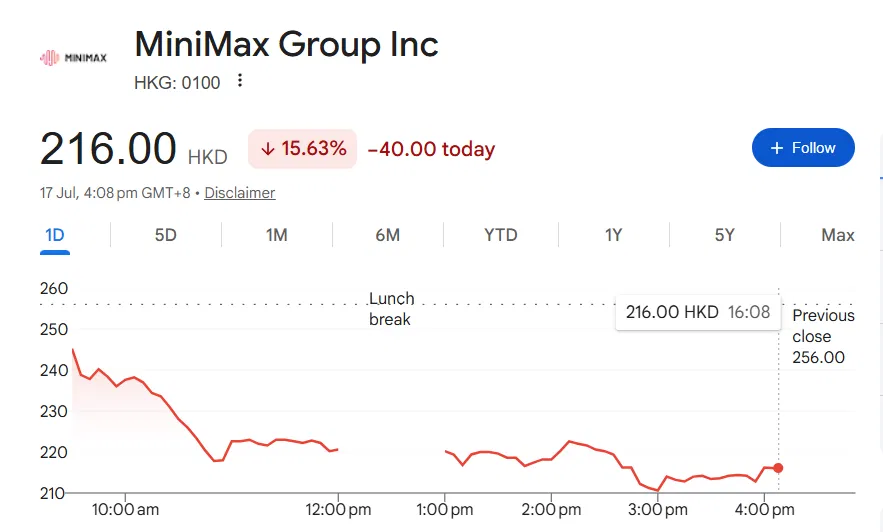
Z.AI, trading on the Hong Kong Stock Exchange as Knowledge Atlas Technology, closed down 28.49% on Friday, shedding HK$441 to end the session at HK$1,107, well off its previous close of HK$1,548. MiniMax Group fell 15.63%, closing at HK$216 after opening the day at HK$256. Both stocks are the only pure-play, publicly listed AI model companies in the world right now, which means they absorb market sentiment around Chinese AI in a way no other equity does. On Friday, that sentiment turned sharply negative, and the reason has a name: Kimi K3.
Moonshot AI released Kimi K3 on Thursday, a 2.8 trillion parameter model the company is calling the largest open-weight AI model ever shipped. Full model weights are scheduled to follow on July 27, but the model is already live via Moonshot’s API and app, and the early numbers are the kind that get read out loud in trading rooms. On Artificial Analysis’s Intelligence Index, K3 placed third overall, trailing only Claude Fable 5 and GPT-5.6 Sol, and ahead of Claude Opus 4.8. On the Frontend Code Arena, it took the top spot outright, ahead of Fable 5, becoming the first Chinese model to lead that leaderboard. It did all this at $3 per million input tokens and $15 per million output tokens, roughly half the cost of Opus 4.8.
The scale of the reaction has surprised even people who follow Chinese AI closely. Z.ai’s own stock had been one of the standout stories of 2026, climbing nearly 10x since its January IPO on the strength of its GLM model line and its status as a scarce, direct way for public market investors to bet on frontier AI. MiniMax had followed a similar arc, overtaking Baidu’s market cap within two months of its own listing. Friday’s selloff wiped out a meaningful chunk of that run in a single session, and it wasn’t confined to the two Chinese listings. TSMC fell 7% despite reporting a 77% jump in quarterly operating profit. SoftBank, widely treated as a proxy for OpenAI exposure, dropped 9%. Nvidia gave up its brief lead over Apple as the world’s most valuable company. The Nasdaq 100 slid alongside them.
Gavin Baker, CIO at Atreides Management, had flagged the direction of this reaction before the market fully caught up to it. In a widely shared thread, Baker argued that K3 is potentially negative for OpenAI and Anthropic specifically, while being net positive for almost every other company in the AI stack. His logic centers on where margin sits. A world with two or three dominant closed labs running inference at 90% margins is a world where those labs become, in his words, the buyer of last resort for power, chips, and compute. Every other layer of the stack, from semiconductors to hyperscalers to neoclouds, benefits when that margin gets compressed and spread out instead of concentrated. Open-weight models that perform close to frontier level do exactly that. Baker made the same argument about Google’s brief run of model competitiveness earlier in the year, and about Grok 4.5 and Meta’s Muse 1.1, noting that vertically integrated players don’t need to extract profit at the model layer the way OpenAI and Anthropic do.
What gets less attention in that framing is what K3 does to the Chinese labs themselves. Z.AI and MiniMax have spent the last year building their public market stories partly around being the labs producing genuinely frontier-competitive, open-weight Chinese models. That story worked because for most of that stretch, nobody else was doing it at the same level. Kimi K3 breaks that. There is now an open model that beats both companies’ flagship releases on independent benchmarks, and it doesn’t come from Silicon Valley. It comes from a third Chinese lab. The market reaction on Friday reads less like fear of American competition and more like a repricing of what “being the open Chinese frontier lab” is actually worth once there’s a better one sitting one API call away.
That repricing has a second layer to it. Moonshot’s own numbers aren’t without caveats. Artificial Analysis found K3’s hallucination rate rose to roughly 51%, up from K2.6’s 33%, even as accuracy improved. It’s also 50 to 70% more expensive to run than GPT-5.6 per token, which cuts against the efficiency story that made earlier Kimi and DeepSeek releases so disruptive on cost alone. None of that stopped the stock market from treating K3 as the more consequential release of the week over anything from a listed competitor.
What happens over the next two weeks will matter more than Friday’s close. The full weights land on July 27, and if the open-weight release holds up under scrutiny, the pressure on Z.AI and MiniMax’s premiums, and on the broader closed-versus-open pricing debate, isn’t going away. If it doesn’t, Friday’s selloff may end up looking like an overreaction to a single week of AI news, of which there is never a shortage.