India is regularly making strides in the quantum space.
QNu Labs, in collaboration with the Bhaskaracharya National Institute for Space Applications and Geo-informatics (BISAG-N) and IIT Gandhinagar, has demonstrated what it says is India’s first free-space Quantum Key Distribution (QKD) link, spanning 5.56 km. The trial was announced by the Press Information Bureau on October 3.
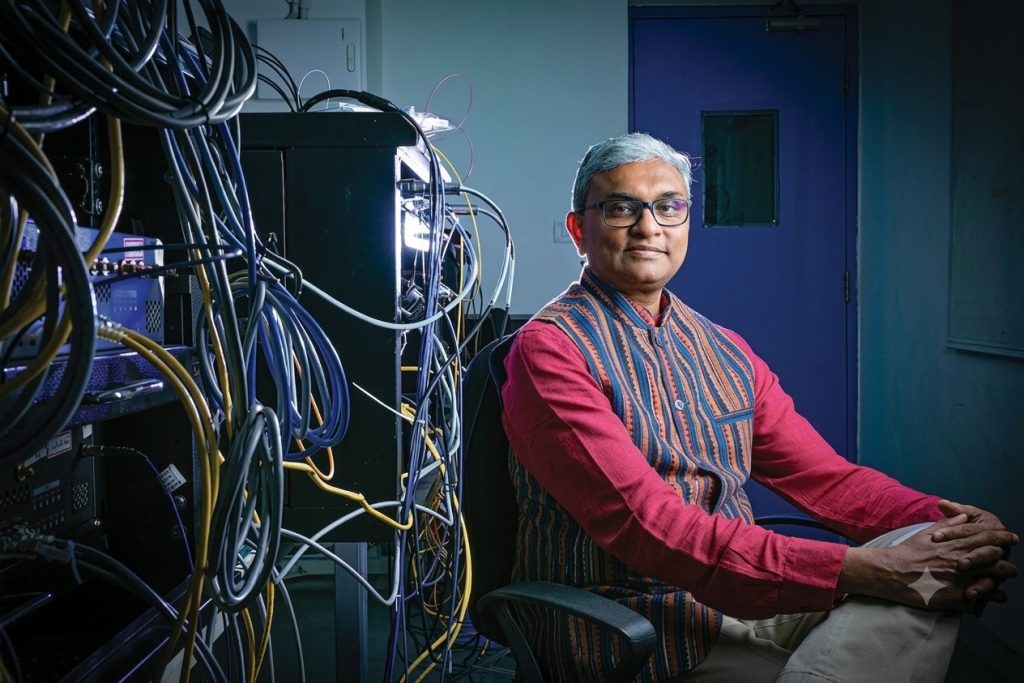
The field trial took place on the night of September 27-28 and set up a secure quantum communication channel between BISAG-N and IIT Gandhinagar. Using QNu Labs’ Pointing, Acquisition and Tracking (PAT) system, which keeps the optical beam locked between the two sites, the teams recorded a stable Quantum Bit Error Rate (QBER) of under 5%. The link generated secure keys at a rate of 230-260 bits per second.
Quantum keys meet post-quantum software
The generated keys were then fed into BISAG-N’s Vedic Kavach platform, which is built on post-quantum cryptography. Test messages were successfully encrypted and decrypted end to end using them.
The demonstration brought together two different layers of quantum-era security. The first is QNu Labs’ hardware-based QKD device, Armos, running over free-space optical channels. The second is Vedic Kavach, BISAG-N’s software-based post-quantum cryptography with quantum random number generation. According to the announcement, pairing the two means the system stays resilient even if the physical quantum channel is temporarily unavailable.
Why free space matters
Most QKD deployments so far have run over optical fibre, which isn’t always practical to lay, especially between buildings, across difficult terrain or for mobile and remote sites. Free-space links send the photons through the air, and need precise pointing and tracking to work, which is where QNu Labs’ PAT system comes in. Free-space techniques are also the basis for satellite-based quantum communication, which is a stated next step for the company.
“The successful 5.56 km demonstration paves the way for longer-distance quantum-secure networks and satellite-based quantum communication,” said Sunil Gupta, Co-founder and CEO of QNu Labs.
Dr. Vinay Thakur, Director General of BISAG-N, said integrating Vedic Kavach with QNu Labs’ QKD technology is a significant step toward practical quantum-resilient communication systems. Cmde Manish Tripathi (Retd.), In-charge of the ISTF at IIT Gandhinagar, said the trial gives researchers a valuable real-world environment for advancing practical quantum communication, and shows how academia and indigenous technology can work together.
India’s growing quantum push
The trial is the latest in a string of quantum milestones from the country. Bengaluru-based QpiAI built India’s first full-stack quantum computer, a 25-qubit system, and DRDO and IIT Delhi demonstrated quantum communication across 1 km in an earlier step toward a quantum internet.
QNu Labs itself was behind a 1,000 km secure quantum communication network demonstrated earlier this year under the National Quantum Mission. The Bengaluru-based startup, founded in 2016 and incubated at IIT Madras, has also raised $21 million to expand its R&D and go-to-market efforts, and to broaden into quantum sensing and AI.
The security angle is increasingly pressing as quantum hardware improves. Google, for instance, has demonstrated a verifiable quantum advantage on its Willow chip, a reminder that the machines which could one day threaten today’s public-key encryption are steadily maturing. Approaches like QKD and post-quantum cryptography are being built to get ahead of that threat.
The trial, the organisations said, provides a foundation for advancing India’s capabilities in secure communication infrastructure and strengthening resilience against emerging quantum-era security threats.