Companies that have recently gone public have to deal with their employees being distracted with the rapidly-moving stock price, but Urban Company has a tongue in cheek way to counter such discussions.
A photo doing the rounds on X, shared by pre-seed investor Rahul Mathur, shows a transparent deposit box sitting at the reception of Urban Company’s office. Taped to it is a printed notice that reads, “Kindly deposit Rs-100 if you discuss the UC stock price inside the Office.” A handful of purple hundred-rupee notes, folded and stuffed through the slot, sit visible at the bottom of the box, suggesting the rule is actually being followed, or at least being playfully violated.
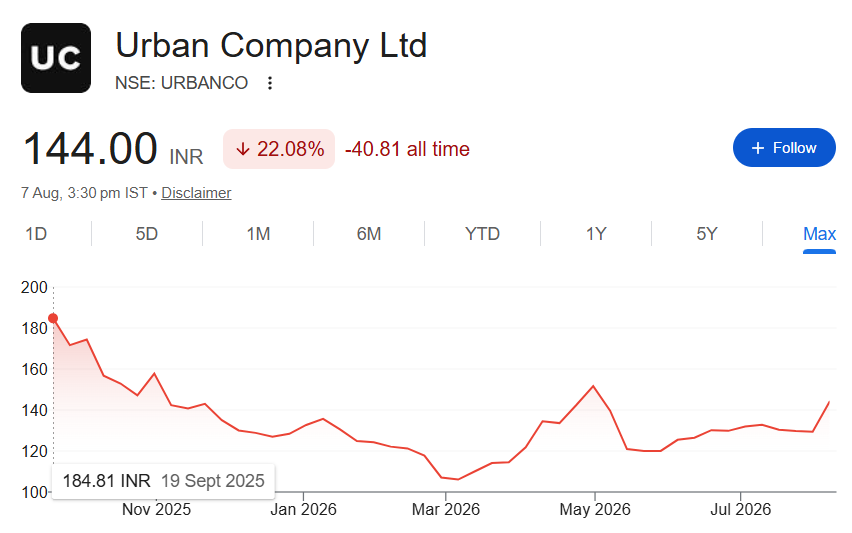
The timing makes sense. Urban Company listed on the stock markets in September 2025, and its debut was the kind that tends to occupy people’s minds well past the opening bell. The stock priced its IPO in a band of Rs. 98-103 and opened trading at Rs. 162.25 on the NSE, a jump of nearly 58%. It kept climbing in the days after, at one point touching close to Rs. 201 a share and nearly doubling from issue price within a week, giving the company a market capitalisation upward of Rs. 27,000 crore. Since then, it’s fallen a bit, and the stock now trades at Rs. 144. For a workforce that includes plenty of employees holding ESOPs, that kind of movement is hard to ignore.
Which is exactly the problem a fine box like this is meant to solve. Watching a stock swing 4% in an hour has a way of pulling attention away from actual work, and for a company barely weeks into its life as a listed entity, the temptation to refresh the NSE app between meetings is presumably constant. Urban Company’s response wasn’t a memo banning the conversation or a stern all-hands about focus. It was a jar on a table, dressed up with a fine and a straight face, that turns a real workplace problem into an office joke people actually engage with.
It’s a clever hack. Rules employees ignore are just laminated paper. Rules employees comply with, fish out notes for, and probably photograph for their own group chats, are rules that work. The box gets the message across without anyone having to sit through a lecture on where the company is headed and why a share price six weeks after listing means very little.
The underlying idea, that a business should be run for the years ahead rather than the next tick on a stock ticker, is one of the oldest lessons in public-market thinking. Jeff Bezos wrote about it in his very first shareholder letter in 1997, titling an entire section “It’s All About the Long Term” and arguing that a long-term horizon should guide every decision, since what benefits the customer over time eventually benefits the shareholder as well. He kept attaching that same letter to every annual report for years afterward, telling investors to read it twice if they wanted to understand the kind of company they were backing. The logic was that a business obsessing over quarterly share price swings ends up optimising for the wrong thing entirely, sacrificing product bets, hiring calls, and market expansion for a number that resets every morning anyway.
Urban Company’s own arc backs this up. The company spent close to a decade building out its home services marketplace before it had a real shot at going public, growing from a handful of Indian cities to a presence across the UAE, Singapore, and Saudi Arabia. It only turned its first profit before tax in 2024, a full ten years after it was founded, while competitors in the same category shut shop one after another. It even pushed into the US market in 2023, years before that expansion had any hope of showing up as a line item on a quarterly earnings call. None of that came from chasing a number on a screen. It came from building something durable enough to survive a decade of India’s notoriously brutal startup graveyard.
A deposit box asking for Rs. 100 isn’t going to stop anyone determined to talk about the stock. But it does something a policy memo can’t: it makes the point land, and it does it with a wink instead of a warning. Whether the money collected goes toward chai for the office or gets donated somewhere is beside the point. The box is really there to remind a newly public company’s workforce that daily share price movement says very little about building a company that lasts for decades.