Flipkart founder Sachin Bansal was one of Ather Energy’s earliest backers, but he hasn’t participated in the company’s recent valuation jump.
The electric scooter maker, which listed on the Indian stock exchanges last year, is now valued at close to ₹58,000 crore, going by its recent market capitalisation on the NSE and BSE. That number matters because of how far removed it is from what Ather was worth when Bansal walked away from his stake in 2024. Back then, the company was valued at roughly ₹5,600 crore. Ather’s valuation has grown nearly tenfold in the two years since, and the person who missed out on almost all of that growth happens to be one of its oldest investors.
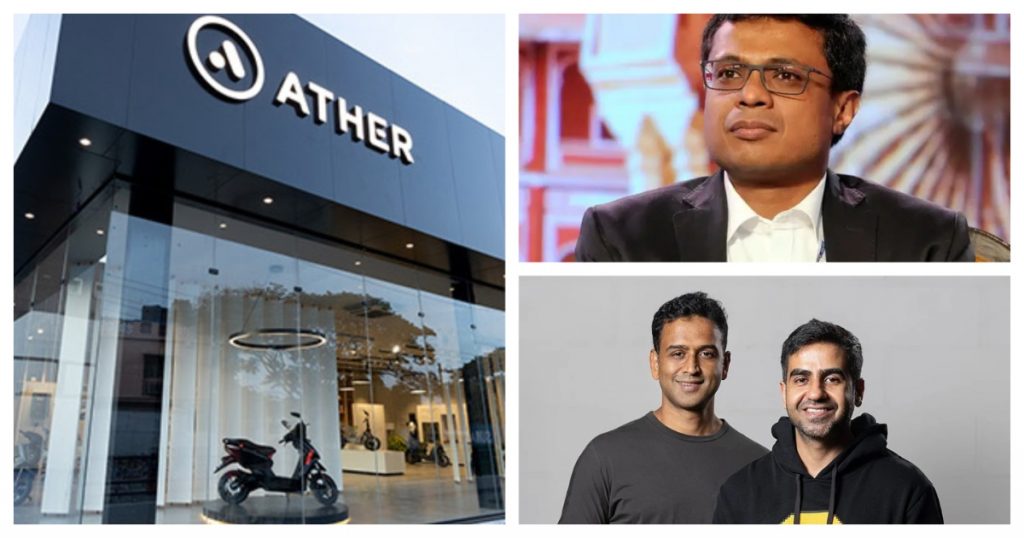
Bansal’s Early Bet On Ather
Bansal first backed Ather in December 2014, not long after Tarun Mehta and Swapnil Jain had started the company. At the time Ather was still working out of IIT Madras’ incubation cell, years away from putting a scooter on the road. Bansal, flush with Flipkart money and increasingly active as an angel investor in Bangalore’s startup scene, put in an initial $0.5 million. He kept adding to his position over the following years, eventually investing close to ₹400 crore in the company between 2014 and 2024.
For a long stretch, that bet didn’t look particularly exciting. Ather struggled with EV policy flip-flops, cash burn, and a market that, as recently as 2021, valued the company at just ₹1,408 crore, a fraction of what rival Ola Electric was commanding despite Ather having been in the business much longer. Ather’s own CEO Tarun Mehta once called the disparity the work of a “stupid market.”
The Exit To The Kamaths
That changed through 2024. Bansal began selling down his Ather holding in stages, and Nikhil Kamath, the Zerodha co-founder, emerged as the buyer picking up the bulk of it. In April 2024, Kamath acquired a large chunk of Bansal’s stake in a secondary transaction, telling reporters at the time that it would be among the largest private bets he had made. Two months later, in June 2024, Bansal sold what remained of his holding, a 7.5% stake, splitting it between Hero MotoCorp, which bought 2.2% for ₹124 crore, and Kamath, who bought the remaining 5.3% for close to ₹282 crore. That transaction valued Ather at ₹5,636 crore, or roughly $675 million.
Add up what Bansal actually made from selling his stake, and it likely comes to a little over ₹400 crore, almost exactly what he had put into the company across a decade. For an investor who came in when Ather was still a pre-revenue startup and stayed through several rounds, that’s a strikingly unremarkable outcome. He got his capital back, but the kind of return that early backers of category-defining startups typically hope for never materialised while he still held the stock.
Kamath, through his firm Kamath Associates, ended up owning what would eventually become a stake of around 1.5% to 1.8% in Ather by early 2026, largely built from what he bought off Bansal.
Where Ather Stands Now
Ather went public in May 2025, pricing its IPO at a valuation of about $1.4 billion after trimming its original target amid a rough stretch for global markets. The stock has moved considerably since. By November 2025, Ather’s market cap had nearly doubled to around ₹24,800 crore, even as early investor Tiger Global exited its entire 5% holding for about ₹1,204 crore. The rally has continued through this year, with Ather crossing ₹58,000 crore in market capitalisation in recent weeks, helped by narrowing losses, rising revenue, and a growing share of India’s electric two-wheeler market, where it has overtaken Ola Electric in several regions.
For Kamath, that run has been lucrative. His shareholding, worth a few hundred crore when he bought it off Bansal, is now valued at several times that. On a single day in June this year, when Ather’s stock jumped nearly 5%, the value of Kamath Associates’ holding rose by close to ₹27 crore, according to shareholding data filed with exchanges.
Bansal, notably, isn’t part of that story anymore. He had already moved on to running Navi, the financial services company he founded after leaving Flipkart, by the time he offloaded his Ather shares. Whether he simply wanted liquidity, had lost conviction in EV two-wheelers as a category, or just needed to free up capital for Navi is not something he’s spoken about publicly. What’s clear is that the timing didn’t work out all that well. Had he held on for two more years, his ₹400 crore investment would likely be worth well over ₹4,000 crore today.