A boy who studied under trees in a Himachal Pradesh village without electricity has just pulled off one of the biggest exits in the history of cybersecurity.
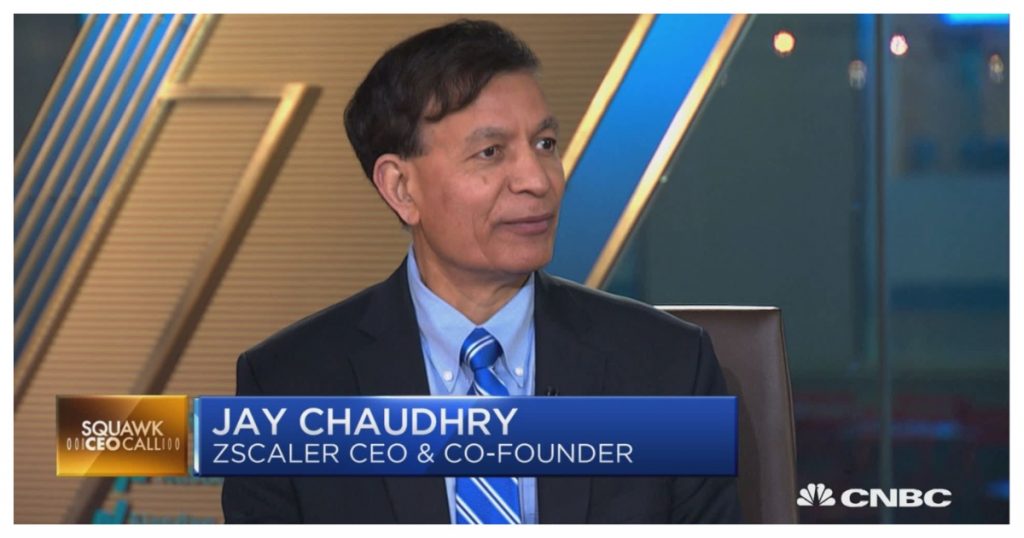
CrowdStrike has agreed to acquire Zscaler, the cloud security company founded by Jay Chaudhry, in an all-stock deal that values Zscaler at about $43.9 billion. Zscaler shareholders will receive 1.135 CrowdStrike shares for every Zscaler share they own, which works out to about $260.41 a share — a premium of roughly 34% over Zscaler’s closing price on November 20. Once the deal closes, existing CrowdStrike shareholders will own about 84.1% of the combined company, and Zscaler shareholders the remaining 15.9%.
The deal is larger than Google’s $32 billion acquisition of Israeli cloud security startup Wiz last year, which had until now been the benchmark for blockbuster cybersecurity acquisitions.
Chaudhry and his affiliates, who hold about 34% of Zscaler, have signed agreements to vote in favour of the transaction. He will continue to lead the Zscaler business after the deal closes and will join CrowdStrike’s board of directors. The transaction is expected to close in the second half of CrowdStrike’s fiscal year 2028, subject to Zscaler shareholder approval and regulatory clearances.
Markets were initially sceptical of the price tag. Zscaler’s shares rose about 13% after the announcement, while CrowdStrike’s fell nearly 10%.
From Panoh To IIT BHU
Chaudhry’s journey to this point is one of the more remarkable stories in global tech. He was born in 1958 in Panoh, a small village in the Una district of Himachal Pradesh, to Bhagat and Surjeet Chaudhry, who were small farmers. The village didn’t have electricity or running water until he was a teenager, and he walked about 4 km every day to attend high school in the neighbouring village of Dhusara.
He went on to study electronics engineering at IIT (BHU) Varanasi, becoming the first person from his village to graduate from an engineering college. Chaudhry has said in the past that the move from his village to university was a bigger change for him than his later move from India to the United States.
In 1980, he took his first-ever flight, to the US, where he earned master’s degrees in electrical and industrial engineering and an MBA from the University of Cincinnati. He later also completed the executive management programme at Harvard Business School.
The Corporate Years, And A Bet On His Life Savings
Chaudhry spent the next several years working in engineering, sales, marketing and management roles at companies such as IBM, NCR and Unisys, and later at IQ Software. He had never really imagined becoming an entrepreneur. That changed in the mid-1990s, when he watched internet companies like Netscape go public and asked himself why he couldn’t build a startup too.
He pitched his ideas to venture capitalists but failed to raise money. So he and his wife Jyoti, who was then a systems analyst at BellSouth, quit their jobs and put their life savings of roughly $500,000 into a cybersecurity startup called SecureIT. Jay ran sales and marketing, while Jyoti handled finance, HR and operations.
The timing was impeccable. Chaudhry has said that at the time, fewer than 5% of Fortune 500 companies had firewalls — and within 18 months, SecureIT had deployed firewalls at about half of them. In 1998, less than two years after it was launched, SecureIT was sold to VeriSign in an all-stock deal worth nearly $70 million. As VeriSign’s stock soared during the dot-com boom, more than 70 of SecureIT’s 80 employees became millionaires on paper.
A Serial Entrepreneur
SecureIT was just the beginning. Chaudhry went on to found and lead a string of security companies, including CoreHarbor, AirDefense, a wireless security pioneer that was later acquired by Motorola, and CipherTrust, an email security company. CipherTrust was acquired by Secure Computing in 2006 for $273.6 million, and Chaudhry briefly joined Secure Computing as vice chairman and chief strategy officer.
By then, the Chaudhrys were already wealthy. But Chaudhry wanted to build one big company and give it his complete focus rather than spread himself across several smaller ventures.
Building Zscaler
In 2007, he founded Zscaler in San Jose along with co-founder K. Kailash. Chaudhry has said his ambition was to build the Salesforce of cloud security. The idea was to move security out of the hardware boxes — firewalls and appliances — that sat inside corporate offices and into the cloud, where it could protect employees wherever they worked and whatever applications they used.
The couple once again backed themselves, putting about $50 million of their own money into Zscaler. It was a bet that took time to pay off — Chaudhry has said it took a few years for the company to gain real traction in the market. Owning a large part of the company early on also meant he kept control of its direction, something he has often recommended to other founders.
Zscaler went public on the Nasdaq in March 2018, and its shares more than doubled on the first day of trading. Even then, Zscaler stood out as one of a growing number of billion-dollar US startups founded by Indian Americans, and Chaudhry later featured among the startup founders on the list of India’s 100 richest people. He has since been widely described as the richest Indian in the United States, with his family controlling about 35% of the company.
What Zscaler Does
Zscaler is best known for popularising “Zero Trust” security — the idea that no user, device or application should be trusted by default, even if it sits inside a company’s network. Instead of connecting employees to the corporate network through VPNs and then protecting that network with firewalls, Zscaler connects users directly to the specific applications they need through its cloud, inspecting traffic along the way.
Its core platform, the Zero Trust Exchange, includes Zscaler Internet Access, which secures employees’ access to the internet and SaaS apps, and Zscaler Private Access, which gives them secure access to internal applications and is billed as the world’s most deployed zero trust network access platform. The company has also expanded into security operations and AI security, including through its $675 million acquisition of managed detection and response company Red Canary in 2025.
The Scale
Zscaler today is one of the largest security companies in the world. It recorded $3.9 billion in annual recurring revenue as of its most recent fiscal quarter. About half the Fortune 500 are customers. It processes 750 billion+ transactions every day on the Zero Trust Exchange. The company has 200+ service locations, and 8,000 employees around the world.
Why CrowdStrike Wants Zscaler
The two companies have long been complementary. CrowdStrike, founded by George Kurtz, is the leader in endpoint security — protecting laptops, servers and other devices — while Zscaler secures the connections between users and applications. They have worked together for years and already share more than 2,000 customers across 16 integrations.
CrowdStrike says the acquisition will expand its total addressable market by more than $185 billion and give it a path to sell its Falcon platform to about 8,000 Zscaler customers who aren’t yet CrowdStrike customers. The combined company is expected to start with more than $10 billion in annual recurring revenue, with revenue synergies expected to reach about $1 billion in annualised run-rate within 30 months, and cost synergies of about $500 million.
Both founders are pitching the deal as a response to the rise of AI agents, which are opening up new attack surfaces just as the number of critical software vulnerabilities being discovered has jumped sharply. Kurtz said security used to be about keeping attackers out, and that today, safety is required to let AI in. Chaudhry said that in the AI era, Zero Trust has become non-negotiable, adding that “AI agents are rapidly becoming the new weakest link.”
For Chaudhry, the deal caps a nearly three-decade run in cybersecurity that began with a $500,000 bet on SecureIT. Few founders get one successful exit; Chaudhry has now had several, with the latest valuing his company at nearly $44 billion. Not bad for someone who once walked 4 km to school in a village that didn’t have electricity.