A Berkeley-trained general relativist who has co-written papers with Edward Witten, Ven Chandrasekaran has spent nearly a decade studying one corner of Einstein’s theory: what gravity looks like on the edges of spacetime. This week that work produced one of the boldest physics preprints of the year.
Until this week, Venkatesa Chandrasekaran was known mostly to specialists in quantum gravity. That changed on November 25, when he posted “An algebraic quantization of gravity from the null cone” to arXiv. The paper proposes a complete quantum theory of gravity in four-dimensional spacetime, and the result quickly spread beyond physics circles, helped along by one line in the acknowledgements: several of the paper’s calculations and proofs, he wrote, came out of months of back-and-forth collaboration with OpenAI’s GPT-6 Astra, using about 400 million tokens.
Social media reactions ranged from careful to breathless, with at least one widely shared post calling it possibly the biggest breakthrough in human history. Here is what is actually known about the physicist at the centre of it.
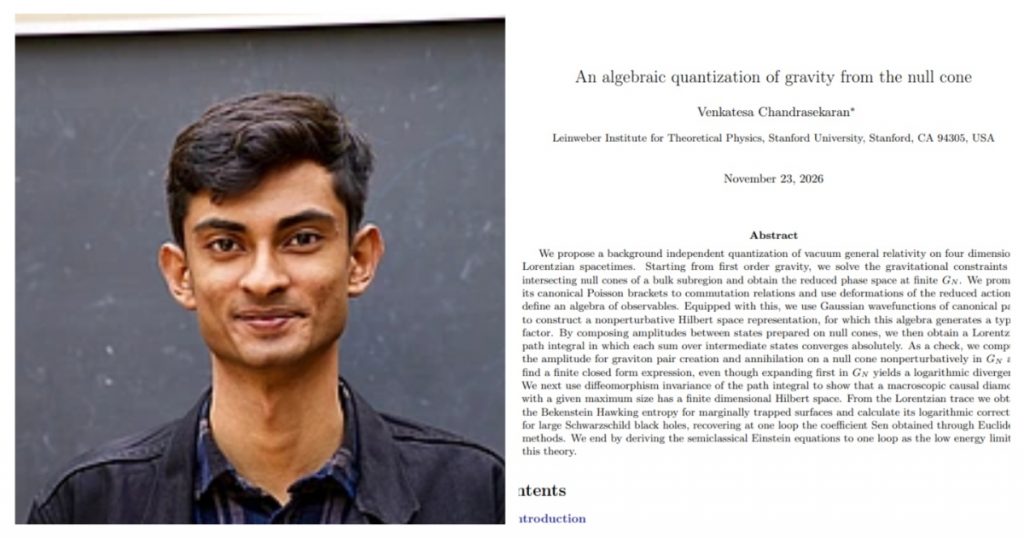
Quick facts
- Name: Venkatesa Chandrasekaran; goes by “Ven” professionally
- Current affiliation: Leinweber Institute for Theoretical Physics, Stanford University
- PhD: University of California, Berkeley, 2021
- Doctoral group: Raphael Bousso’s quantum gravity group at Berkeley
- Previous position: Member, School of Natural Sciences, Institute for Advanced Study, Princeton (funded by the Simons Foundation)
- Field: General relativity, quantum field theory and quantum gravity
- Known for: Gravitational symmetries and “edge modes” on null surfaces; the von Neumann algebra approach to black hole and de Sitter entropy (with Edward Witten, Geoff Penington and Roberto Longo)
Berkeley and the Bousso group
Chandrasekaran did his doctorate at UC Berkeley, finishing in 2021. He was part of the group led by Raphael Bousso, one of the best-known figures in quantum gravity. Bousso studied under Stephen Hawking at Cambridge and is famous for the “Bousso bound,” a rule linking how much information a region of space can hold to the geometry of its boundary. Bousso’s group at Berkeley has produced a string of influential young researchers working where quantum information meets gravity.
Bousso is thanked in the new paper, and his influence shows. The quantum gravity paper’s claim that a finite region of spacetime holds only a finite amount of information is very much in the spirit of the ideas Bousso is known for.
A specialist in the edges of spacetime
Chandrasekaran’s early work set up the tools that the new paper relies on.
In 2018, while still a graduate student, he co-wrote “Symmetries and charges of general relativity at null boundaries” with Éanna Flanagan and Kartik Prabhu of Cornell. The paper looked at what happens to Einstein’s equations on “null” surfaces, the surfaces traced out by light rays such as black hole horizons. It showed that certain symmetries, previously associated with the far edges of the universe, matter at every such surface, including the horizons of black holes that are still changing. Published in the Journal of High Energy Physics, it became a standard reference in the field.
Further papers in the same vein followed: on symmetries and conservation laws in causal diamonds (with Prabhu), on charges at null boundaries (with Flanagan, Ibrahim Shehzad and Antony Speranza), and in 2023, from the Institute for Advanced Study, “Horizon phase spaces in general relativity” with Flanagan. That last paper worked out a way to describe general relativity on two intersecting null surfaces using initial data set on light rays. That is the classical foundation for the new paper, which quantizes gravity on intersecting light cones.
Put simply, he has spent around eight years carefully mapping the classical scaffolding that a quantum theory of gravity on light cones would need. The new paper is the attempt to build the quantum building on top of it. Flanagan is thanked in the acknowledgements too.
Princeton, and working with Witten
After Berkeley, Chandrasekaran became a member of the School of Natural Sciences at the Institute for Advanced Study in Princeton, Einstein’s old home, with funding from the Simons Foundation. His IAS profile describes his research as focused on gravitational edge modes and their role in black hole entropy, alongside the link between “modular flow,” a mathematical idea from quantum theory, and how spacetime emerges.
At IAS he co-wrote two of the most talked-about quantum gravity papers of recent years, both with Edward Witten, widely regarded as the most influential living theoretical physicist, and Geoff Penington, one of the physicists behind recent progress on the black hole information paradox:
- “An Algebra of Observables for de Sitter Space” (2022, with Roberto Longo, Penington and Witten) described the measurements an observer can make in an expanding universe like ours, using a branch of mathematics called von Neumann algebras. It found a natural notion of entropy in which empty de Sitter space is the maximum-entropy state.
- “Large N algebras and generalized entropy” (2022, with Penington and Witten) applied similar methods to black holes in the AdS/CFT framework, connecting the entropy defined by the algebra to the entropy of black hole horizons, and deriving the generalized second law of thermodynamics as a consequence.
These papers helped launch a wave of research on “algebras of observables” in quantum gravity, and Witten highlighted the de Sitter paper in his talk at Strings 2023, the field’s flagship annual conference.
That history matters for the new paper. Its title calls it an algebraic quantization, and it describes its results in the same von Neumann algebra language, finding that its observables generate a “type I factor.” The new work effectively joins his two research threads: classical gravity on null surfaces, and the algebraic approach to quantum gravity he developed with Witten.
Stanford, OpenAI and GPT-6 Astra
The new paper lists Chandrasekaran’s affiliation as Stanford’s Leinweber Institute for Theoretical Physics. Its acknowledgements also thank Sam Altman, Sébastien Bubeck and “my OpenAI colleagues” for their encouragement, and some reports describe him as affiliated with both Stanford and OpenAI. OpenAI has been hiring theoretical physicists for its OpenAI for Science initiative, starting with black hole physicist Alex Lupsasca, and its latest models have been solving research-level physics problems at a striking rate.
The list of people he thanks for discussions reads like a who’s who of quantum gravity: Juan Maldacena, the originator of the AdS/CFT correspondence; Andrew Strominger; Eva Silverstein; Penington; Bousso; Flanagan and others. That doesn’t amount to endorsement, but it shows the work has been discussed with leading figures in the field.
On GPT-6 Astra’s role, he is specific about scale but not about detail. He says “several” calculations and proofs were developed through “detailed, back and forth collaboration” with the model over many months, and he is the paper’s only listed author. Unlike some of the year’s other AI-assisted results, such as OpenAI’s Navier-Stokes proof, which was produced by thousands of AI agents running in parallel, this looks like the model working as a long-term research partner for a single human expert who has spent years on the problem.
Why he is the one to watch
Chandrasekaran fits a pattern emerging in AI-assisted science this year. As with mathematician Levent Alpöge, the biggest results have come from people with deep, years-long expertise in a narrow problem, who know which questions to ask and can check every step of the answers. That combination, along with Sam Altman’s prediction that AI will compress decades of theoretical physics progress into a few years, is what’s being put to the test now.
His paper is still a preprint and hasn’t been peer reviewed, and quantum gravity has a long history of proposals that ran into problems once other experts looked closely. But it comes from someone with a strong record in exactly the corner of physics it builds on, which is why physicists are taking it seriously.