Moonshot AI’s newly released Kimi K3.1 Pro has landed in 4th place on the Artificial Analysis Intelligence Index, the widely tracked composite benchmark that aggregates performance across ten evaluations spanning coding, reasoning, science and agentic work.
Scoring 55 on the index, K3.1 Pro trails only three models — Claude Opus 5.5 (max with fallback, 58), Claude Sonnet 5.5 (max with fallback, 56) and Muse Wonder Full (max, 56). It outscores OpenAI’s GPT-6 Astra (53), Google’s Gemini 4 Argon (53), and every other model currently on the board, including Meta’s Muse Wonder (max, 52) and GPT-6.1 Sol (52).
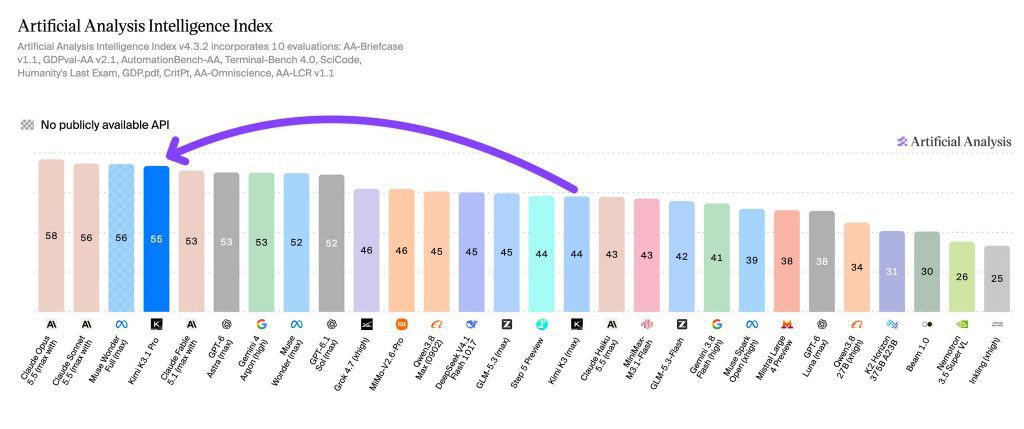
The jump is a sharp one. K3.1 Pro gains 11 points over its predecessor Kimi K3 (max), which scored 44. Once Moonshot publishes the open weights for K3.1 Pro, as it has said it plans to do shortly after launch, it will become the highest-scoring open-weights model available, narrowing the gap between the leading open and proprietary models on the index from 12 points down to just 3.
Biggest Gains Come From Agentic Performance
The standout improvement is in agentic work. On GDPval-AA, which measures performance on real-world work tasks, K3.1 Pro scores 1,846 Elo, up a massive 312 Elo from Kimi K3. That places it 3rd overall, behind only Claude Opus 5.5 (1,866 Elo) and Muse Wonder Full (1,857 Elo).
K3.1 Pro also takes the top score of any model, proprietary or open, on Terminal-Bench 4.0, a benchmark for agentic coding and terminal use. It scores 67.2%, a dramatic jump from Kimi K3’s 13%, and ahead of Claude Sonnet 5.5’s 63.6%. On AutomationBench-AA, which tests agentic SaaS workflows, the model rises from 58% to 73%.
Gains on other evaluations are more modest by comparison. Humanity’s Last Exam rises from 47% to 52%, CritPt moves from 23% to 25%, and SciCode climbs from 59% to 61%. The AA-Omniscience Index, which rewards correct answers while penalizing incorrect ones, rises from 20 to 30 — driven mainly by the hallucination rate falling from 53% to 44%, with accuracy improving more modestly from 48% to 51%.
Same Size As Kimi K3, Far Better Performance
At 2.8 trillion total parameters and 104 billion active parameters, K3.1 Pro is identical in size to the original Kimi K3, yet scores 11 points higher on the Intelligence Index. That puts it at the top of the Pareto frontier on both the Intelligence Index vs. Total Parameters and Intelligence Index vs. Active Parameters charts, ahead of competitors like Xiaomi’s MiMo-V2.6-Pro (46 points, 1.02T total / 42B active) and Z AI’s GLM-5.3 (max, 45 points, 753B total / 40B active).
Cost Stays Flat Despite More Output Tokens
Despite the across-the-board gains, Kimi K3.1 Pro costs roughly the same to run per task as the original K3 — $1.98 versus $2.00. The model uses 55K output tokens per Intelligence Index task, 14% more than K3’s 48K, with output tokens rising on agentic evaluations like AutomationBench-AA and GDPval-AA but falling by more than half on AA-Omniscience.
That near-flat cost is possible because Moonshot has cut K3.1 Pro’s first-party API pricing by 33% across the board — $2 per million input tokens, $10 per million output tokens, and $0.20 per million cache-hit tokens, down from $3, $15 and $0.30, respectively, for Kimi K3.
Other Model Details
- Context window: 1 million tokens
- Size: 2.8T total parameters, 104B active parameters
- Input modalities: Text and image
- Weights and license: Not yet published; Moonshot has said it expects to release them soon after launch
Kimi K3.1 Pro’s strong showing continues Moonshot’s rapid cadence of releases this year, following the original Kimi K3’s debut as the largest open-weights model ever released back in July, and its subsequent weights release that saw it become one of the fastest-growing model releases on Hugging Face. With K3.1 Pro, the Chinese lab has moved from being a strong open-weights contender to sitting within striking distance of the very top of the Intelligence Index, proprietary models included.