Indians are already the largest subgroup of foreign-born unicorn founders in the US, and they also seem to be the largest subgroup in its most popular incubator program.
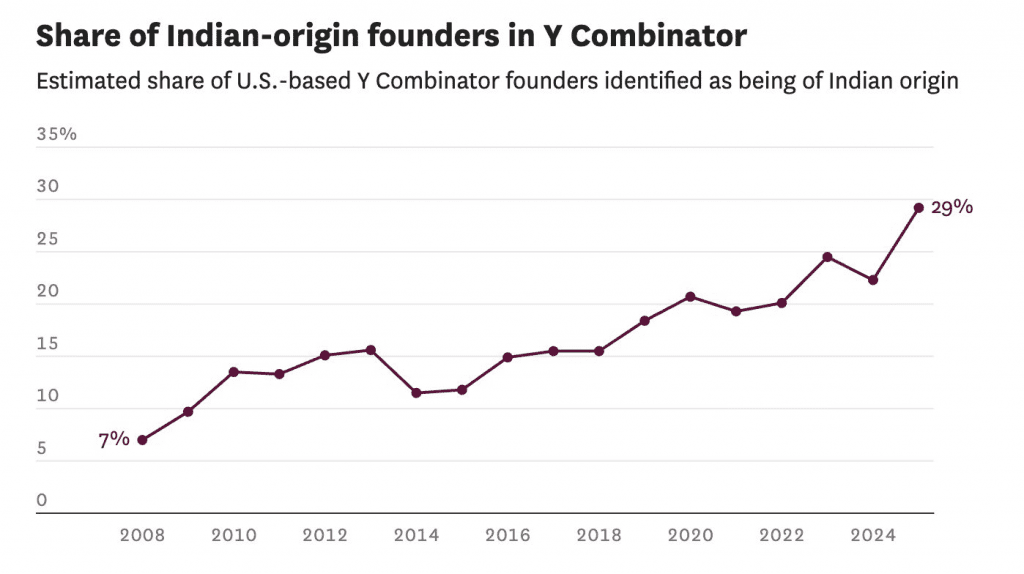
According to data published by the San Francisco Chronicle, 29% of U.S.-based Y Combinator founders are now of Indian origin — up from just 7% in 2008. The rise has not been linear: the share hovered around 10–15% through much of the 2010s before accelerating sharply post-2019, nearly doubling from roughly 15% to 29% in the space of five years.
A Steady Climb, Then a Surge
The chart tells a clear story of two phases. Through 2008–2018, Indian representation at YC grew modestly, dipping as low as ~10% around 2014 before recovering. Then, from 2019 onward, the numbers climbed steeply — crossing 17%, then 20%, touching 23% in 2023, briefly dipping to 21%, and then surging to 29% in the latest cohort. That final jump is the steepest single-year rise on record.
The timing of the post-2019 acceleration is notable. It coincides with the global remote-work shift, the AI startup boom, and YC’s own expansion of its batch sizes — all of which appear to have disproportionately benefited Indian-origin founders, many of whom are building in AI infrastructure, developer tools, and B2B SaaS.
A Pattern That Extends Well Beyond YC
The YC numbers aren’t an anomaly — they reflect a broader trend of Indian-origin entrepreneurs punching well above their weight in the US tech ecosystem. A Stanford study found that 90 out of 1,078 founders of 500 top US unicorns were born in India, making Indians the single largest immigrant group among unicorn founders despite constituting just 1.2% of the US population. A separate analysis put the number of Indian-co-founded US unicorns at 67, built by a diaspora of just 4.2 million people.
More recently, the country of origin data for US unicorns has further cemented India’s lead — India ranks as the top source country for immigrant-founded billion-dollar companies, ahead of Israel, Canada, and China.
The YC-India Connection Is Already Deep
Y Combinator’s ties to India go back over a decade. Razorpay was only the second Indian startup ever accepted into the program; today it is a decacorn. Groww, Meesho, Zepto, and Khatabook have all come through YC’s doors. Indian-origin founders in the US have meanwhile built companies like Perplexity AI — founded by IIT Madras alumnus Aravind Srinivas — which is now one of the fastest-growing AI companies in the world.
The 29% figure, however, is specifically about U.S.-based founders of Indian origin — meaning it captures the Indian diaspora building companies for the American market, not Indian startups seeking YC funding from India. That distinction matters: it suggests Indian-origin talent is not just feeding the US tech pipeline through established companies, but is now seeding it at the earliest stage.
What It Signals
The structural reasons are well understood: deep IIT and engineering college pipelines, a culture that heavily emphasizes technical education, and decades of emigration that have built dense professional networks in Silicon Valley. What’s changed recently is the velocity — the share nearly doubled in five years.
If the trend holds, Indians could soon account for nearly a third of all U.S.-based YC founders. For a country still debating how to stop its best founders from incorporating abroad, that number is both a point of pride and a pointed question.