Elon Musk and many US companies are talking about orbital data centers, and India too has thrown its hand into the ring.
Bengaluru-based Pixxel, a planetary intelligence company, has announced a partnership with AI startup Sarvam to develop India’s first orbital data centre satellite — a mission that pushes both companies well beyond their existing mandates.
What The Mission Is
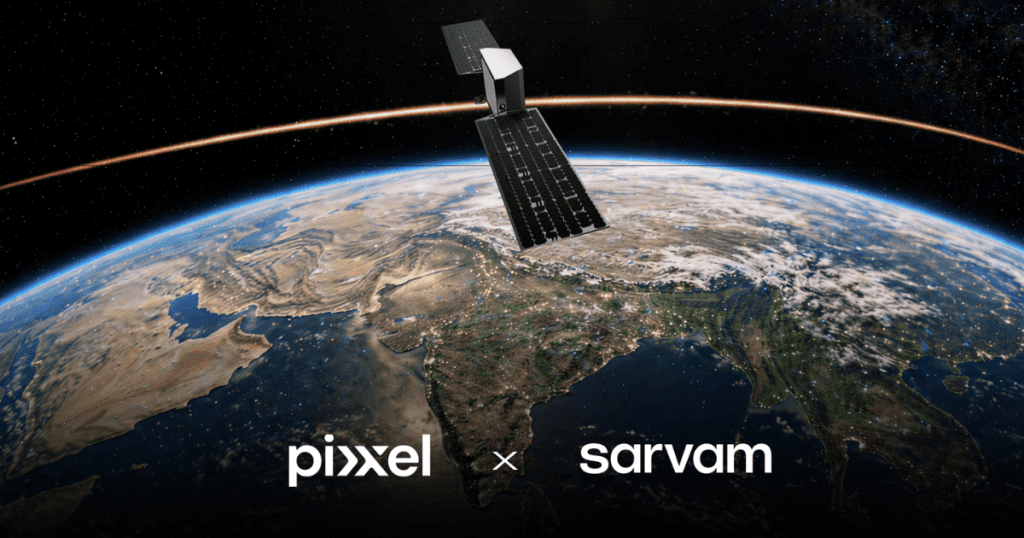
The satellite, called Pathfinder, is a 200 kg-class spacecraft scheduled for orbit as early as Q4 2026. Pixxel will design, build, launch, and operate it. Sarvam will provide the AI backbone — full-stack language models running inference and training directly aboard the satellite, with no dependence on ground-based or foreign cloud infrastructure.
What makes this different from conventional satellite computing is the hardware. Rather than the low-power edge processors typical of satellites, Pathfinder will carry datacentre-class GPUs — the same generation used in ground-based AI training facilities. The satellite will also carry Pixxel’s flagship hyperspectral imaging camera, making it one of the first satellites capable of capturing high-fidelity hyperspectral data and analysing it in orbit using foundation models.
The practical upshot: instead of beaming raw imagery down to Earth for processing, the satellite can detect patterns, identify changes, and deliver insights in real time — dramatically compressing the gap between data capture and decision.
Why It Matters
The compute infrastructure story on the ground is straining under its own weight. AI capex at the top four hyperscalers alone is set to touch $715 billion in 2026, driven by energy hunger, land constraints, and regulatory friction. Pixxel CEO Awais Ahmed frames orbital data centres as a structural answer to this — compute powered by abundant solar energy, operating closer to space-based data sources, and freed from some of the physical limits of Earth-bound infrastructure.
For Sarvam, the stakes are as much political as technical. The company has been building India’s sovereign AI stack from the ground up — its models trained from scratch in India, on Indian compute. Having those models run in orbit on an Indian-built satellite is a logical extension of that sovereignty argument. As Sarvam CEO Pratyush Kumar put it: “AI infrastructure is not just a software question — it is a sovereignty question.”
Sarvam is not a trivial player in this regard. Its Sarvam 105B model has placed India sixth on the Artificial Analysis Intelligence Index — the only credible Indian entry on the global AI leaderboard right now.
Pixxel’s Trajectory
Founded in 2019 by BITS Pilani alumni Awais Ahmed and Kshitij Khandelwal, Pixxel has moved quickly. It launched its first satellite aboard a SpaceX Falcon 9 in 2022, followed by another on ISRO’s PSLV. Google led a Rs. 300 crore funding round in the company in 2023, giving it both capital and credibility. The Pathfinder will be built at Gigapixxel, Pixxel’s upcoming production facility designed to scale to up to 100 satellites.
What Comes Next
The Pathfinder mission is explicitly a demonstrator — validating AI inference, power management, thermal performance, and real-time data workflows under the harsh conditions of space. Success would establish the technical and commercial groundwork for dedicated orbital data centre satellites built in India, for both strategic and commercial customers.
India’s space startup ecosystem has been maturing fast. GalaxEye just launched the world’s first OptoSAR imaging satellite. Pixxel is now chasing something more ambitious still: a satellite that doesn’t just observe the planet, but thinks about what it sees. If it works, the Pathfinder could mark the moment India stopped being a consumer of space intelligence and started building the infrastructure to generate it.