Even as OpenAI and Anthropic are headed to their IPOs, they’re losing marketshare — in volume terms — in a big way.
Closed-weight models handled roughly 70% of token volume on Vercel’s AI Gateway in late June. By September 18 their share had dropped to 21.6%, with open-weight models taking the other 78.4%.
Vercel CEO Guillermo Rauch flagged the number on X, saying it may be a record day for open models on the platform. The chart he shared shows daily token share from June 21 to September 18. It starts with closed models above two-thirds of volume and ends with them at roughly a fifth. The decline is not perfectly smooth, but the trend is consistent.
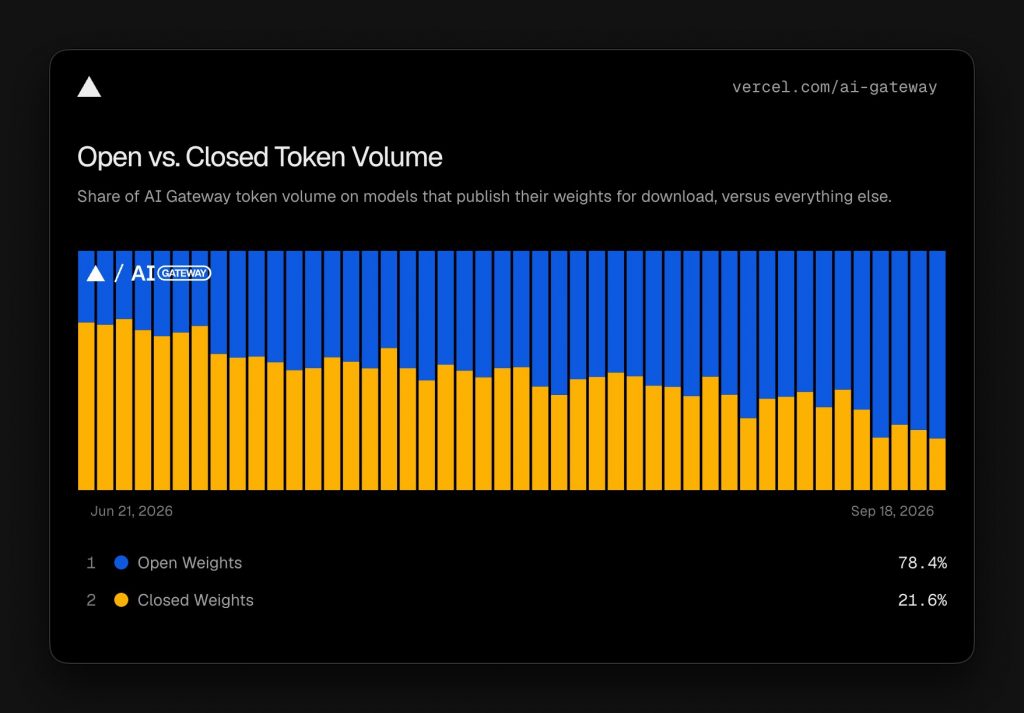
Vercel’s gateway routes production traffic for a large number of developers and companies, so this reflects real usage rather than benchmark experiments. Open-weight models held just 11% of Vercel’s token volume in April, up to 62% on August 22. The new reading is well above even that earlier record.
What changed
The shift tracks a run of strong open releases. DeepSeek’s V4-Pro and V4-Flash arrived in April with aggressive pricing, and V4 Pro debuted as the second-highest-rated open model on the Artificial Analysis Intelligence Index. In July, Moonshot’s Kimi K3 landed third on that index, behind only Claude Fable 5 and GPT-5.6 Sol.
August added more. Alibaba’s Qwen3.8 Max matched Claude Opus 4.8 on the same index and was released with open weights. Z.ai’s GLM-5.3 beat Claude Mythos 5 and GPT-5.6 Sol on a cybersecurity benchmark, and its Flash variant shipped under an MIT license. In Artificial Analysis’s latest rankings, Kimi K3 and GLM-5.3 both score 60. That is close behind a tight cluster of closed models, though the top two spots still belong to Claude Fable 5.1 and Claude Opus 5.
For developers, the gap in quality has narrowed while the gap in price remains large. Open models can be run at a fraction of the cost of frontier closed ones, so it makes sense to route more traffic their way.
Volume is not spend
Rauch himself noted that spend usually tells a different story. Anthropic still takes 64% of spend on the gateway even as open-weight models became the majority of tokens. Rauch said the No. 3 and No. 4 spenders on the day were Moonshot AI and DeepSeek, and that adding Z.ai puts their combined spend above OpenAI, which sits at No. 2.
He also cautioned that this is spend on inference of these models across providers, mostly in the US. It is not revenue flowing to the open-weight labs themselves. Much of that money goes to the companies hosting the models.
A note of caution
A single day is a noisy data point, and this one is a record, so some drop back would not be surprising. But the direction is hard to dispute. Rauch has argued that this is likely just the start, since enterprise adoption is still early and many tools remain hard-wired to specific closed models. If that changes, the closed labs will have to compete on more than benchmark leadership.