India’s space startups are continuing to break new ground at rapid pace.
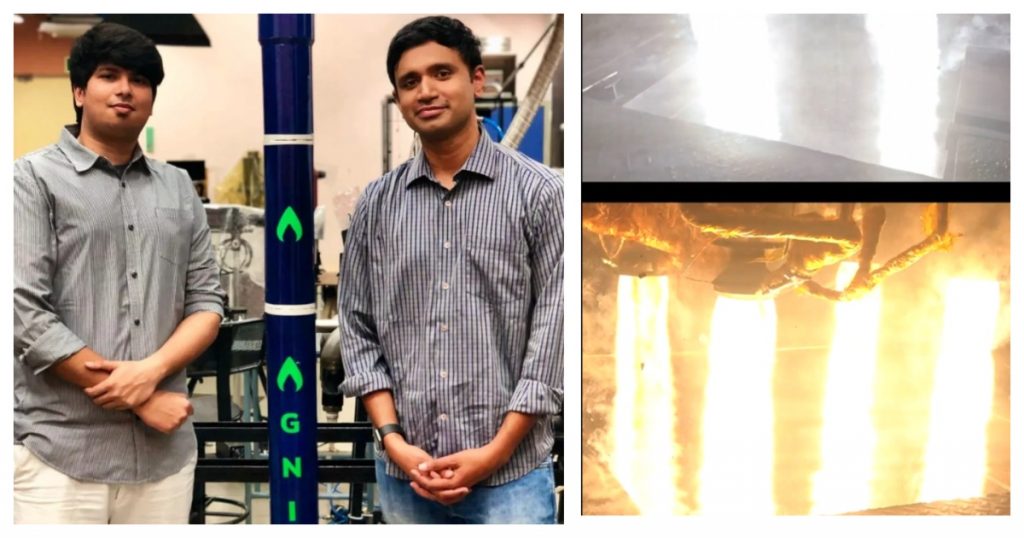
Chennai-based Agnikul Cosmos has announced that it successfully test-fired four semi-cryogenic rocket engines simultaneously, as a cluster — a feat the company says is a first for India in this category of propulsion. All four engines are 3D printed as single pieces of hardware, designed and manufactured entirely in-house at Agnikul’s Rocket Factory-1.
What Happened
The test involved calibrating 8 pumps, 8 motors, and tuning 8 speed control algorithms to work in perfect sync, achieving uniform startup, steady-state, and shutdown performance across the entire system. Like all of Agnikul’s propulsion systems, the engines are powered by electric motor-driven pumps — a design choice that simplifies the system and reduces failure points compared to conventional turbopump-driven engines.
Agnikul says this is the first time such a cluster test has been performed in India with semi-cryogenic engines. The company acknowledged support from IIT Madras, ISRO, and IN-SPACe in making the test possible.
Why It Matters
Cluster engine tests are a critical step toward building orbital-class launch vehicles. Firing multiple engines simultaneously — and doing so reliably — is fundamentally different from firing a single engine. The challenge is synchronisation: any variance in startup timing, thrust, or shutdown across engines can send a rocket off course or cause structural failure.
The fact that Agnikul achieved this with 3D-printed engines, each manufactured as a single piece of hardware, makes it even more significant. Single-piece 3D printing eliminates assembly joints — historically a major source of leaks and failure in rocket engines — while also compressing manufacturing timelines dramatically.
The company also notes that engine additions to future clusters will “likely increase non-linearly,” signalling that this is not just a milestone but a scalability inflection point. More engines in a cluster means more thrust, which means heavier payloads and higher orbits — the foundation of a viable commercial launch business.
Agnikul’s Journey So Far
Agnikul’s path to this point has been methodical and built on a series of credible firsts.
In 2022, the company test-fired the world’s first single-piece 3D-printed rocket engine, validating the core technology that now underpins all its propulsion work. That same year, it set up India’s first private launchpad at Sriharikota, built in collaboration with ISRO and IN-SPACe — a piece of infrastructure that no Indian private company had operated before.
Then, on May 30, 2024, Agnikul crossed its most visible milestone yet: the successful launch of Agnibaan SOrTeD (Sub-Orbital Technology Demonstrator) from its private launchpad at Sriharikota. The mission marked India’s first semi-cryogenic engine flight, the world’s first flight of a single-piece 3D-printed engine, and India’s first launch from a privately operated pad — three firsts in a single mission.
The Agnibaan launch vehicle is designed to carry 100–300 kg of payload to Low Earth Orbit at altitudes up to 700 km, targeting the rapidly growing small satellite market.
India’s Private Space Sector Is Growing Fast
Agnikul is not alone in pushing the frontier. Skyroot Aerospace launched India’s first private rocket into space in November 2022 with its Vikram-S mission, becoming the first Indian private firm to reach space. Over 100 startups are now registered with ISRO, working across launch vehicles, satellites, propulsion, and ground systems.
India’s broader space ambitions have also grown sharper. The government’s space sector reforms — including the creation of IN-SPACe as a dedicated regulator and promoter — have opened doors for private players to access ISRO infrastructure, expertise, and launch facilities, lowering barriers that once made private space nearly impossible in India.
ISRO itself has been on a strong run, with the Chandrayaan-3 mission in 2023 making India the first country to land near the Moon’s south pole. That success has significantly raised the global profile of Indian space technology and created a tailwind for commercial players looking to build on India’s credibility in space.
What Comes Next
Agnikul’s immediate priority is its first orbital mission, which would be a step-change from the suborbital Agnibaan SOrTeD flight. The four-engine cluster test is a prerequisite on that path — orbital rockets require significantly more thrust than what a single engine can provide, and the ability to fire multiple engines reliably is non-negotiable.
With a strong foundation in 3D-printed propulsion, a private launchpad, an in-house rocket factory, and now a successful multi-engine cluster test, Agnikul has assembled most of the building blocks for commercial launch services. The question now is execution — getting to orbit, and doing it repeatedly at competitive cost.
India’s private space sector has moved from ambition to demonstration. Agnikul is one of its clearest proof points.