Every once in a while there comes a disruption that can leave even veterans of an industry scratching their heads.
For Hari Menon, co-founder and outgoing CEO of BigBasket, that disruption arrived in the form of quick commerce — and by his own admission, he didn’t see it coming. In a LinkedIn post marking his transition out of the CEO role, Menon reflected on 14 years of building one of India’s most recognisable grocery brands, and was refreshingly candid about the moment the ground shifted under him.
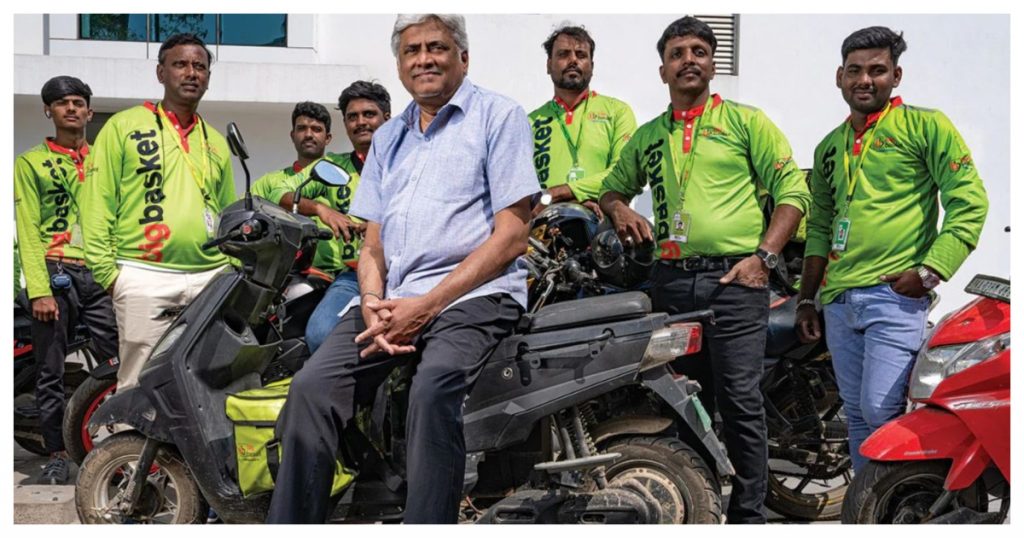
“I was in denial with the idea of QC,” he wrote. “If you’d asked 100 people back then whether they wanted groceries in 10 mins… most of them would’ve said no. But the moment we gave it to our customers, they lapped it up.”
That admission carries more weight than it might seem. Menon had, as recently as 2023, publicly questioned whether 10-15 minute deliveries made economic sense — drawing a sharp rebuke from Zepto CEO Aadit Palicha, who called BigBasket a legacy player and defended his company’s unit economics. At the time, it read like a turf war between an incumbent holding its ground and a scrappy new entrant poking holes in the old model. In hindsight, it was the industry mid-pivot.
BigBasket’s own journey to quick commerce was gradual, then sudden. The company ran two verticals for a while — its traditional slotted delivery service and BB Now, which operated on a 10-20 minute promise. When BB Now began accounting for around half of BigBasket’s sales, the decision to go all-in became easier. The company eventually dropped the slotted model entirely and pivoted to full quick commerce — a move that was once unthinkable for a company built on the logic of scheduled, large-basket grocery orders.
What Menon is leaving behind is considerably different from what he started. BigBasket now runs over 900 dark stores across more than 60 cities. Its private labels, which Menon described with as something he is “enormously proud of,” have become a meaningful part of its identity. The company that once operated out of Bengaluru, Mumbai, and Hyderabad — and brought in Shah Rukh Khan to help it grow beyond those three cities — is now a national platform embedded in the daily routines of millions of households.
The early years had a different kind of obsession. Menon described building the business around four metrics: order fill rate, on-time delivery, keeping 95% of SKUs in stock at any given time, and customer satisfaction. Everything else, he said, was secondary until those four were nailed. They got there by 2014. It’s a useful reminder that the companies that scale well are usually the ones that spend their earliest years solving the most boring, operational problems with unusual rigour.
The transition of power goes to Amit Nanda, and Menon’s note was warm about the handoff — praising Nanda’s consumer instincts and the energy he brings to the next phase. Menon and co-founder Vipul Parekh will remain on the board, which probably means they’ll do exactly what Menon joked about: mentor, cheer, and occasionally send very many suggestions.
There’s something worth sitting with in how Menon frames the quick commerce chapter. He doesn’t dress it up as vision or foresight. He was wrong about the consumer, he knew it, and BigBasket moved. That kind of institutional honesty — rare enough in founder narratives — is probably part of what kept the company in the game long enough to figure it out.
Fourteen years is a long run in Indian consumer tech. The grocery delivery space has seen a procession of well-funded companies come and go — from PepperTap to early Grofers iterations — while BigBasket kept compounding. Menon stepping back isn’t the end of that story; it’s a chapter break. The next one will be written against a much more crowded and contested quick commerce market, with Blinkit, Zepto, and Swiggy Instamart all fighting hard for the same urban consumer. But BigBasket arrives at that fight with scale, private labels, and the backing of the Tata Group. It’s not a bad position to hand over.