Google’s model page for Gemini 4 Neon has appeared on Vertex AI, and it describes the model as a fast reasoning system that brings quality close to Gemini 4 Carbon at faster speeds and lower cost. The page positions Neon for coding, reasoning and production agents.
“Gemini 4 Neon builds on Gemini 4 Hydrogen with deeper reasoning,” the page says. “It brings quality close to Gemini 4 Carbon on coding, reasoning, and agentic tasks, at Flash-tier speed and cost.” The page also says the model is now available on the Gemini platform, and that it can be accessed through Google’s Gen AI SDK, which covers Google AI Studio and the Agent Platform in Python, Go, JavaScript, Java and .NET.
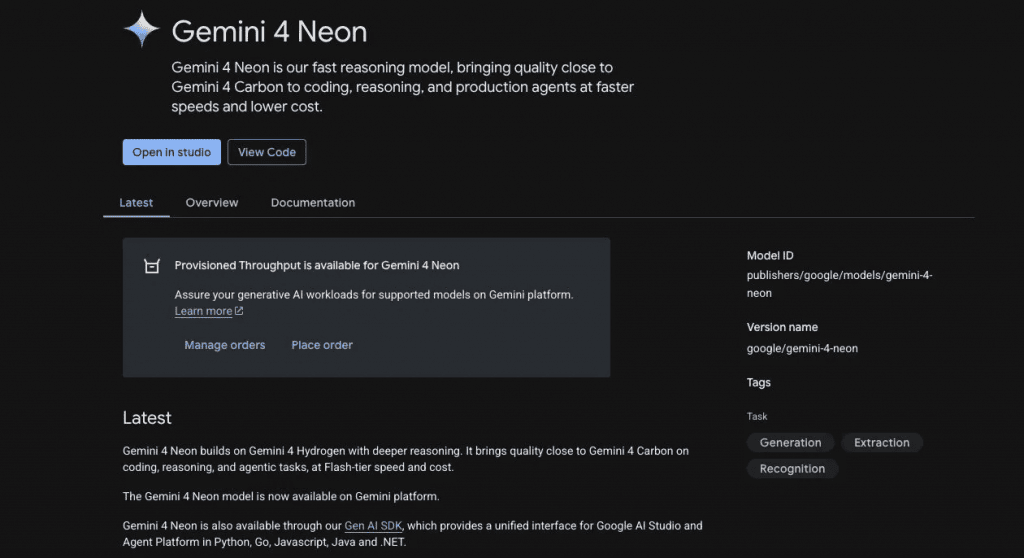
The listing gives the model ID as gemini-4-neon and tags it for generation, extraction and recognition tasks. Provisioned Throughput, which lets enterprises reserve capacity for their workloads, is also available for the model.
Where Neon fits in the Gemini 4 lineup
Neon is the fourth model in the Gemini 4 family, after Gemini 4 Argon, Gemini 4 Carbon and Gemini 4 Hydrogen. Carbon is Google’s flagship, which topped the Artificial Analysis Intelligence Index at launch, while Hydrogen is the cheap, fast Flash-tier option. Neon is meant to sit between the two, taking Hydrogen’s speed and adding more reasoning depth to get closer to Carbon’s output quality.
That is a different pitch from what X users had speculated. Some had guessed that Neon could be a new Flash-Lite model, while others thought it might be Gemini 4 Krypton, the Carbon upgrade that testers claimed to have spotted earlier this month. Google’s own description points to a mid-tier model built on Hydrogen instead.
Pricing
Google’s Cloud SKU catalog had already shown Neon priced at $3 per million input tokens and $15 per million output tokens. Those numbers make the “lower cost” framing relative. Neon is cheaper than Carbon, which is set to move from its introductory $2/$10 to $4/$20 on December 1, and it would be 25% below Carbon at those standard rates. But it costs twice as much as Hydrogen, which is priced at $1.50/$7.50, and it’s 50% more expensive than Carbon’s introductory price.
Google is also describing Neon’s cost as “Flash-tier”, which is notable given that Hydrogen is itself a Flash model at half the price. It’s possible that Google considers the pricing of its Flash line to have moved up, with Gemini 3.5 Flash having tripled prices over Gemini 3 Flash earlier this year, or that it’s comparing Neon’s cost per task rather than per token. Models that reason more tend to use more tokens, so the actual bill will depend on how much thinking Neon does for each task.
What to watch
Google hasn’t yet published benchmark numbers that we’ve seen for Neon, so “close to Carbon” is the company’s own characterisation for now. The independent test that will matter most is the Artificial Analysis Intelligence Index, where Hydrogen scored 54 at its highest reasoning setting and Carbon scored 59 at launch. If Neon lands somewhere in between at a price below Carbon’s standard rate, it could become the default choice for a lot of agentic workloads, and a direct competitor to Anthropic’s Claude Sonnet 5.5, which is priced at $2/$10.
Google has now shipped four Gemini 4 models in about seven weeks, and the pace shows no sign of slowing.