Google’s rapid-fire run of Gemini 4 launches is starting to show up where it matters most for AI labs: in what developers actually pay for.
OpenRouter users spent more money on Google’s models than on OpenAI’s models last week, according to Peter Walker, OpenRouter’s head of insights. “OpenRouter users spent more $ on models from Google than OpenAI last week,” Walker wrote. “That was more common at the start of 2026, but hadn’t happened since the week of June 8th.” He credited Gemini 4 Neon, Google’s newest model, with tipping things over the 50% mark.
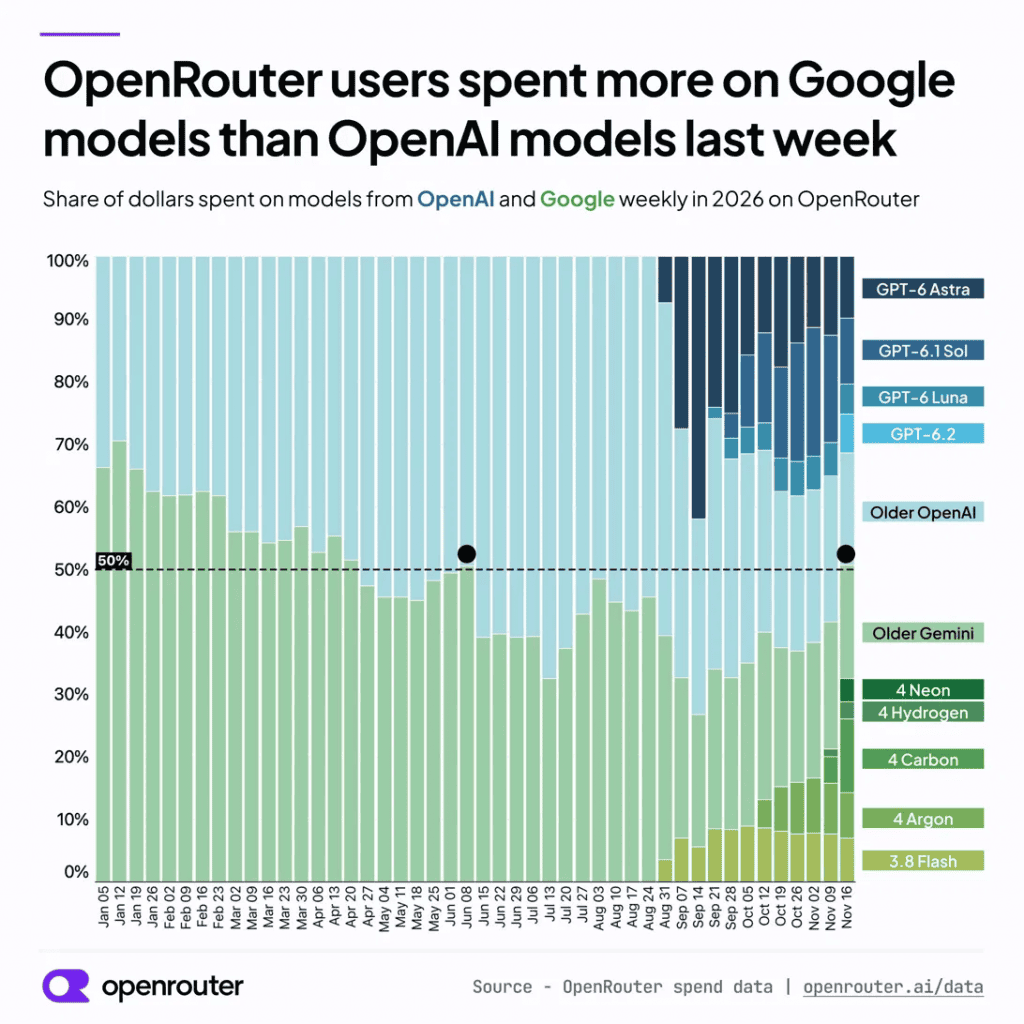
What the chart shows
The chart tracks how dollar spend on OpenRouter splits between the two companies each week in 2026. It only counts spend on Google and OpenAI models, so it shows the head-to-head between the two rather than either company’s share of the whole platform.
For the week of November 16, Google’s share came in just above 50%, the first time it has crossed that line in more than five months.
It’s a reversal of how the year began. Google dominated early on, taking roughly two-thirds of the combined spend in January and peaking at about 70% in the week of January 12. That lead shrank steadily through the spring, and by late April OpenAI had moved ahead. Google briefly pulled level again in early June, just above 50% in the week of June 8, before OpenAI opened up a clear gap.
The low point for Google came in September. After OpenAI released GPT-6 Astra, Google’s share of combined spend fell to roughly 26% in the week of September 14, with Astra alone taking more than 40% of the total that week. OpenAI then filled out its lineup with GPT-6 Sol and GPT-6 Luna, followed shortly by GPT-6.1 Sol, which it pitched as Astra-level intelligence at a fifth of the price.
Four Gemini 4 models in about seven weeks
Google’s recovery since then lines up neatly with the Gemini 4 rollout. Gemini 4 Argon arrived on September 30, Gemini 4 Carbon followed on October 28, and Gemini 4 Hydrogen came in mid-November as the fast, cheap Flash-tier option. Each one shows up as a new green band on the chart, and Google’s share climbed back into the high 30s and low 40s through October and early November.
Neon, launched on November 18, is the fourth model in the family. It sits between Hydrogen and Carbon, and Google pitches it as close-to-Carbon quality at much higher speed. It is priced at $3 per million input tokens and $15 per million output tokens, double Hydrogen’s $1.50/$7.50. Carbon and Argon are currently on an introductory $2/$10 rate that doubles to $4/$20 on December 1, at which point Neon becomes the cheaper option.
The model has impressed early on independent leaderboards too. Neon beat Claude Opus 5.5 and GPT-6.2 Sol on most of the benchmarks Google published, and it went on to place second on both the Vals Index and the Arena Agent Index, and top CursorBench outright.
Neon tipped it, but it wasn’t alone
Neon’s slice of last week’s spend is a modest one, around 3% to 4% of the combined total, but that’s notable given it was only available for part of the week. And because Google was sitting at roughly 41% the week before, it needed several models pulling in the same direction to get over the line.
The bigger jump came from Carbon. Its band on the chart roughly tripled week-on-week to around 12% of the combined spend, after the model began showing up in Google Cloud ahead of a wider release. Together with Argon, Hydrogen, Gemini 3.8 Flash and older Gemini models, Google had enough momentum that Neon’s arrival pushed it just past OpenAI.
On the OpenAI side, the same week brought the launch of GPT-6.2 Astra and GPT-6.2 Sol, which already took about 6% of combined spend. But Astra’s own share has been shrinking from its September highs, and the new release hasn’t helped much so far. GPT-6.2 Astra has had unusually harsh reviews from early testers, and it placed only seventh on the Vals Index, behind even Gemini 4 Argon and Gemini 4 Hydrogen.
Why dollar spend matters
Dollar spend is a different signal from token volume, which is how OpenRouter usage is usually measured. By tokens, the platform is dominated by cheap Chinese open-weight models. Six of the top nine models by tokens in early November came from Chinese labs, and the combined token share of US labs has collapsed from around 70% to 30% over the past year.
Spend shows where developers are willing to pay frontier prices, and that is still largely a contest among the big US labs. Small shifts here mean real revenue. OpenAI’s budget model GPT-6 Luna is its most-used model on OpenRouter by tokens, but on the spend chart it accounts for only a thin slice next to Astra and Sol.
A close race that could flip again
Google’s lead is slim, just over the 50% mark, and this chart has swung back and forth all year. OpenAI only released its GPT-6.2 models last week, so their real impact won’t be clear until more data comes in. Carbon’s price also doubles on December 1, which could push some spend toward Neon or Hydrogen, or toward cheaper rivals entirely.
Still, the trend since mid-September is clear. Google has gone from a quarter of combined spend to a half in about two months, with a new Gemini 4 model arriving every couple of weeks. If the newer models keep gaining once they’ve had a full week on the market, last week may turn out to be the start of a longer lead for Google rather than a one-off.