Google’s newly released Gemini 4 Neon has landed in second place on two independent leaderboards, the Vals Index and Arena’s Agent Arena Index. In both cases it sits behind only Anthropic’s Claude Fable 5.2, and ahead of Claude Opus 5.5.
Vals Index: second place, at under half of Fable’s cost
On the Vals Index, Neon scores 70.87% accuracy, just 0.44 points behind Fable 5.2’s 71.31%. The Vals Index is a composite of agentic tasks in finance, coding, legal and tax, weighted by each field’s share of the US economy, and its private test sets make it harder to game than most public benchmarks.
The top of the leaderboard is tightly packed.

Neon’s lead over Sonnet 5.5 is two hundredths of a percentage point, so the two are effectively tied. What separates them is cost and speed. Neon’s $7.40 per test is less than half of Sonnet 5.5’s $16.18, and it finishes in about 31 minutes against Sonnet’s roughly hour and a half. Against Opus 5.5, Neon is 0.73 points more accurate at under a third of the cost.
It’s also cheaper to run on the Vals Index than both Carbon and Hydrogen, even though its per-token price of $3/$15 is higher than Hydrogen’s $1.50/$7.50. Only Meta’s Wonder Full ($6.81) and GPT-6.2 Sol ($3.18) in the top ten cost less per test, and both trail Neon by several points of accuracy.
Agent Arena: one point ahead of Opus 5.5
On Arena’s Agent Arena Index, Neon (High) scores 1,336, which puts it second behind Fable 5.2 (Max) at 1,453. Opus 5.5 (Max) is third at 1,335, a single point behind. Given the margins of error Arena shows, those two should be treated as tied.
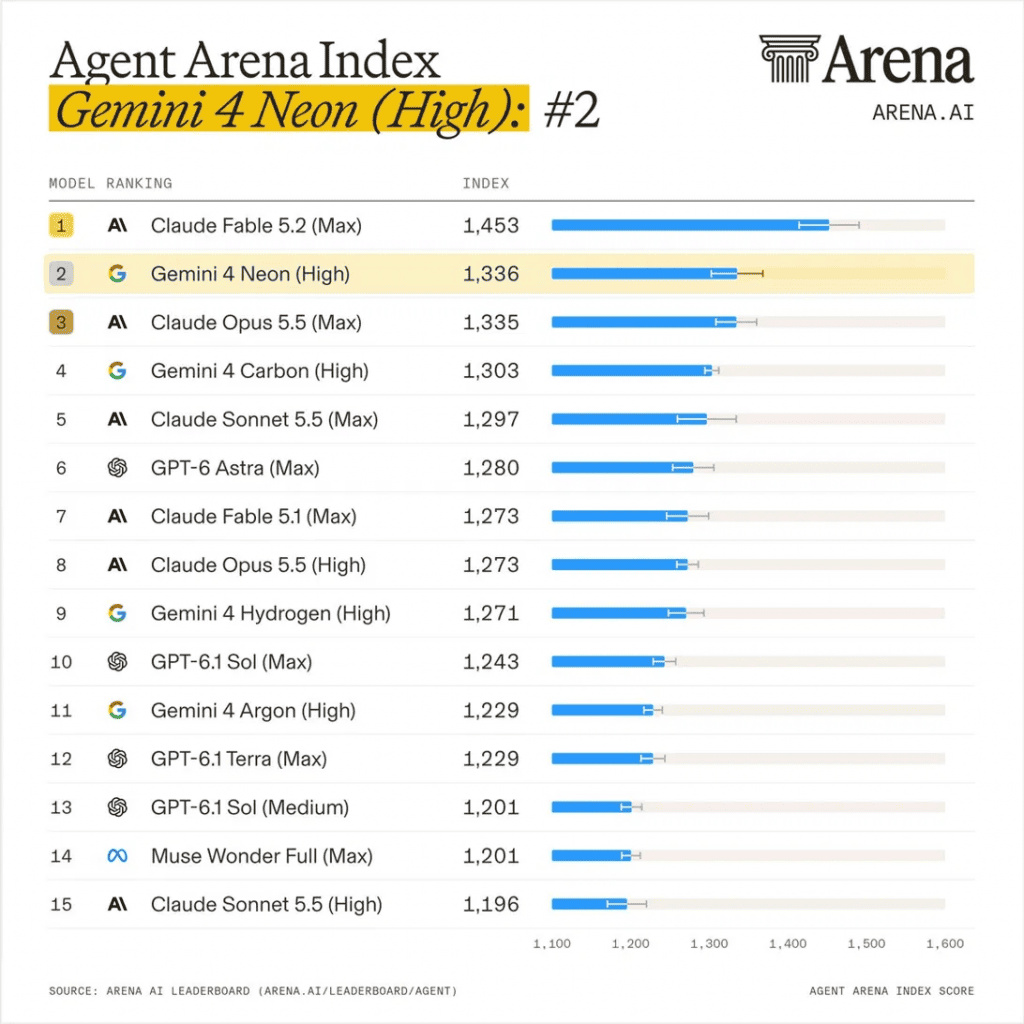
Neon is 33 points ahead of Carbon, which placed second on the same leaderboard when it launched, and 65 points ahead of Hydrogen (High) at 1,271. Neon is being run at High effort here, while Fable and Opus are at their Max settings. Fable is a long way clear at the top, 117 points ahead of Neon.
Other benchmarks
The two rankings are part of a broader pattern. Google’s own benchmark table has Neon ahead of Opus 5.5 and GPT-6.2 Sol on 16 of 19 results. Among them are CursorBench 4.1 (65.4% against Opus’s 58.1%), AutomationBench (56.3% against 42.5%) and HLE-Diamond (71.3% against 67.9%). It trails Opus narrowly on Terminal-Bench 4.1 (65.2% against 65.8%) and FrontierCode 2.0 (46.2% against 47.3%), and it trails Sol on Chartography. Google’s comparison doesn’t include Fable 5.2.
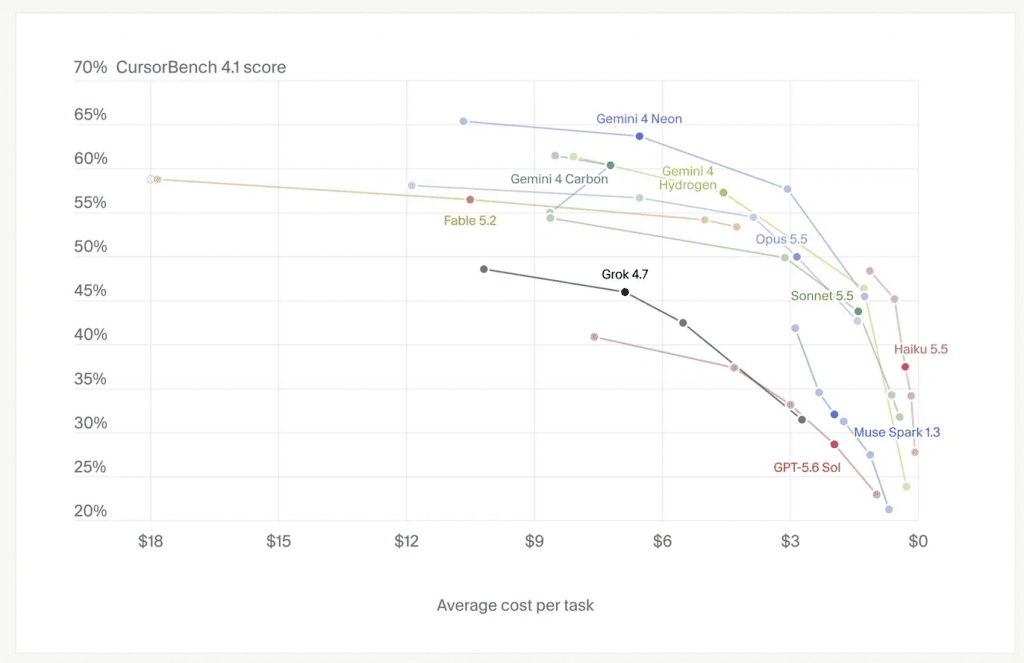
A CursorBench 4.1 chart plotting score against average cost per task tells a similar story. Neon’s curve sits above those of every other model in the chart at comparable cost, including Carbon, Hydrogen, Opus 5.5 and Fable 5.2, with its top setting at roughly 65%.
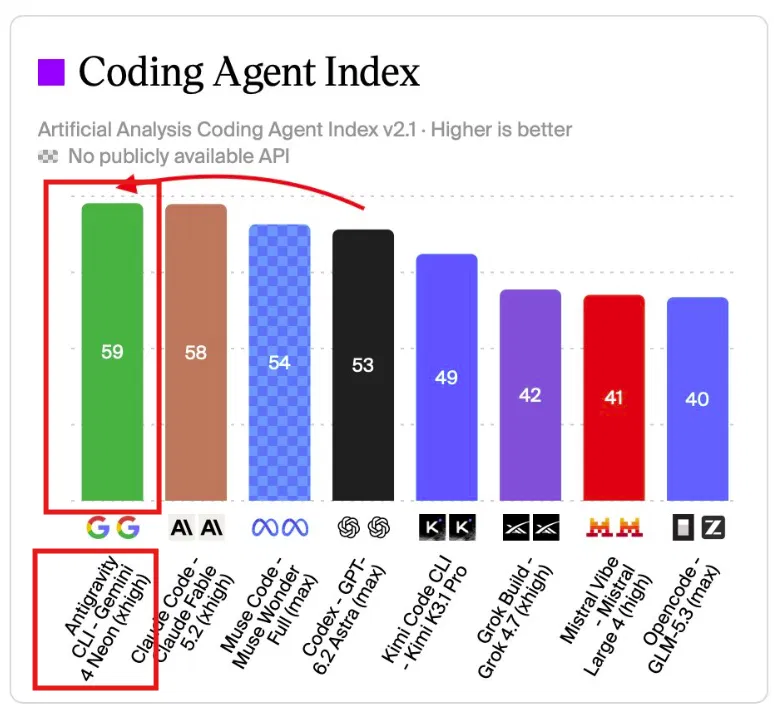
On the Artificial Analysis Intelligence Index, Neon (xhigh) scores 61, one point ahead of Carbon and Google’s highest-scoring model on the index. It’s third overall, behind GPT-6.2 Astra at 62 and Fable 5.2 at 65. Artificial Analysis says Neon runs at about 110 tokens per second against Carbon’s 57, and costs about 17% less than Carbon to run the index. On the firm’s Coding Agent Index, Neon running in Google’s Antigravity CLI scores 59, ahead of Claude Code with Fable 5.2 and with Opus 5.5 (both 58), and well ahead of Carbon’s 55.
Neon also takes the top spot on Artificial Analysis’s Coding Agent Index, which measures models together with the coding harnesses they run in. Running in Google’s Antigravity CLI at xhigh effort, Neon scores 59, one point ahead of Claude Code with Fable 5.2 (xhigh) at 58, even though Fable leads Neon on the other leaderboards. Meta’s Muse Code with Wonder Full (max) is third at 54, followed by Codex with GPT-6.2 Astra (max) at 53, Kimi Code CLI with Kimi K3.1 Pro at 49, Grok Build with Grok 4.7 (xhigh) at 42, Mistral Vibe with Mistral Large 4 (high) at 41 and Opencode with GLM-5.3 (max) at 40. The gap to Carbon is notable, as it scores 55 on the index, and Claude Code with Opus 5.5 (max) is level with Fable at 58.
It isn’t a clean sweep, though. On AA-Briefcase, Neon’s Elo of 1,700 is behind Fable 5.2 (1,785) and Sonnet 5.5 (1,815), though it leads the field on Artificial Analysis’s Presentation Quality benchmark.
What this means
Google’s own page had described Neon as a fast model close to Carbon’s quality, at $3/$15 pricing that sits below Carbon’s standard rates. The independent results suggest it has delivered a little more than that, edging past Carbon on most measures while being faster and cheaper to run on these tests. Anthropic’s Fable 5.2 still holds the top spot on every leaderboard here, but Neon has become the strongest model per dollar among the leaders, and Google now has four models in the top seven on the Vals Index.