One of the world’s leading number theorists, and a vocal critic of how AI labs are approaching mathematics, says the AI-assisted Riemann proof shows qualities we would call creative if they came from a human.
For decades, the standard defence of human mathematicians against AI has been that machines can calculate, search and check, but cannot create. One of the people best placed to judge that claim now says the Riemann Hypothesis proof has weakened it considerably.
James Maynard, the Oxford number theorist who won the Fields Medal in 2022, was asked by French magazine L’Express whether the AI-assisted solution to a problem first posed in 1859 counted as creativity. His answer was a qualified but striking yes.
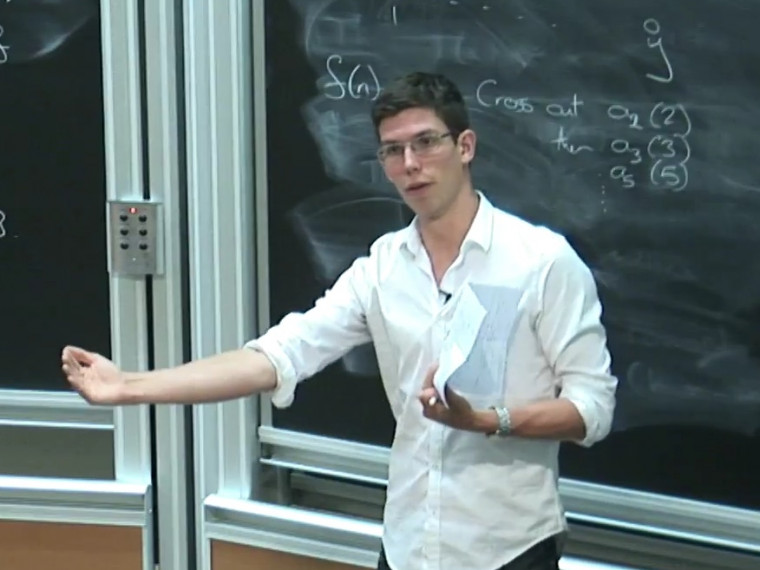
“The rise of AI has led me to ask what ‘creativity’ really means, and to what extent my own work was creative or a form of pattern recognition,” Maynard said. “The situation is reminiscent of chess: machines there sometimes play moves that we would consider very creative if they came from a human. The proof of the Riemann Hypothesis shows, I believe, that AI possesses qualities that we would call creative — and good mathematical taste — if they belonged to a human. And it will probably continue to improve considerably in these respects.”
Who Maynard is, and why his view matters
Maynard is not a casual observer of the Riemann Hypothesis. In 2024 he and MIT’s Larry Guth published a widely celebrated improvement on a decades-old bound related to the zeros of the Riemann zeta function, one of the most significant pieces of human progress on the problem in years. His Fields Medal citation rests in part on his work on gaps between prime numbers, the very objects the Riemann Hypothesis describes. He has also reduced the bounded gap between primes to 600, a result that later became a target for AI formalisation.
He is also no AI cheerleader. Maynard was among the 25 Fields Medal winners who signed a declaration warning that AI companies’ race to solve famous problems was harming mathematics, and he was one of three Fields Medalists who signed a statement criticising Anthropic days before the company’s IPO. That makes his acknowledgment of the AI’s creative contribution all the more notable.
The proof in question
On November 20, Anthropic mathematician Levent Alpöge released a claimed proof of the Riemann Hypothesis made with Claude, along with versions of the Generalized Riemann Hypothesis for Dirichlet L-functions. The proof was released as a Lean library of roughly 17 million lines of code, and according to the note on Alpöge’s website, the final push took just 41 days.
The next day, the Lean Focused Research Organization and the Mathlib Initiative certified that the proof states the right theorem and is correct, having passed multiple independent proof checkers and relying only on Lean’s three standard axioms. Alpöge has said he steered the research but that Claude “far outpaced” him near the finish line, and he credits the model with specific key ideas in the argument.
“No human understands the proof”
Maynard’s comments on creativity came with an important caveat, which L’Express used as its headline: no human yet understands the proof as a whole. He told the magazine the result must be taken very seriously, given that the statement had been independently vetted in advance and the proof depends only on standard Lean axioms. But he called the situation “quite strange” and new — a proof that is almost certainly correct, but whose deeper reasons remain unknown to the mathematical community.
That echoes concerns raised by others. Queen Mary University of London’s Abhishek Saha has said that there is likely no single mathematician with the breadth of expertise needed to understand all of the proof, while the Association for Human Mathematics has argued that an AI-generated Lean program is no substitute for a proof a human can be held responsible for. Anthropic co-founder Jack Clark has suggested that an entire new field of “machine hermeneutics” will be needed to make sense of such results.
The creativity question
Maynard’s chess comparison is an apt one. When AlphaGo played its famous move 37 against Lee Sedol in 2016, commentators struggled over whether to call it creative or simply the output of a very good search. Maynard’s position is pragmatic: if a human had produced the Riemann proof, nobody would hesitate to call it creative, and the same standard should arguably apply to the machine.
Perhaps the most interesting part of his answer is his admission that AI has made him question how much of his own celebrated work was creativity and how much was sophisticated pattern recognition. It’s a sharp contrast with the view of AI pioneer Fei-Fei Li, who argued last year that AI would not be able to deduce Newton’s laws of motion because it lacks creativity. And it’s a far cry from Terence Tao’s estimate, just a month before Alpöge’s announcement, that AI might solve the Riemann Hypothesis only by 2050.
Maynard isn’t alone among Fields Medalists in reassessing AI’s abilities. Richard Borcherds recently said that AI is now better than him at research and teaching. But Maynard’s comments go to something more fundamental than capability. “Good mathematical taste” — the instinct for which problems matter, which approaches are promising and which ideas are beautiful — has long been considered the most human part of mathematics, and the hardest thing to teach. If one of the field’s sharpest critics of AI labs now says a machine has it, and that it will keep getting better, the question for mathematicians is no longer whether AI can be creative, but what their own role looks like once it is.